The evidence: The F-16 radar recordings of 30–31 March 1990
▶ See the original radar at Prof. Auguste Meessen's study of the recordings (PDF) ↗ (not reproduced here: author copyright)
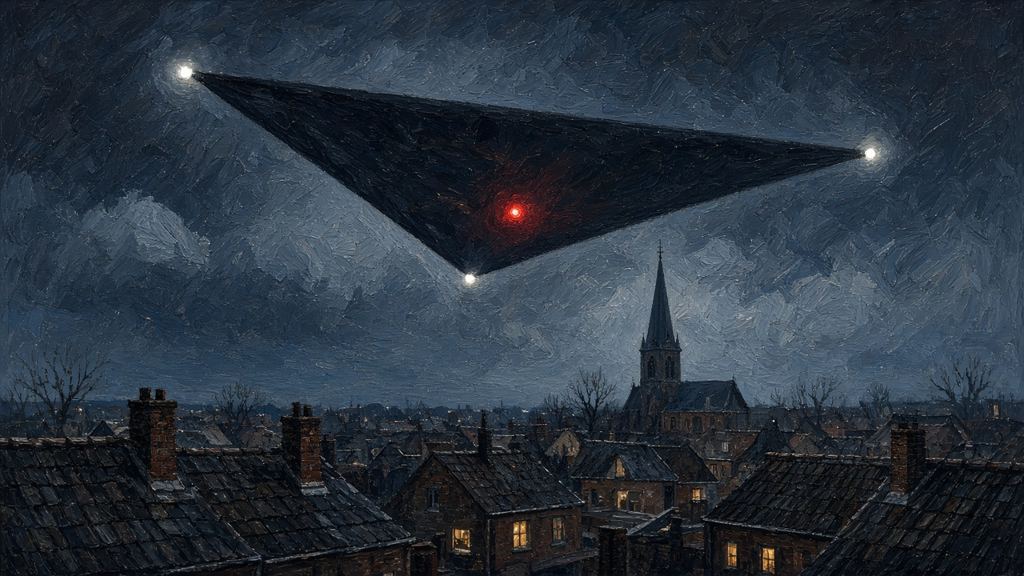
The Belgian Triangles, 1989–1990, and the F-16 Night
Last reviewed Next review
We review and update every article weekly. When the record changes, so does the article. How we review
From November 1989 into spring 1990 thousands of Belgians reported dark triangles with lights.
Verdict: Many sightings were never explained, and the sources disagree about the F-16 radar locks.
Sources Belgian Air Force, Maj. P. Lambrechts, 'Report concerning the observation of UFOs in the night from March 30 to March 31, 1990' (English translation); Col. Wilfried De Brouwer press conference, 11 Jul 1990; Prof. Auguste Meessen, study of the F-16 radar recordings (meessen.net); Wikipedia, 'Belgian UFO wave'
On 29 November 1989 gendarmes near Eupen in eastern Belgium reported a large dark triangle with lights underneath. Over the next months thousands of reports followed, and a civilian group, SOBEPS, collected them with unusual cooperation from the Belgian Air Force.
The F-16 night
The official record centers on 30–31 March 1990. A gendarme near Ramillies phoned in three bright, color-changing lights in a triangle. The air-defense center at Glons and the radar at Semmerzake both picked up a contact in the area. At 00:05 two F-16s took off. According to the air force report by Major Lambrechts, they made nine interception attempts in under an hour and locked on three times for a few seconds, with the target seeming to jump in speed and altitude. The pilots never saw anything. At a July 1990 press conference Colonel Wilfried De Brouwer showed the radar charts and said the air force could not determine what the object was.
The other side
The sources disagree about the radar data. The Lambrechts report says the speeds and altitude changes rule out planes, balloons and weather. Physicist Auguste Meessen traced the ground-radar echoes to masses of humid air and found no conventional explanation he could accept for the F-16 contacts at first, though he later argued the Doppler speed reading itself can be thrown off; he still reports two tracks that stay unidentified. A Belgian Air Force technical report by Lt. Col. Salmon, released by the Ministry of Defence in June 2025, puts the extreme maneuvers down to the F-16 radar’s Kalman tracking filter. None of these settles the question on its own. The best-known photo of the wave, taken at Petit-Rechain, was admitted to be a hoax in 2011.
Sources
- Belgian Air Force, Lambrechts report on 30–31 March 1990 (English translation, PDF): das-ufo-phaenomen.de
- Auguste Meessen, “Étude approfondie des mystérieux enregistrements radar des F-16”: meessen.net
- Lt. Col. Salmon, F-16 radar trace report, 30–31 March 1990 (released by the Belgian MoD, June 2025; summary and file): ufotransparency.com
- Wikipedia, “Belgian UFO wave”: en.wikipedia.org
Every image on this page is credited where it appears.
Weighing it
An air force openly published what it recorded and couldn’t explain. On the radar data the sources still disagree, and we don’t pick a side.
Verdict
Disputed Many sightings were never explained, and the sources disagree about the F-16 radar locks.
Evidence ledger
Each claim in this file, the source it rests on, and how well it holds up: 3 corroborated · 1 disputed · 1 debunked. What the labels mean.
| Claim | Source | Type · date | Status |
|---|---|---|---|
| A wave of triangle sightings ran in Belgium from 29 Nov 1989 to about April 1990. | Wikipedia; Belgian Air Force report | secondary | corroborated |
| On 30–31 Mar 1990 gendarmes reported lights near Wavre and two military radars (Glons, Semmerzake) logged a contact. | Lambrechts report, Belgian Air Force | official · 1990 | corroborated |
| Two F-16s made nine interception attempts and got brief radar locks but never saw the object. | Lambrechts report | official · 1990 | corroborated |
| The radar target changed speed from about 150 to 970 knots in seconds.Later analysts attribute the jumps to radar processing artifacts and weather returns; Meessen disputed parts of that. | Lambrechts report (F-16 lock at 00:13) | official · 1990 | disputed |
| A famous 1990 photo of a triangle (Petit-Rechain) shows the craft.The photographer said in 2011 it was a hoax made with polystyrene. | Popular accounts | secondary | debunked |
Update log
-
We added this case file.
-
Correction: we removed the claim that the F-16 radar locks have a credible instrument explanation. The sources disagree: the Lambrechts report rules out conventional causes, Meessen found no acceptable conventional explanation at first and later argued the Doppler speed reading can be distorted, and the 2025-released Salmon report blames the radar's Kalman filter.
Sources A. Meessen, Étude approfondie des mystérieux enregistrements radar des F-16 (meessen.net) · Belgian Air Force, Lt. Col. Salmon F-16 radar trace report (released June 2025)
-
Weekly re-check of sources; no newer change to the record. Next check November 23, 2026.
Discussion
Discuss this case on the on-site Community board — no GitHub account required. Prefer a private tip for the editorial team? Submit a Sighting.
House rules: Community guidelines.