The evidence: The army search on Lake Kölmjärv, summer 1946

The Kölmjärv Ghost Rocket, Sweden 1946: Something Went Into the Lake and Nothing Came Out
Last reviewed Next review
We review and update every article weekly. When the record changes, so does the article. How we review
In July 1946 two villagers in northern Sweden saw a winged shape plunge into Lake Kölmjärv. The army searched for three weeks. We read the secret reports.
Verdict: Two villagers saw something plunge into Lake Kölmjärv and the army found a churned-up lake bed, but three weeks of searching found no object; it was not a Soviet rocket, and what it was remains unknown.
Original sources: Secret field report on the Kölmjärv impact site, visit of 26 and 27 July 1946 (scan, UFOScans.com) · Telegram nr 304, 10 August 1946: no positive result at Kölmjärv, search ended (scan, UFOScans.com) · Riksarkivet (Swedish National Archives), 'Arkivpodden: Spökraketer', with war archivist Bo Berg (transcript) · Göran Jansson, 'Spökraketerna 1946', UFO-Sverige (PDF, Swedish) · Göran Jansson, 'Spökraketerna 1946', UFO-Sverige (PDF, archived copy, 27 Oct 2026)
Sources Rapport från besök i Övre Norrland den 26/7 och 27/7 1946 vid platser för rapporterade ni-nedslag (title as UFOScans lists it; secret field report, July 1946); Försvarets forskningsanstalt, 'Undersökningar vid förmodad nedslagsplats för raketprojektil i Kölmjärn' (secret, July 1946); TT dispatch Överkalix nr 17, 20 July 1946, and the Defense Staff's request not to publish it; telegram nr 304, 10 August 1946, to Major Ahlgren, Defense Staff; all as scans on UFOScans.com; Riksarkivet, 'Arkivpodden: Spökraketer', episode 33 (27 April 2023), with war archivist Bo Berg; Göran Jansson, 'Spökraketerna 1946', UFO-Sverige (PDF; live ufo.se link now returns 403, archived copy at web.archive.org); Brian Dunning, 'The Swedish Ghost Rockets', Skeptoid 628 (19 June 2018); Defense Staff series 'Handlingar angående rymdprojektiler', Riksarkivet SE/KrA/0202/044:H/F 9
Just before noon on Friday 19 July 1946, Knut Lindbäck was making hay near Lake Kölmjärv, a narrow forest lake about 24 kilometers west of Överkalix in Sweden’s far north. He heard a humming sound, looked up, and saw something come over the treetops and go into the water. Beda Persson, 18, who also lived in the village, saw the water thrown up. By that evening the police had sealed off the lake, and the next morning an army engineer officer was on his way with orders to find whatever was at the bottom.
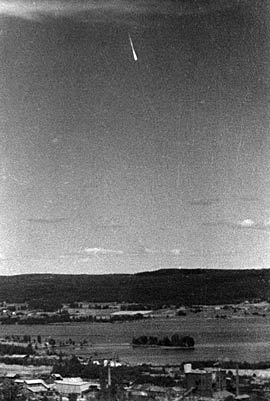
That summer Sweden was in the middle of what the newspapers called the “spökraketer”, the ghost rockets: hundreds of reports of fireballs, cigar shapes and wingless missiles over the country, often said to have come down in lakes. Kölmjärv became the best-known of these lake crashes, because there were witnesses, a search, and a paper trail. We read the secret field reports from July 1946, the news agency dispatch the Defense Staff tried to stop, and the telegram that ended the search, as scans posted online. We then read the Swedish National Archives’ own account, the study by the Swedish researcher Göran Jansson, which is built on the declassified Defense Staff files, and a skeptic’s review. The documents are in Swedish, so the translations below are ours, with the original words where it matters.
What the witnesses reported
The fullest early account is a secret field report from a visit to the north on 26 and 27 July 1946 by investigators looking at four reported impact sites. It puts the strike in the lake about 400 meters from its north end, where the lake is roughly 225 meters wide. Lindbäck, it says, heard at 11.45 a sound like an aircraft engine, then saw an object about a kilometer away on the far side of the lake come over the treetops. The report describes it as gray-brown or gray, cigar-shaped, narrowing toward the rear and 1.5 to 2 meters long, and adds, underlined, that it “hade troligen vingar” (probably had wings). It went into the lake at an angle of 30 to 45 degrees without an explosion, throwing up water about 2 meters high. Persson told them she had seen water splash into the forest more than 200 meters from the impact.
The national news agency TT carried the story the next day. Its dispatch from Överkalix says Lindbäck cycled along the shore to the nearest point, rowed out and tried to find the object, but saw nothing because the water had turned muddy. It also says there was a second column of water shortly after the first. Then, in a note to editors, came the Defense Staff’s request: “Försvarsstaben hemställer enträget att lördagens TT-meddelande från Överkalix (nr 17) om nedslaget av rymdprojektilen icke måtte publiceras.” (The Defense Staff urgently requests that Saturday’s TT dispatch from Överkalix (no. 17) on the impact of the space projectile not be published.) If it was printed anyway, the name Kölmjärv was to be replaced with “southeastern Norrbotten.”
The witness details do not quite agree from one paper to the next. TT says the object was “ett par meters” long, a couple of meters. A separate secret report from Sweden’s defense research institute, FOA, says one eyewitness compared it with details on a nearby house and estimated it at about 3 meters.
The search
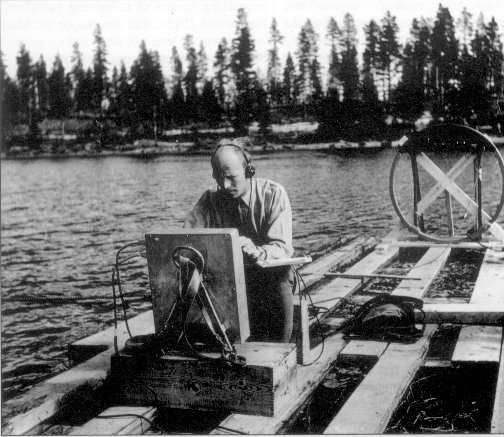
The officer sent to the lake was Lieutenant Karl-Gösta Bartoll of the Boden engineer regiment, Ing 3 (the 1946 report and the National Archives spell his name Barthold). According to the National Archives’ account, his team found a crater about 30 meters across on the lake bed, searched with metal detectors and took 3,500 samples from the bottom without result. A plan to drain the lake was dropped because it would have cost about 20,000 kronor.
The July field report is more cautious. It says the impact point had not been pinned down exactly but probably lay in an area of about 20 by 20 meters, where arm-thick water-lily roots lay torn up in large clumps and stones of up to 5 kilograms sat on or in the mud with lake-bottom material on them. The engineers were probing in lanes across the lake, two to three probes per square meter, and had covered 13,000 square meters without a positive result.
The FOA team came for a different reason. Its report says the trip of 20 and 21 July was meant to look for projectile parts, with special attention to “möjligen kvarvarande radioaktivitet, som kunde tyda på att atomenergi använts vid framdrivningen” (possibly remaining radioactivity, which could suggest that atomic energy had been used for propulsion). The reasoning was the size the witness gave: “Om projektilen verkligen varit så liten, förefaller det svårförklarligt, att den med drivmedel av gängse typ kunnat tillryggalägga den skjutsträcka, som i detta fall kan förmodas.” (If the projectile really was that small, it seems hard to explain how, with fuel of the usual kind, it could have covered the range that must be assumed in this case.) Jansson reports that the Geiger counter found nothing.
Jansson interviewed Bartoll, and his study gives the lieutenant’s own account. The bottom, Bartoll said, was stirred up over a diameter of 30 meters and the water was bubbling. They built a raft held together with hemp rope instead of nails, so the metal detector would react only to what was on the bottom, probably the raft in the photograph at the top of this page. They borrowed a detector and resistivity equipment from the mining company Boliden, which found nothing. He believed a heavy charge had gone off on the bottom. His conclusion: “Jag är helt övertygad om att något har slagit ner i sjön Kölmjärv - tyvärr så hittade vi det aldrig.” (I am completely convinced that something came down in Lake Kölmjärv; unfortunately we never found it.)
In early August the head of the Defense Staff’s air defense department, Major Nils Ahlgren, told TT in an interview quoted by Jansson that “Det säkraste nedslaget torde vara det som inträffat i Kölmjärv” (the most certain impact is probably the one at Kölmjärv). A few days later it was over. A telegram to Ahlgren dated 10 August 1946 reads, in full lower case: “intet positivt resultat vid undersökningen i kölmjärv.vilka nu avslutats.” (No positive result from the investigation at Kölmjärv, now concluded.)
What the ghost rockets turned out to be
The Defense Staff set up a committee in July 1946 to collect and analyze the reports. Its experts put most of them down to meteors and fireballs, and the busiest day, 11 August, fell at the peak of the Perseid meteor shower. But the committee never closed the case. In the National Archives podcast, war archivist Bo Berg says of the committee’s final meeting on 12 December 1946: “Någon hållbar förklaring till fenomenet med spökraketerna kunde kommittén aldrig presentera.” (The committee was never able to present any lasting explanation for the ghost rocket phenomenon.)
The suspicion at the time was that the Soviet Union was test-firing captured German V-weapons across the Baltic. That idea has not survived. Writing for Skeptoid in 2018, Brian Dunning sums up what later Soviet sources showed: “The Soviets never launched a single V-2 rocket in 1946 from anywhere.” Jansson makes the same point, dating the first Soviet test of a German V-2 to 18 October 1947. Dunning puts most of the wave down to meteors by night and contrails by day, and on the lake crashes notes only that “At least one was said to have crashed into a lake, though nothing was ever found.”
Sources
- “Rapport från besök i Övre Norrland den 26/7 och 27/7 1946 vid platser för rapporterade ni-nedslag”, secret field report, July 1946, scan of the typed original on UFOScans.com (read 15 Nov 2026). We read the scan itself, not the site’s automated summary. Title as UFOScans lists it; the typed heading is blurred by an underline.
- Försvarets forskningsanstalt (FOA), “Undersökningar vid förmodad nedslagsplats för raketprojektil i Kölmjärn”, secret report on the visit of 20 and 21 July 1946, scan on UFOScans.com (read 15 Nov 2026). Title as UFOScans lists it; the typed heading misspells the lake’s name.
- TT, dispatch from Överkalix no. 17, 20 July 1946, with the Defense Staff’s request to editors, typed copy on UFOScans.com (read 15 Nov 2026)
- Telegram no. 304 to Major Ahlgren, Defense Staff, 10 August 1946, signed Dahlgren, scan on UFOScans.com (read 15 Nov 2026)
- Riksarkivet (Swedish National Archives), “Arkivpodden: Spökraketer”, episode 33, 27 April 2023, transcript, with war archivist Bo Berg (read 15 Nov 2026). The Defense Staff’s file is the series “Handlingar angående rymdprojektiler”, Riksarkivet SE/KrA/0202/044:H/F 9, which the archive says is digitized; we did not read it in the archive’s own viewer.
- Göran Jansson, “Spökraketerna 1946”, UFO-Sverige, PDF, based on the declassified Defense Staff files and interviews (read 15 Nov 2026). The live PDF now returns 403; archived copy
- Brian Dunning, “The Swedish Ghost Rockets”, Skeptoid episode 628, 19 June 2018 (read 15 Nov 2026)
- Photographs: the lake search, Wikimedia Commons, and Erik Reuterswärd’s 9 July 1946 photograph, Wikimedia Commons, both tagged PD-Sweden-photo (read 15 Nov 2026)

Weighing it
We think something real happened at Kölmjärv. Two named villagers described it, Lindbäck went to the police the same day, and investigators who arrived within days found torn-up plants and displaced stones in the right part of the lake. What we cannot say is what made that mess. The 30-meter crater comes from Bartoll’s later recollection and the National Archives’ retelling; the report written at the time describes a smaller disturbed patch and an exact spot that could not be fixed. The object itself is described differently from paper to paper, from 1.5 to 3 meters long, and only “probably” winged. In our reading, the one idea the record does rule out is the one the Defense Staff feared most: a Soviet missile, since the Soviets launched none that year. A small meteorite is the obvious natural candidate, since it could bury itself in deep mud, but none was recovered, and the witnesses described something they watched cross the treetops with an engine-like hum, which is not how we would expect a falling stone to look. With no object, no fragment and only two short eyewitness accounts, we leave Kölmjärv open: a lake that took something in and never gave it back.
Verdict
Open Two villagers saw something plunge into Lake Kölmjärv and the army found a churned-up lake bed, but three weeks of searching found no object; it was not a Soviet rocket, and what it was remains unknown.
Update log
-
We added this case file.
-
Added a Wayback copy of Göran Jansson's 'Spökraketerna 1946' PDF after the live ufo.se link began returning 403. Marked the July 1946 field-report title as UFOScans lists it, because the typed heading is blurred by an underline and we could not confirm the reading. Added Erik Reuterswärd's 9 July 1946 photograph to the gallery so it appears on the page, with its PD-Sweden-photo credit.
Sources https://web.archive.org/web/20261027083733/https://www.ufo.se/images/UFO/pdf/Spkrakterna1946_GJ.pdf · https://www.ufoscans.com/000718/ · https://commons.wikimedia.org/wiki/File:Ghostrocket_7-09-1946.jpg
-
Weekly re-check of sources; no newer change to the record. Next check November 23, 2026.
Discussion
Discuss this case on the on-site Community board — no GitHub account required. Prefer a private tip for the editorial team? Submit a Sighting.
House rules: Community guidelines.