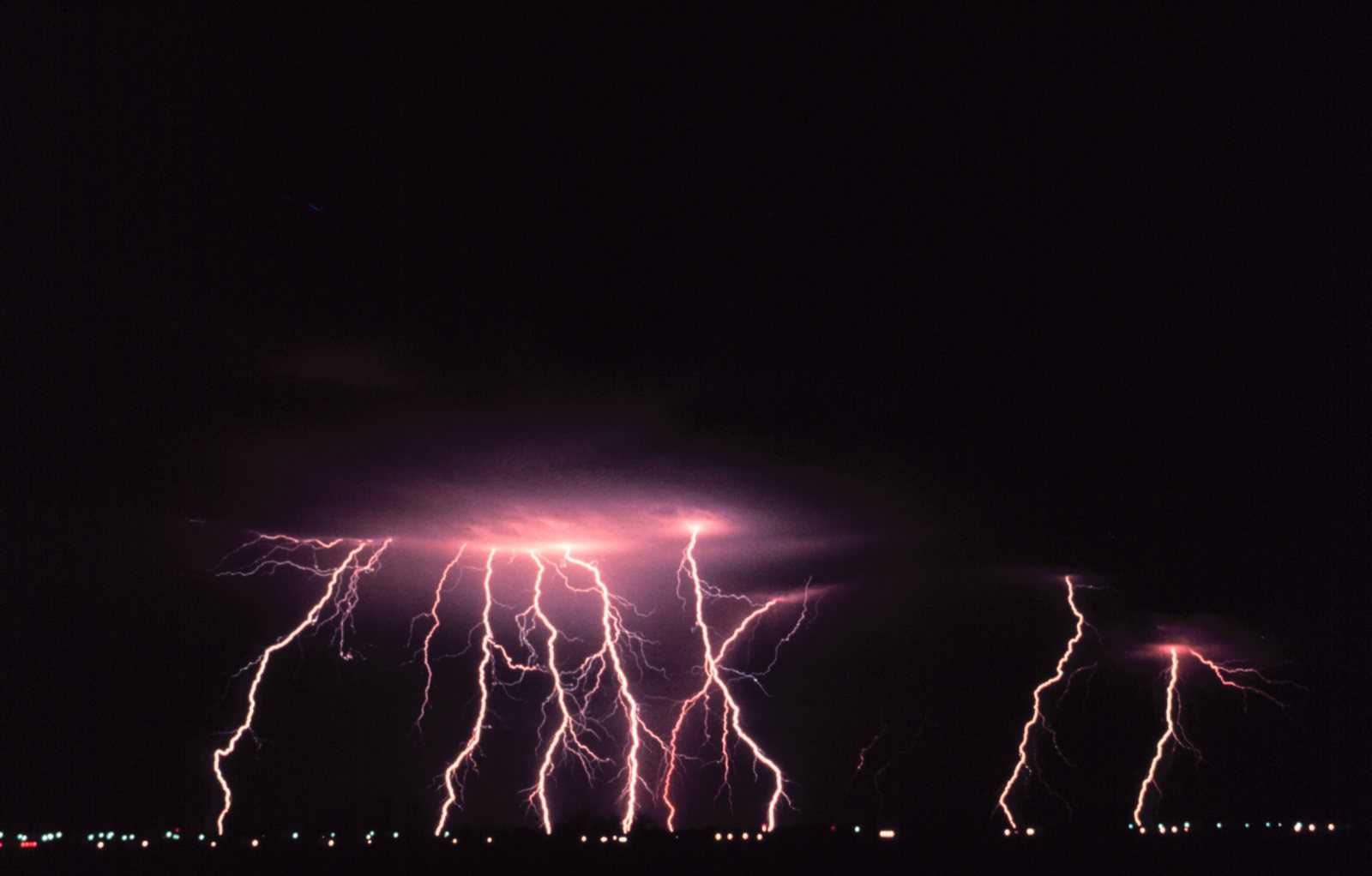
Qinghai, 2012: The Ball Lightning That Got Caught on a Spectrograph
One late-evening thunderstorm in July 2012, a team studying ordinary lightning on China's Qinghai Plateau recorded a glowing ball rising from a ground strike about 900 meters away. Their spectrum found silicon, iron and calcium, the stuff of soil. It's the best instrumental record of natural ball lightning, and it doesn't settle what ball lightning is.
Sources Jianyong Cen, Ping Yuan & Simin Xue, “Observation of the Optical and Spectral Characteristics of Ball Lightning,” Physical Review Letters 112, 035001 (17 Jan 2014), abstract via Europe PMC (PMID 24484145); Philip Ball, “First Spectrum of Ball Lightning,” Physics 7, 5 (APS, 17 Jan 2014)
Ball lightning is one of the oldest puzzles in weather. For centuries people have described glowing balls, from golf-ball size to several meters across, that float through thunderstorms for a second to tens of seconds and then vanish. Some historical reports say they injured people or set buildings alight. What’s been missing is measurement. In January 2014, Physical Review Letters published the first spectrum of a natural one, and it arrived by luck.
What happened
A team led by Ping Yuan of Northwest Normal University in Lanzhou had set up instruments on the remote Qinghai Plateau in northwest China to study ordinary lightning, which is frequent there. According to the American Physical Society’s Physics magazine, during a late-evening thunderstorm in July 2012 they saw ball lightning appear just after a cloud-to-ground strike about 900 meters from their equipment. They caught it with two slitless spectrographs and on high-speed video.
As Physics reported:
- The recorded glow was about 5 meters across, though the researchers say the ball itself was much smaller.
- It changed from white to reddish over the second or so that it lasted.
- It drifted about 10 meters horizontally and rose about 3 meters. In the dark, the team couldn’t estimate its altitude.
- Yuan said it was the first time ball lightning had been seen to form from a cloud-to-ground strike.
What the spectrum showed
The paper’s abstract says the spectral analysis shows “radiation from soil elements” throughout the ball’s lifetime. Physics names them: emission lines of silicon, iron and calcium. Aluminum, also common in soil, couldn’t be checked, because neutral aluminum has no lines in the instrument’s 400–1,000-nanometer range.
That fits one well-known hypothesis, published by J. Abrahamson and J. Dinniss in Nature in 2000. A lightning strike vaporizes silicate minerals in the soil. Carbon strips out the oxygen, leaving silicon vapor that condenses into nanoparticles or filaments, which glow as they react with oxygen in the air.
Why this stays open
The lightning specialist Martin Uman of the University of Florida, quoted by Physics, called it “a unique observation that is probably of ball lightning, or one type of ball lightning.” “This one certainly seems to be made of dirt,” he said, but the data don’t reveal which ball lightning theory is correct.
So the ledger keeps two things separate:
- Measured: one glowing ball, about a second long, born from a ground strike, with soil elements in its light.
- Reported: centuries of eyewitness fireballs, some said to last tens of seconds. Whether they’re all the same phenomenon as the Qinghai ball is not something one spectrum can answer.
The exact date and duration of the event appear in the full paper, which the ledger hasn’t read. This file prints only what the abstract and the APS summary state. The published figures and video are the American Physical Society’s copyright and are linked, not reproduced.
Status: open. For lightning safety, follow the National Weather Service (weather.gov/safety/lightning). Part of the Ball Lightning & Luminous Weather series. An account from 1638 Devon joins the series later this month.
Sources
- Jianyong Cen, Ping Yuan and Simin Xue, “Observation of the Optical and Spectral Characteristics of Ball Lightning,” Physical Review Letters 112, 035001, published 17 Jan 2014, doi:10.1103/PhysRevLett.112.035001 (cited as text; abstract read via Europe PMC) — link.aps.org
- Philip Ball, “First Spectrum of Ball Lightning,” Physics 7, 5 (American Physical Society), 17 Jan 2014 — physics.aps.org
- J. Abrahamson and J. Dinniss, “Ball lightning caused by oxidation of nanoparticle networks from normal lightning strikes on soil,” Nature 403, 519 (2000), as cited in Physics (citation only)
- An et al., “Temperature of apparent natural ball lightning obtained by examination of the spectra,” Physics of Plasmas 29, 113503 (2022), abstract only — doi.org
- Wang et al., “Study on the luminous characteristics of a natural ball lightning,” Applied Physics Letters 112, 064103 (2018), abstract only — doi.org
Evidence ledger
Each claim in this file, the source it rests on, and how well it holds up: 3 corroborated · 1 disputed · 1 unverified. What the labels mean.
| Claim | Source | Type · date | Status |
|---|---|---|---|
| Ball lightning was recorded with two slitless spectrographs from about 0.9 km away. | Cen, Yuan & Xue, Phys. Rev. Lett. 112, 035001 (abstract) | scholarly · 17 Jan 2014 | corroborated |
| It formed from a cloud-to-ground lightning strike and moved horizontally.Physics: drifted about 10 m horizontally and rose about 3 m. | Cen, Yuan & Xue (abstract); Ball, Physics 7, 5 | scholarly · 17 Jan 2014 | corroborated |
| Soil elements (silicon, iron, calcium) appear in its spectrum for the ball's entire lifetime. | Cen, Yuan & Xue (abstract); Ball, Physics 7, 5 | scholarly · 17 Jan 2014 | corroborated |
| This proves ball lightning is vaporized soil.Uman: “This one certainly seems to be made of dirt,” but the data don't reveal which theory is correct. It may be one type of ball lightning. | Martin Uman, quoted in Physics 7, 5 | scholarly · 17 Jan 2014 | disputed |
| The event happened on a specific date in July 2012 and lasted a specific fraction of a second.The ledger hasn't read the full paper; it prints only “July 2012” and “a second or so” (Physics). | Search excerpts of the paper (not read in full) | secondary | unverified |
Updates
-
THIN (abstracts only). Logged 13 Oct 2026; not new research in 2026. Two follow-up papers share authors with the original 2014 Physical Review Letters report (Cen, Yuan, Xue). The ledger has read only their abstracts. In Physics of Plasmas (4 Nov 2022), An et al. re-examined the high-speed spectra of the 2012 Qinghai object. They describe a mostly steady brightness with a regular oscillation: soil elements (Si, Fe, Ca lines) give most of the light, and air elements (N, O lines) drive the oscillation. Temperature estimates depend on which lines are used, from 7,170–11,410 K for oxygen lines down to a mean of 2,700 K for the continuum. The authors read this as a hotter energy-source core. Earlier, Wang et al. in Applied Physics Letters (Feb 2018) estimated a peak luminous intensity of about 1.24×10^5 cd early in the event, and about 5.9×10^4 cd for most of its life. All three papers come from one group working from one recording, and none is an independent replication. Status stays open.
Sources An et al., “Temperature of apparent natural ball lightning obtained by examination of the spectra,” Physics of Plasmas 29, 113503 (4 Nov 2022), abstract only: https://doi.org/10.1063/5.0098329 · Wang et al., “Study on the luminous characteristics of a natural ball lightning,” Applied Physics Letters 112, 064103 (2018), abstract only: https://doi.org/10.1063/1.5019318 · Cen, Yuan & Xue, “Observation of the Optical and Spectral Characteristics of Ball Lightning,” Physical Review Letters 112, 035001 (2014): https://doi.org/10.1103/PhysRevLett.112.035001
Discussion
Discussions activating. Per-case threads will embed here once the Giscus GitHub App is installed on the public satellite repo.
Meanwhile, join the conversation on GitHub Discussions: https://github.com/dclewis21/anomaly-ledger-community/discussions
CoS / D.C.: see Community guidelines and
SETUP.mdin the site repo for the one-click Giscus install.