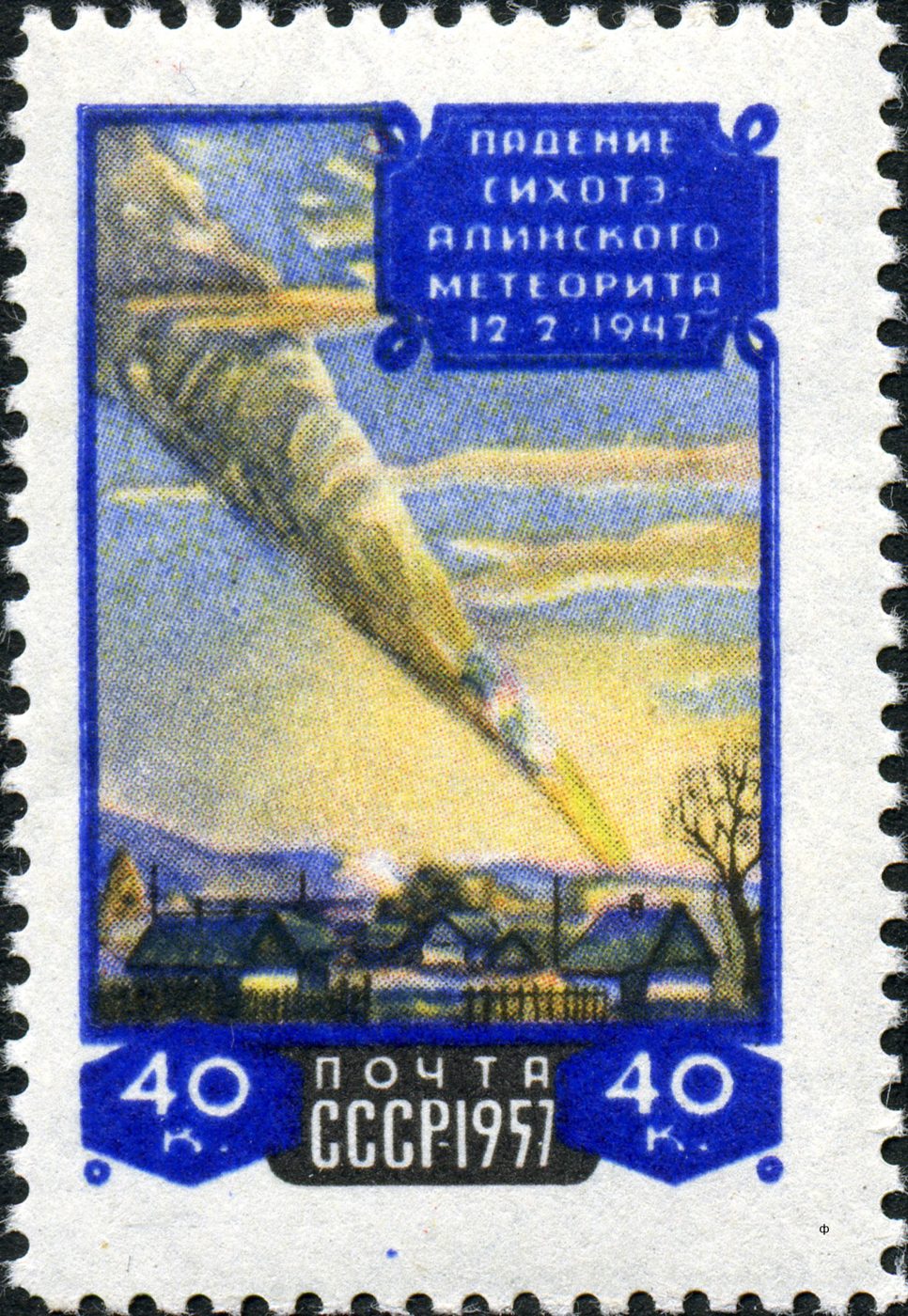
The evidence: P. I. Medvedev's eyewitness painting of the fireball and its smoke trail over Iman, as reproduced on a 1957 Soviet stamp
The Sikhote-Alin Iron Rain, 1947: A Painter at His Easel When the Sky Fell on the Taiga
Last reviewed Next review
We review and update every article weekly. When the record changes, so does the article. How we review
In February 1947 a fireball brighter than the sun broke over Russia's Far East and rained tonnes of iron on the taiga. We read the Russian expedition records.
Verdict: An iron asteroid several meters across broke apart low over the Sikhote-Alin mountains and fell as the largest iron meteorite shower on record, and Soviet scientists found the craters and tonnes of iron to prove it.
Original sources: Laboratory of Meteoritics, Vernadsky Institute of Geochemistry (GEOKHI RAS), 'Sikhote-Alin' (in Russian) · L. N. Khetchikov, 'The first expeditions: the Sikhote-Alin meteorite shower', Far East Geological Institute FEB RAS (in Russian) · Monnig Meteorite Gallery, Texas Christian University, 'Sikhote-Alin' · National Space Centre, Leicester, 'Sikhote Alin Meteorite', object 2014-40 · BelTA, 'Lida museum displays piece of Sikhote-Alin meteorite' (12 Feb 2026) · E. L. Krinov, 'New studies of the Sikhote-Alin iron meteorite shower', Meteoritics 6, no. 3 (1971): 127-138, DOI 10.1111/j.1945-5100.1971.tb00104.x
Sources Laboratory of Meteoritics, Vernadsky Institute (GEOKHI RAS), 'Sikhote-Alin' (meteorites.ru); L. N. Khetchikov, 'The first expeditions', Far East Geological Institute FEB RAS (fegi.ru); Monnig Meteorite Gallery, Texas Christian University, 'Sikhote-Alin'; National Space Centre (Leicester), 'Sikhote Alin Meteorite', object 2014-40; BelTA, 'Lida museum displays piece of Sikhote-Alin meteorite' (12 Feb 2026); E. L. Krinov, 'New studies of the Sikhote-Alin iron meteorite shower', Meteoritics 6 (1971): 127-138; USSR 1957 commemorative stamp after P. I. Medvedev
On a clear winter morning in 1947, a painter in the small town of Iman in Russia’s Far East was outside getting ready to paint a landscape when a fireball crossed the sky. He painted it in oils straight away, while the picture was still fresh in his head. A few weeks later the canvas went to a scientific expedition from Moscow, and it became the best-known image of one of the most closely studied meteorite falls in history.
We read the account of the fall published by the meteoritics laboratory of the Russian Academy of Sciences, and a longer history of the first expeditions written by a geologist at the Far East Geological Institute in Vladivostok who took part in the second one. We checked their numbers against two museum records in the United States and Britain and a 2026 Belarusian news report. Translations from the Russian are ours. The image at the top is a Soviet stamp issued in 1957 that reproduces the painter’s work.
The morning of 12 February
The academy’s laboratory dates the fall to 10:38 a.m. on 12 February 1947, in what is now Primorsky Krai, north of Vladivostok. It quotes the Moscow evening paper Vechernyaya Moskva of 17 February, which reported that people in the forested Krasnoarmeysky district saw a giant blazing meteorite race toward the spurs of the Sikhote-Alin range at about 10 o’clock. A thunderous noise followed. Windows broke, chimneys collapsed, and trees swayed as if in a storm. A thick, reddish-brown trail of smoke hung in the air for a long time, and people heard explosions. Nobody yet knew where it had come down.
The Space Centre in Leicester, which holds a small fragment, says witnesses described a fireball brighter than the sun coming out of the north at an angle of about 41 degrees, with a smoke and dust trail some 20 miles long that lasted for hours. Light and sound were noticed up to 200 miles away.
The painter in Iman
The geologist L. N. Khetchikov’s history tells the painter’s part. When the academy’s first expedition passed through Iman, today called Dalnerechensk, in late April 1947, its members met a local artist, P. I. Medvedev. He had been outside getting ready to paint a landscape when the fireball with its many-colored tail flew past. It made such an impression on him that he painted the scene in oils straight away. The canvas went to the expedition, and a reproduction is kept by the academy’s Committee on Meteorites. The laboratory’s own page shows the painting with a caption calling Medvedev an eyewitness and naming Iman as the place.
Ten years later the Soviet post put the painting on a 40-kopek stamp. That is the version we can show, because the stamp is in the public domain.
Finding the craters
Two days after the fall, on 14 February, two pilots, P. Ya. Fartsikov and A. I. Ageev, were flying a scheduled route from Ulunga to Khabarovsk when they spotted fresh pits in the forest from the air. They reported it in Khabarovsk, and the regional geological office flew out three geologists on 21 February. After two hard days on foot through the taiga, they reached the site on 24 February.
They were not alone. A Vladivostok geologist, F. K. Shipulin, had set out on his own by train and on foot with two local hunters, asking eyewitnesses in each village which way the fireball had gone. He walked into the site the same day. The two Russian sources disagree slightly here: the laboratory says he arrived an hour after the Khabarovsk team, and Khetchikov says half an hour.
What they found, in both accounts, was a patch of taiga about a square kilometer across that looked as if it had been shelled. Trees were snapped, their tops sheared off. Big cedars lay pulled out by the roots and pointing away from the holes. The snow was packed hard enough to walk on and mixed with clay, sand, broken rock and wood. The largest crater was 26 meters across and 6 meters deep. They counted about 30 craters and pits and picked fragments of iron out of one of them.
The expeditions
The academy’s first expedition was led by the astronomer V. G. Fesenkov, with E. L. Krinov as his deputy, and the army lent them a unit of sappers to dig. Spring blizzards held them up, and they only reached the site on 27 April, where sappers were still finishing a log hut in wet snow. Khetchikov records what they found in the following weeks. In a crater field of 0.75 square kilometers there were 106 craters and pits, 24 of them 9 meters across or more. The bigger the crater, the earlier it had formed, because the heaviest pieces arrived first.
Digging showed how the holes were made. Pits under a meter wide each held a single unbroken iron of 68 to 85 kilograms just below the bottom. Pits about 3 meters across held masses of around 300 kilograms that had split on hitting rock. In the largest craters the iron had shattered into thousands of small, twisted shards. The expedition carried 1.7 tonnes of whole individual meteorites back to Moscow, 257 pieces in all. The smallest weighed 0.18 grams and was found resting on an old leaf caught in last year’s grass.
Search teams went back every year until 1950 and again from 1967 to 1975, using mine detectors and magnetometers. The single largest piece, 1,745 kilograms, was hauled out of a pit by sappers in 1950, and the laboratory’s page shows the photograph.
What fell
The laboratory’s summary is that a body several meters across and weighing hundreds of tonnes entered the atmosphere and broke apart again and again, first at about 25 kilometers up and last at about 6. Pieces that broke off early tumbled a long way and came down rounded, with a melted crust and thumbprint-like hollows. Pieces that broke off near the ground are raw, jagged shrapnel. The iron is about 93 percent iron and 6 percent nickel. Its calculated orbit lay inside the asteroid belt, and the laboratory says the parent body broke up about 350 million years ago.
How much reached the ground depends on who is counting. The laboratory’s header gives tens of thousands of pieces weighing more than 31 tonnes, and its text says more than 27 tonnes were collected. Khetchikov says the first expedition estimated 100 tonnes in 1947. The Monnig gallery at Texas Christian University and the 2026 BelTA report give about 23 tonnes. The museums also disagree on the type: the Russian laboratory files it in iron group IIB, Monnig in IIAB. None of this touches what happened.
Weighing it
There is nothing unexplained left in the fall itself. It was seen and heard across a wide area, found from the air within two days, dug up by trained teams over decades, and its iron is in museums from Moscow to Texas and Leicester. What makes it worth a place here is how rare it is: the laboratory quotes Krinov calling it the most abundant iron meteorite shower known, far beyond any other in the number of pieces and their total weight. It is also a reminder that the best record of a sudden sky event can be a painting made by a man who happened to be standing outside with his brushes.
Sources
- Laboratory of Meteoritics, Vernadsky Institute of Geochemistry and Analytical Chemistry (GEOKHI RAS), “Сихотэ-Алинь” (Sikhote-Alin), in Russian, quoting Vechernyaya Moskva of 17 February 1947 and E. L. Krinov (1981), with Medvedev’s painting and expedition photographs (read 11 Nov 2026)
- L. N. Khetchikov, Far East Geological Institute FEB RAS, “Первые экспедиции” (The first expeditions), in Russian (read 11 Nov 2026)
- Monnig Meteorite Gallery, Texas Christian University, “Sikhote-Alin” (read 11 Nov 2026)
- National Space Centre, Leicester, “Sikhote Alin Meteorite”, object 2014-40 (read 11 Nov 2026)
- BelTA, “Lida museum displays piece of Sikhote-Alin meteorite” (12 Feb 2026) (read 11 Nov 2026)
- E. L. Krinov, “New studies of the Sikhote-Alin iron meteorite shower”, Meteoritics 6, no. 3 (1971): 127-138, DOI 10.1111/j.1945-5100.1971.tb00104.x (further reading; we confirmed the citation but did not read the paywalled text)
- USSR Post, 40-kopek stamp for the tenth anniversary of the fall (20 November 1957), after P. I. Medvedev, Wikimedia Commons

Verdict
Explained An iron asteroid several meters across broke apart low over the Sikhote-Alin mountains and fell as the largest iron meteorite shower on record, and Soviet scientists found the craters and tonnes of iron to prove it.
Update log
-
We added this case file.
-
Weekly re-check of sources; no change to the record since filing. Next check November 23, 2026.
Discussion
Discuss this case on the on-site Community board — no GitHub account required. Prefer a private tip for the editorial team? Submit a Sighting.
House rules: Community guidelines.