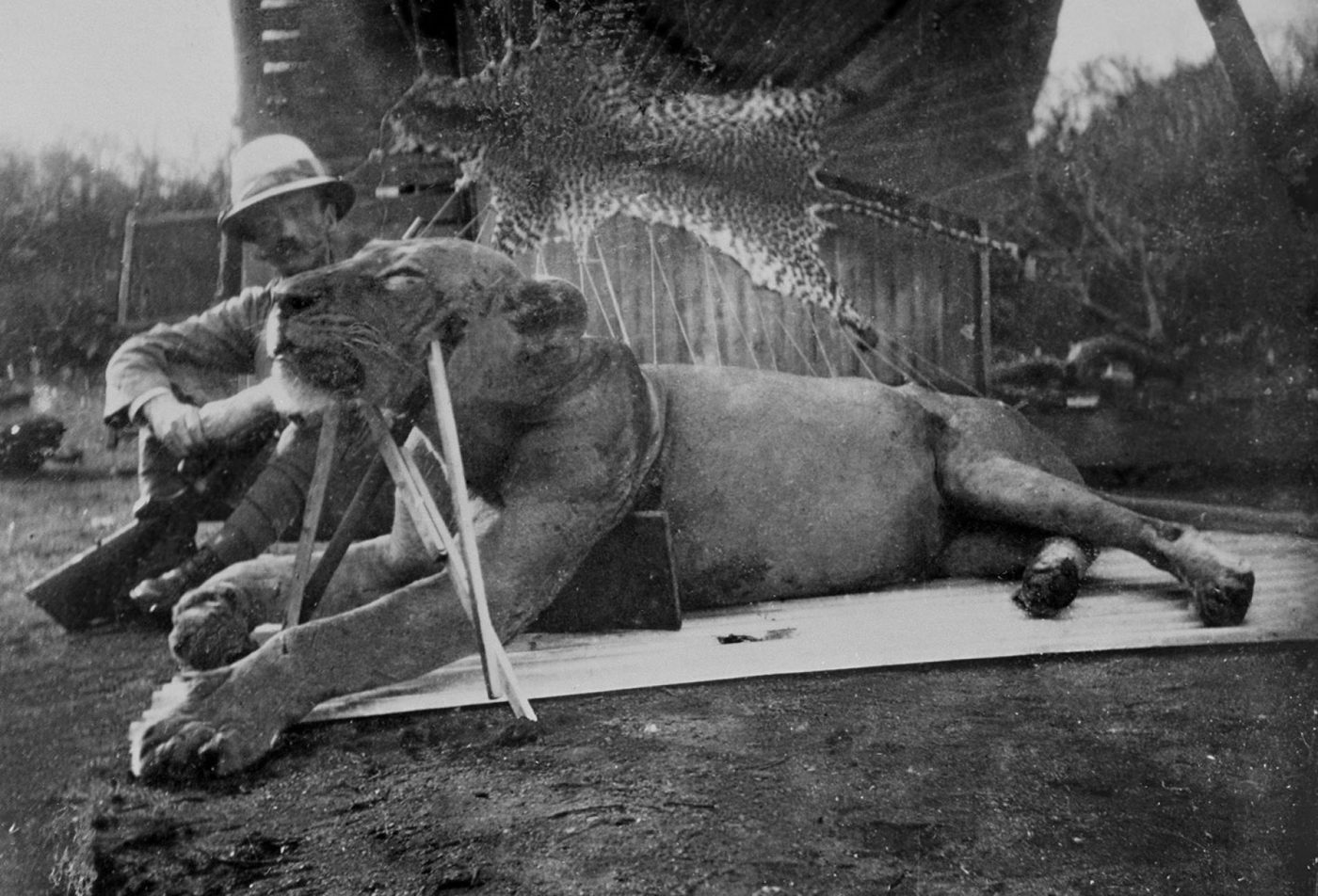
The evidence: Patterson with the first of the two Tsavo lions, shot on 9 December 1898
The Man-Eaters of Tsavo, Kenya 1898: Two Lions, and a Death Toll That Keeps Changing
Last reviewed Next review
We review and update every article weekly. When the record changes, so does the article. How we review
In 1898 two maneless lions raided the railway camps at Tsavo. The toll has been put at 28, 35 and 135. We read Patterson's own words and the science.
Verdict: Two real lions killed and ate railway workers at Tsavo in 1898, but Patterson's later toll of 135 is unsupported; the best evidence points to about 35 people eaten, driven by bad teeth and scarce prey.
Original sources: J. H. Patterson, The Man-Eaters of Tsavo (Macmillan, 1907; 1921 printing), full text on the Internet Archive · J. H. Patterson, The Man-Eating Lions of Tsavo, Field Museum Zoology Leaflet 7 (1925), on the Internet Archive · Yeakel et al., 'Cooperation and individuality among man-eating lions', PNAS (2009), open full text at PubMed Central · DeSantis and Patterson, 'Dietary behaviour of man-eating lions as revealed by dental microwear textures', Scientific Reports (2017), CC BY 4.0 · Lucy Mkanyika, 'Man eaters of Tsavo: Bring back the lions, Taita Taveta tells US Chicago museum', Daily Nation (Kenya), 5 December 2023
Sources J. H. Patterson, The Man-Eaters of Tsavo and Other East African Adventures (London: Macmillan, 1907; 1921 printing via Internet Archive); J. H. Patterson, The Man-Eating Lions of Tsavo, Field Museum of Natural History Zoology Leaflet 7 (Chicago, 1925), via Internet Archive; Yeakel et al., 'Cooperation and individuality among man-eating lions', PNAS 106 (2009): 19040-19043; DeSantis and Patterson, 'Dietary behaviour of man-eating lions as revealed by dental microwear textures', Scientific Reports 7 (2017): 904; de Flamingh et al., 'Compacted hair in broken teeth reveals dietary prey of historic lions', Current Biology 34 (2024): 5104-5111; Field Museum, 'Tsavo Lions' (2018); Lucy Mkanyika, Daily Nation (Kenya), 5 December 2023; Peter Muiruri, The Standard (Kenya), 15 December 2022
In March 1898 a British engineer named John Henry Patterson arrived at Tsavo, in what was then British East Africa and is now Kenya, to build a permanent railway bridge over the Tsavo River for the Uganda Railway. Thousands of laborers, many of them brought from India, were camped along the line. Over the next nine months two male lions without manes came into those camps at night, again and again, and dragged people away. In December the works stopped for weeks because the men would not stay. Patterson shot the first lion on 9 December and the second on 29 December 1898.
That much nobody disputes. What is still argued over is how many people the lions killed, and why two lions took to hunting people at all. The number has been given as 28, as “scores” more, as 135, and, from the lions’ own bones and hair, as about 35. We read Patterson’s 1907 book and his 1925 museum leaflet, the three scientific studies that have worked on the lions’ remains, the Field Museum’s own account, and two Kenyan newspapers.
What Patterson wrote in 1907
Patterson’s book, The Man-Eaters of Tsavo, came out in 1907 and has never really gone out of print. We read the 1921 printing on the Internet Archive. He writes that two lions “for over nine months waged an intermittent warfare against the railway and all those connected with it in the vicinity of Tsavo”, and that this “culminated in a perfect reign of terror in December, 1898, when they actually succeeded in bringing the railway works to a complete standstill for about three weeks.”
He also reports what the workers believed. Their methods became so uncanny, he writes, that the workmen “firmly believed that they were not real animals at all, but devils in lions’ shape.” They were convinced “that the angry spirits of two departed native chiefs had taken this form in order to protest against a railway being made through their country”. He admits that when the first men vanished he did not believe lions had taken them, and suspected “foul play at the hands of some of their comrades”, since the missing men had saved money.
He describes sitting alone at night on a wooden platform about twelve feet high, next to the carcass of a donkey the lions had killed, and shooting the first lion there on 9 December. The second, he writes, measured “nine feet six inches from tip of nose to tip of tail”. At the end of that chapter he gives his count: the two lions had eaten 28 Indian workers (he uses the colonial word of the time, “coolies”), plus “scores of unfortunate African natives of whom no official record was kept.”
How 28 became 135
By 1924 Patterson still had the two skins, used as rugs. According to his Field Museum leaflet, published in 1925 (the copy we read is dated 1926 on its first page), he gave a public lecture at the museum in Chicago in 1924 and mentioned the skins to its president, Stanley Field, who bought them and gave them to the museum. The skins were mounted and are still on show.
The leaflet’s opening paragraph, written by Patterson, gives a far bigger number than the book. Visitors, it says, will find it hard to believe that “these two ferocious brutes killed and devoured, under the most appalling circumstances, one hundred and thirty-five Indian and African artisans and laborers employed in the construction of the Uganda Railway.” Nowhere in the leaflet does Patterson say where the figure of 135 came from.
The Kenyan papers repeat the story with small differences. The Daily Nation reports that Patterson sold the skins and skulls in 1924 for $5,000 and that the museum put them on display in 1928. The Standard also gives 1924 and a price of 5,000 (its web text shows “PS5,000”, which we read as a garbled pound sign, where the Nation says dollars), and adds that the workers “claimed they were no ordinary lions but spirits of departed African chiefs unhappy about the construction.” The Field Museum’s own blog says Patterson sold them in 1925. The leaflet itself puts the lecture in 1924 and the purchase after it.
What the lions’ bodies say
In 2009 a team led by Justin Yeakel, with the Field Museum’s mammal curator Bruce Patterson (no relation to the engineer), published a study of the two lions in the Proceedings of the National Academy of Sciences. They opened by noting that “the full extent of the lions’ man-eating behavior is unknown; estimates range widely from 28 to 135 victims.”
They measured carbon and nitrogen isotopes in the lions’ bone, which records diet over years, and in their hair, which records the last months of life, and compared them with grazing and browsing animals from Tsavo and with bone from 12 Taita people of the late 1800s held in the Duckworth Laboratory. Their model put the first lion, the one in the photograph above, at about 30 percent human food in its last months, and the second at about 13 percent. Spread over the nine months of attacks, that came to about 10.5 people eaten by the second lion and 24.2 by the first, a total of 34.7, with a possible range of 4 to 72. In the paper’s words, “Our median estimate is larger than the Uganda Railway’s documented value of 28 humans killed (16), and much less than Patterson’s estimate of 135 humans killed (15).”
The Field Museum sums up the result plainly: “Later research by Field Museum scientists drastically reduced that estimate to 35 (which is still disconcerting!).”
Two points of caution. The method estimates people eaten (“humans consumed”, in the paper’s words), not people attacked or killed, so in our reading anyone killed but not eaten, or only wounded, would not show up. And it rests on assumptions the authors spell out, such as about 6 kg of food a day and about 20 kg eaten per person.
Why people?
The 2009 paper lists conditions that left little to hunt: a severe drought from 1897 to 1900 and rinderpest epidemics in 1889 and 1898, which together reduced the herbivores the lions lived on. It also links the heavier man-eating of the first lion to its “severe craniodental infirmities”. The first lion had a broken lower canine with an abscess at the root, and the second a broken upper carnassial tooth.
In 2017 Larisa DeSantis and Bruce Patterson looked at the microscopic wear on the lions’ teeth, published in Scientific Reports. They found no sign of heavy bone-crunching shortly before the lions died, and suggest that people recovering bodies quickly kept the lions from the bones. Their conclusion: “Man-eating was likely a viable alternative to hunting and/or scavenging ungulates due to dental disease and/or limited prey availability.”
In 2024 a team led by Alida de Flamingh, with the Field Museum’s Thomas Gnoske and Julian Kerbis Peterhans among the authors, extracted DNA from hair packed into the lions’ broken teeth, published in Current Biology. “Analysis of hair DNA identified giraffe, human, oryx, waterbuck, wildebeest, and zebra as prey and also identified hair that originated from lion.” So people were on the menu, but so was a good deal of ordinary game.
The lions today
The two lions are still in Chicago, and Kenyans have asked for them back. In December 2023 the Daily Nation reported that leaders in Taita Taveta County, where Tsavo lies, were calling for their return. “They are either brought back or we get a piece of our cake,” the county assembly member Peter Shambi told a visiting parliamentary committee, whose acting chair, Alfred Mutai, said: “A law is in the offing in Parliament to see that we get back the remains of our lions. That is on course.” We found no report that the lions have been returned.
Sources
- J. H. Patterson, The Man-Eaters of Tsavo and Other East African Adventures (London: Macmillan, first published October 1907; 1921 printing), chapters II, VIII and IX, pp. 20-21 and 85-107, full text via the Internet Archive (read 17 Nov 2026)
- J. H. Patterson, The Man-Eating Lions of Tsavo, Field Museum of Natural History, Zoology Leaflet 7 (Chicago, 1925), opening page and footnote, via the Internet Archive (read 17 Nov 2026)
- Justin D. Yeakel, Bruce D. Patterson, Kena Fox-Dobbs and others, “Cooperation and individuality among man-eating lions”, Proceedings of the National Academy of Sciences 106, no. 45 (2009): 19040-19043, DOI 10.1073/pnas.0905309106 (read 17 Nov 2026)
- Larisa R. G. DeSantis and Bruce D. Patterson, “Dietary behaviour of man-eating lions as revealed by dental microwear textures”, Scientific Reports 7 (2017): 904, DOI 10.1038/s41598-017-00948-5, CC BY 4.0 (read 17 Nov 2026)
- Alida de Flamingh, Thomas P. Gnoske, Julian C. Kerbis Peterhans and others, “Compacted hair in broken teeth reveals dietary prey of historic lions”, Current Biology 34 (2024): 5104-5111, abstract read via Europe PMC (read 17 Nov 2026)
- Field Museum, “Tsavo Lions” (blog, 10 February 2018) (read 17 Nov 2026)
- Lucy Mkanyika, “Man eaters of Tsavo: Bring back the lions, Taita Taveta tells US Chicago museum”, Daily Nation (Kenya), 5 December 2023 (read 17 Nov 2026)
- Peter Muiruri, “How man-eating lions of Tsavo ended up in US in 1924”, The Standard (Kenya), 15 December 2022 (read 17 Nov 2026)
Weighing it
We are sure of the core of this story. Two lions killed and ate people at Tsavo through 1898, the attacks stopped after Patterson shot them in December, and the two animals he shot are the ones in Chicago: the isotope work finds human food in the diet of both, and the DNA work finds human hair packed in their teeth. The legend sits on top of that, in the numbers. Patterson’s own 1907 count was 28 Indian workers plus an unknown number of Africans whom no one recorded, and that gap is real: the 28 is a railway figure, not a full count. But his jump to 135 in 1925, in a leaflet written to go with the mounted lions, comes with no source, and the chemistry of the lions’ hair and bone points to about 35 people eaten, with a wide possible range of 4 to 72. In our reading the 135 is a storyteller’s figure, and the honest answer is “probably a few dozen, and we will never know exactly”. As for why, the two studies that ask the question point to the same plain explanation: a drought and cattle plague that thinned out their usual prey, and at least one lion with teeth too damaged to hunt big game well. The workers’ belief that the lions were angry spirits tells us how frightening that year was, not what the lions were. We file the Tsavo man-eaters as disputed, because the death toll is still argued over, not because anyone doubts the lions.
Verdict
Disputed Two real lions killed and ate railway workers at Tsavo in 1898, but Patterson's later toll of 135 is unsupported; the best evidence points to about 35 people eaten, driven by bad teeth and scarce prey.
Update log
-
We added this case file.
-
Weekly re-check of sources; no change to the record since filing. Next check November 23, 2026.
Discussion
Discuss this case on the on-site Community board — no GitHub account required. Prefer a private tip for the editorial team? Submit a Sighting.
House rules: Community guidelines.