Trailhead / site map
Ape Canyon Trail #234 · Mount St. Helens
A Forest Service ridge trail to the rim of the gorge named for the 1924 ‘mountain devils’ story — volcanic views and Bigfoot toponymy on legal, fee-posted public land.
Access
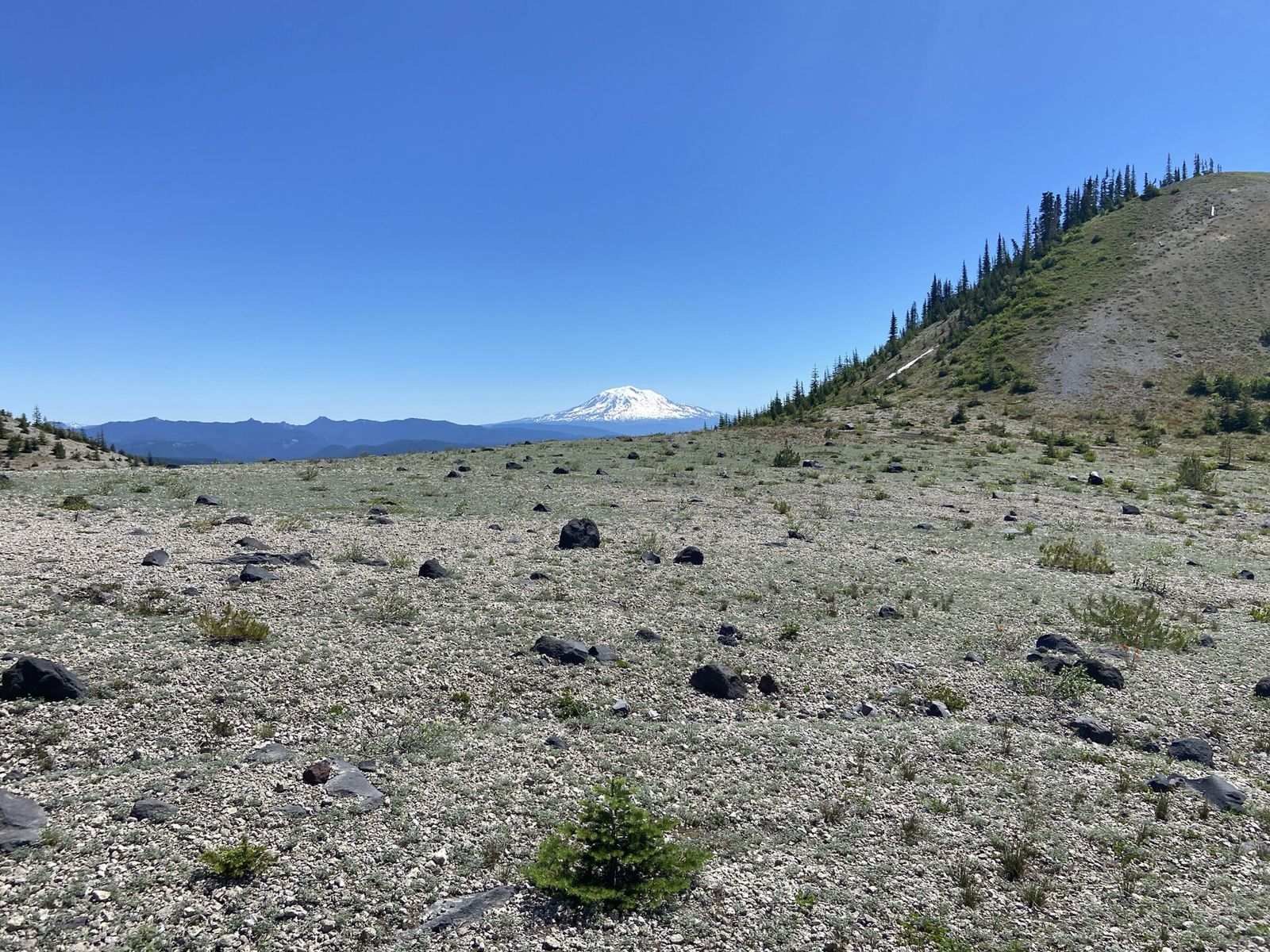
Public USFS / National Volcanic Monument trail. Fee: $5 per vehicle per day or a valid recreation pass at Ape Canyon Trailhead (USFS; see the Mount St. Helens map for pay sites). USFS directions: from Cougar, WA take Lewis River Road east 2.8 miles (becomes Forest Road 90), continue about 4 miles to Forest Road 83, turn left and drive 8.4 miles to the trailhead. The trail climbs through young plantation and old-growth fir to an open ridge and ends at the top of Ape Canyon at Loowit Trail #216. Heavy mountain-bike use on weekends — share the trail. No water. Low trails melt out around mid-May, high ones around mid-July. USFS publishes no trailhead decimal on the trail page; the map link below is a place-name search, not a published pin.
Safety & respect
Volcanic backcountry: exposed ridges, loose pumice, snow patches into summer, washouts and downed trees. Carry all your water and mosquito repellent. Report wildfire to 911 or Columbia Dispatch (360) 891-5140. Stay on trail — the 1980 blast zone is a recovering landscape and a research area. No off-trail ‘creature hunting,’ calling, or baiting.
Lore note
In July 1924 The Oregonian ran ‘Fight With Big Apes Reported By Miners’: five prospectors (Marion and Roy Smith, Fred Beck, Gabe Lefever, John Peterson) said ape-like ‘mountain devils’ had stoned their cabin near Mount St. Helens after one was shot. Follow-up reporting the same month had forest rangers J.H. Huffman and William Welch walk in with Beck and conclude the miners had likely placed the big stones themselves. Researchers tracked Beck down in the 1960s and his own account revived the story in the Bigfoot era, and the gorge carries the name Ape Canyon. Status here: folklore — a well-documented 1924 news story, not evidence of an animal.
Map links
Official / public map link · Open in Google Maps (street-address search — not a published decimal pin)
Sources
- USFS Gifford Pinchot NF — Trail #234 Ape Canyon (route, fee, directions, melt-out, last updated 2 Jul 2026; checked 2026-10-03): https://www.fs.usda.gov/r06/giffordpinchot/recreation/trails/trail-234-ape-canyon
- The Oregonian (Portland), 13 Jul 1924, ‘Fight With Big Apes Reported By Miners’ — as quoted in OregonLive, ‘How a 1924 Bigfoot battle on Mt. St. Helens helped launch a legend’ (Throwback Thursday, Jan 2018): https://www.oregonlive.com/history/2018/01/1924_bigfoot_battle_on_mt_st_h.html
- Lapham's Quarterly, ‘That Was No Bear’ (on the 1924 Oregonian report and Beck's later account): https://www.laphamsquarterly.org/roundtable/that-was-no-bear
Ape Canyon is a narrow cut on the east side of Mount St. Helens, and the trail named for it is mostly a pleasant climb: young trees above the old mudflow, then big Douglas and noble fir, then open ridge with Mount Adams across the way. The name is the anomaly. It comes from a single week of 1924 newspaper copy, when five miners came down to Kelso with a story about hairy giants and rocks crashing through their cabin roof.
The 1924 story, briefly
The first Oregonian piece took the miners at their word. Within days the coverage turned: rangers walked in with Fred Beck, found the cabin and the rocks, and were not persuaded that anything but people had put them there. The tale faded until the 1960s, when Bigfoot researchers found Beck, by then an old man, and he wrote his own version. The canyon kept the name either way.
Archivist’s margin
The trail is the public part of this legend. The cabin site was never marked, the 1980 eruption reshaped the ground, and the Ledger offers no pins beyond the trailhead. Pay the fee, hike the ridge, and read the newspapers.