Feature reference (not a verified entrance)
Cave of Swallows
Last reviewed: not yet Next review
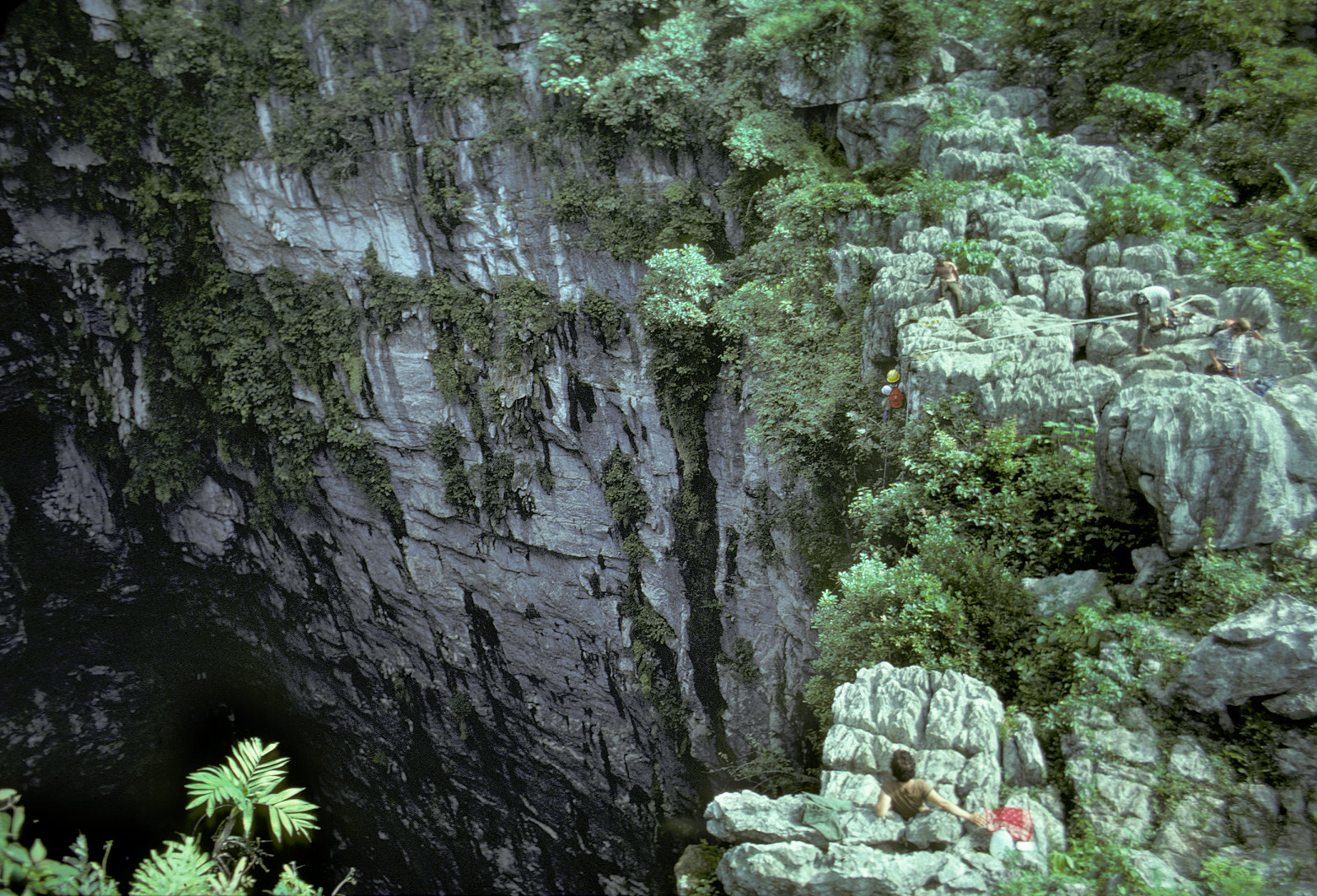
A sinkhole in San Luis Potosí, Mexico.
Access
We haven't checked access for this place. Check the land manager's or local tourism site for hours, fees and closures, and stay off private or closed land.
Safety & respect
Stay on marked paths and behind barriers. Ground near caves, sinkholes, geysers and cliffs can be unstable or hot.
Lore note
The Cave of Swallows, also called the Cave of the Swallows (Spanish: Sótano de las Golondrinas), is an open-air pit cave in the municipality of Aquismón, San Luis Potosí, Mexico. The elliptical mouth, on a slope of karst, is 49 by 62 m (161 by 203 ft) wide and is undercut around all of its perimeter, widening to a room approximately 303 by 135 m (994 by 443 ft) wide. The floor of the cave is a 333 m (1,093 ft) freefall drop from the lowest side of the opening, with a 370 m (1,210 ft) drop from the highest side, making it the largest known cave shaft in the world, the second deepest pit in Mexico and perhaps the 11th deepest sheer drop in the world.
Map links
Official / public map link · Approx. 21.5997, -99.0989: feature coordinate, not a checked entrance · Pin source: Wikipedia article coordinates, cross-checked against Wikidata Q1688770 P625 (within 2 km)
Sources
- Wikipedia, Cave of Swallows (CC BY-SA 4.0; read 1 Nov 2026): https://en.wikipedia.org/wiki/Cave_of_Swallows
- Wikidata, Q1688770 (coordinate location P625, country P17; read 1 Nov 2026): https://www.wikidata.org/wiki/Q1688770
The Cave of Swallows, also called the Cave of the Swallows (Spanish: Sótano de las Golondrinas), is an open-air pit cave in the municipality of Aquismón, San Luis Potosí, Mexico. The elliptical mouth, on a slope of karst, is 49 by 62 m (161 by 203 ft) wide and is undercut around all of its perimeter, widening to a room approximately 303 by 135 m (994 by 443 ft) wide. The floor of the cave is a 333 m (1,093 ft) freefall drop from the lowest side of the opening, with a 370 m (1,210 ft) drop from the highest side, making it the largest known cave shaft in the world, the second deepest pit in Mexico and perhaps the 11th deepest sheer drop in the world.
This entry is part of our world atlas. The summary above is adapted from the Wikipedia article (CC BY-SA 4.0), and the map pin uses the coordinates published there, cross-checked against Wikidata. We haven’t visited this place or checked current access.