Feature reference (not a verified entrance)
Haʻamonga ʻa Maui
Last reviewed: not yet Next review
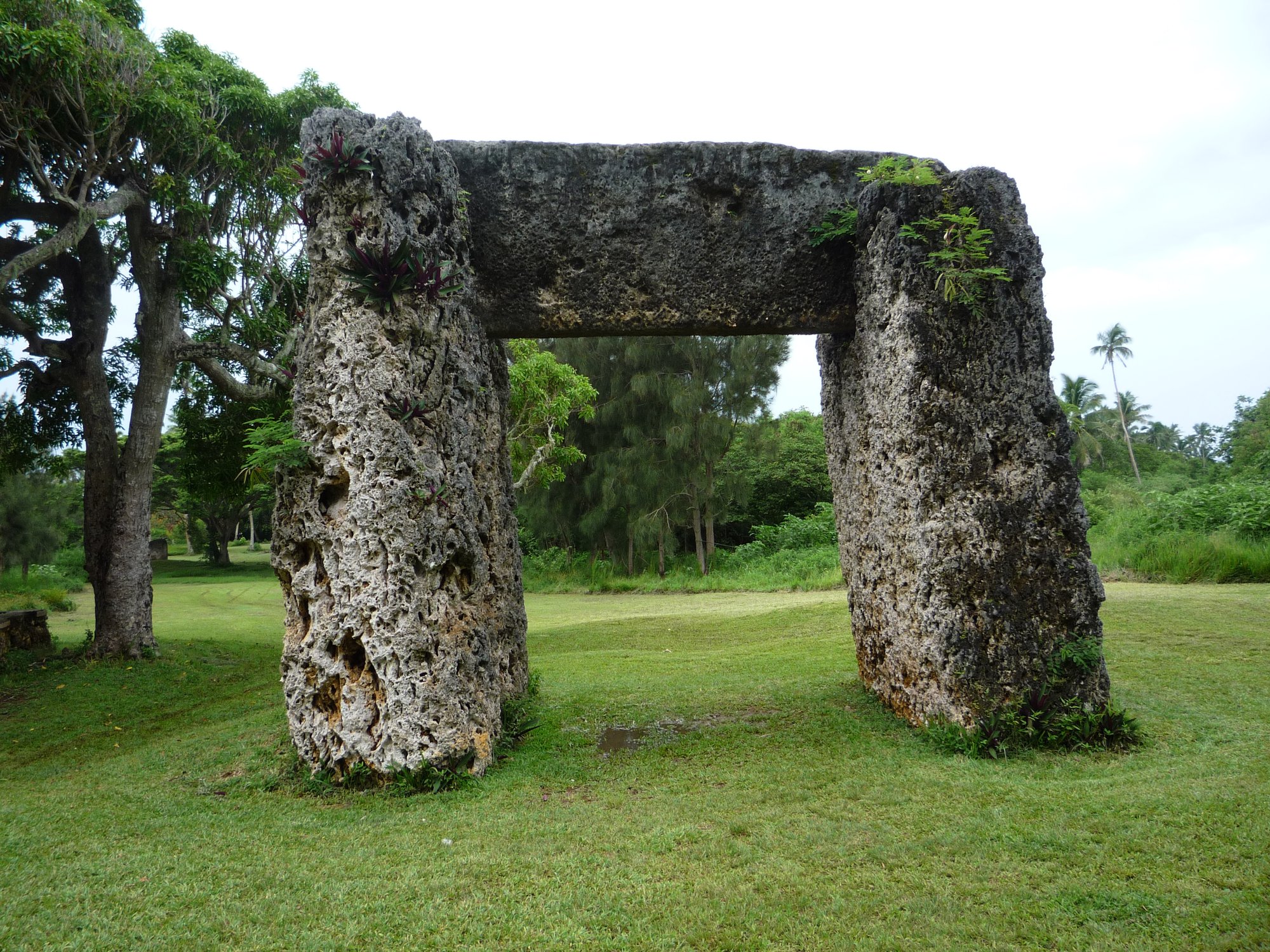
A 13th-century coral limestone trilithon on Tongatapu, nicknamed the Stonehenge of the Pacific and once credited to the hero Maui.
Access
We haven't checked access for this place. Check the land manager's or local tourism site for hours, fees and closures, and stay off private or closed land.
Safety & respect
Stay on marked paths and behind barriers. Ground near caves, sinkholes, geysers and cliffs can be unstable or hot.
Lore note
Haʻamonga ʻa Maui, the Burden of Maui, is a gateway of three coral limestone slabs about 5.2 m high and 5.8 m long, with the lintel seated in deep mortises cut into the uprights. The visible part of each upright is thought to weigh 30 to 40 tons. Historians date it to about 1200 and the reign of Tuʻitātui, the eleventh Tuʻi Tonga, who is said to have raised it in honor of his two sons. Tradition held the stones too heavy for mortals, so the hero Maui was believed to have carried them by canoe from ʻUvea. Some see it as pointing toward Pulotu, the place of the gods, and in 1967 King Tāufaʻāhau Tupou IV came to believe it had astronomical meaning.
Map links
Official / public map link · Approx. -21.1367, -175.0481: feature coordinate, not a checked entrance · Pin source: Wikipedia article coordinates, cross-checked against Wikidata Q1433433 P625 (within 2 km) · Wikidata, Wikipedia and OpenStreetMap agree within 0.01 km.
Sources
- Wikipedia, Haʻamonga ʻa Maui (CC BY-SA 4.0; read 12 Nov 2026): https://en.wikipedia.org/wiki/Ha%CA%BBamonga_%CA%BBa_Maui
- Wikidata, Q1433433 (coordinate location P625, country P17; read 12 Nov 2026): https://www.wikidata.org/wiki/Q1433433
Haʻamonga ʻa Maui, the Burden of Maui, is a gateway of three coral limestone slabs about 5.2 m high and 5.8 m long, with the lintel seated in deep mortises cut into the uprights. The visible part of each upright is thought to weigh 30 to 40 tons. Historians date it to about 1200 and the reign of Tuʻitātui, the eleventh Tuʻi Tonga, who is said to have raised it in honor of his two sons. Tradition held the stones too heavy for mortals, so the hero Maui was believed to have carried them by canoe from ʻUvea. Some see it as pointing toward Pulotu, the place of the gods, and in 1967 King Tāufaʻāhau Tupou IV came to believe it had astronomical meaning.
This entry is part of our world atlas. The summary above is written in our own words from the Wikipedia article, and the map pin uses published coordinates cross-checked against Wikidata. We haven’t visited this place or checked current access.