Feature reference (not a verified entrance)
Rano Raraku
Last reviewed: not yet Next review
A crater lake in Isla de Pascua, Chile.
Access
We haven't checked access for this place. Check the land manager's or local tourism site for hours, fees and closures, and stay off private or closed land.
Safety & respect
Stay on marked paths and behind barriers. Ground near caves, sinkholes, geysers and cliffs can be unstable or hot. Rapa Nui moai quarry: cultural/heritage warning; not a rights failure.
Lore note
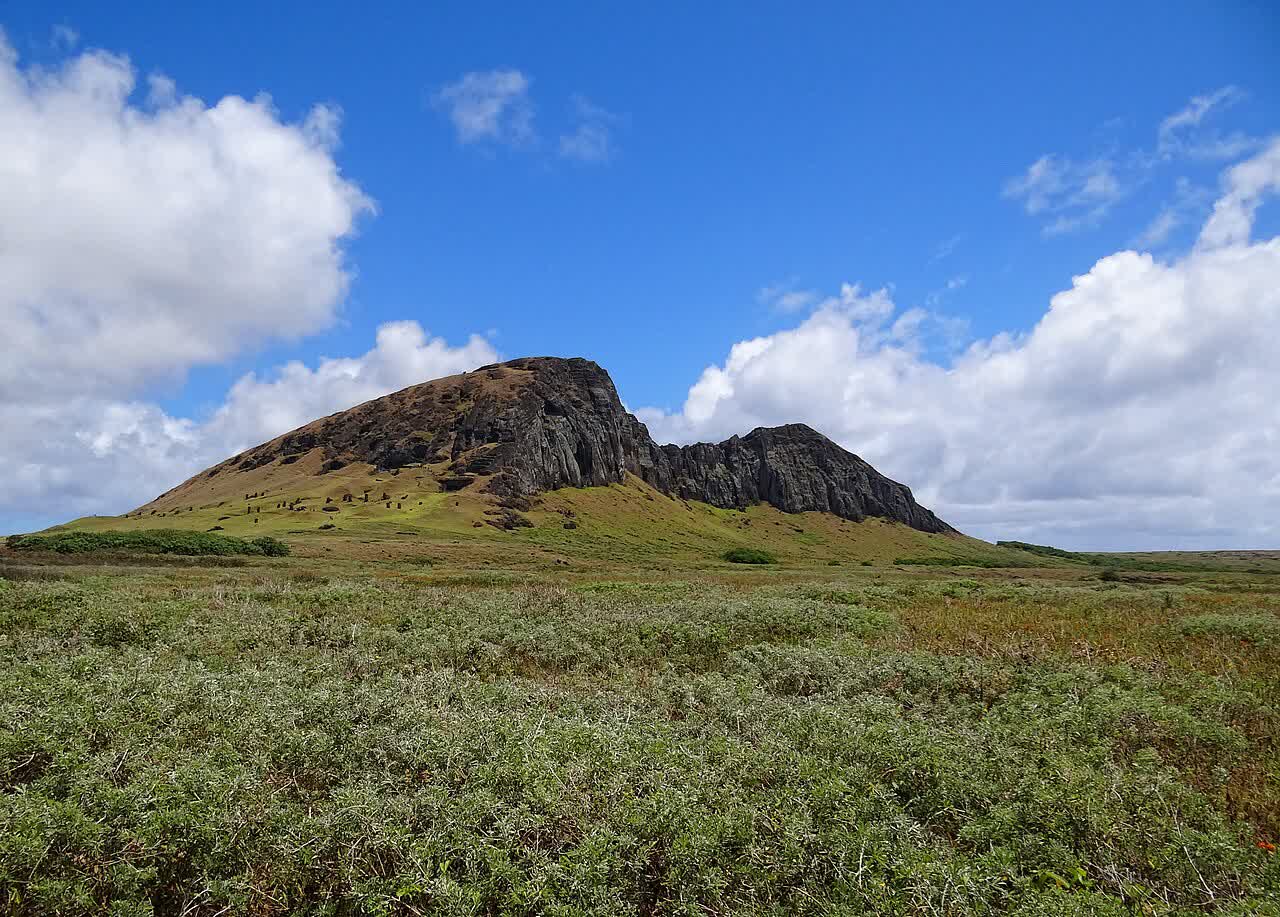
Rano Raraku (Rapa Nui: [ˈɾano ɾaˈɾaku], Spanish: [ˈrano raˈɾaku]) is a volcanic crater formed of consolidated volcanic ash, or tuff, and located on the lower slopes of Terevaka in the Rapa Nui National Park on Easter Island in Chile. It was a quarry for about 500 years until the early eighteenth century, and supplied the stone from which about 95% of the island's known monolithic sculptures (moai) were carved. Rano Raraku is a visual record of moai design vocabulary and technological innovation, where 887 moai remain.
Map links
Official / public map link · Approx. -27.1239, -109.2861: feature coordinate, not a checked entrance · Pin source: Wikipedia article coordinates, cross-checked against Wikidata Q937167 P625 (within 2 km)
Sources
- Wikipedia, Rano Raraku (CC BY-SA 4.0; read 1 Nov 2026): https://en.wikipedia.org/wiki/Rano_Raraku
- Wikidata, Q937167 (coordinate location P625, country P17; read 1 Nov 2026): https://www.wikidata.org/wiki/Q937167
Rano Raraku (Rapa Nui: [ˈɾano ɾaˈɾaku], Spanish: [ˈrano raˈɾaku]) is a volcanic crater formed of consolidated volcanic ash, or tuff, and located on the lower slopes of Terevaka in the Rapa Nui National Park on Easter Island in Chile. It was a quarry for about 500 years until the early eighteenth century, and supplied the stone from which about 95% of the island’s known monolithic sculptures (moai) were carved. Rano Raraku is a visual record of moai design vocabulary and technological innovation, where 887 moai remain.
This entry is part of our world atlas. The summary above is adapted from the Wikipedia article (CC BY-SA 4.0), and the map pin uses the coordinates published there, cross-checked against Wikidata. We haven’t visited this place or checked current access.