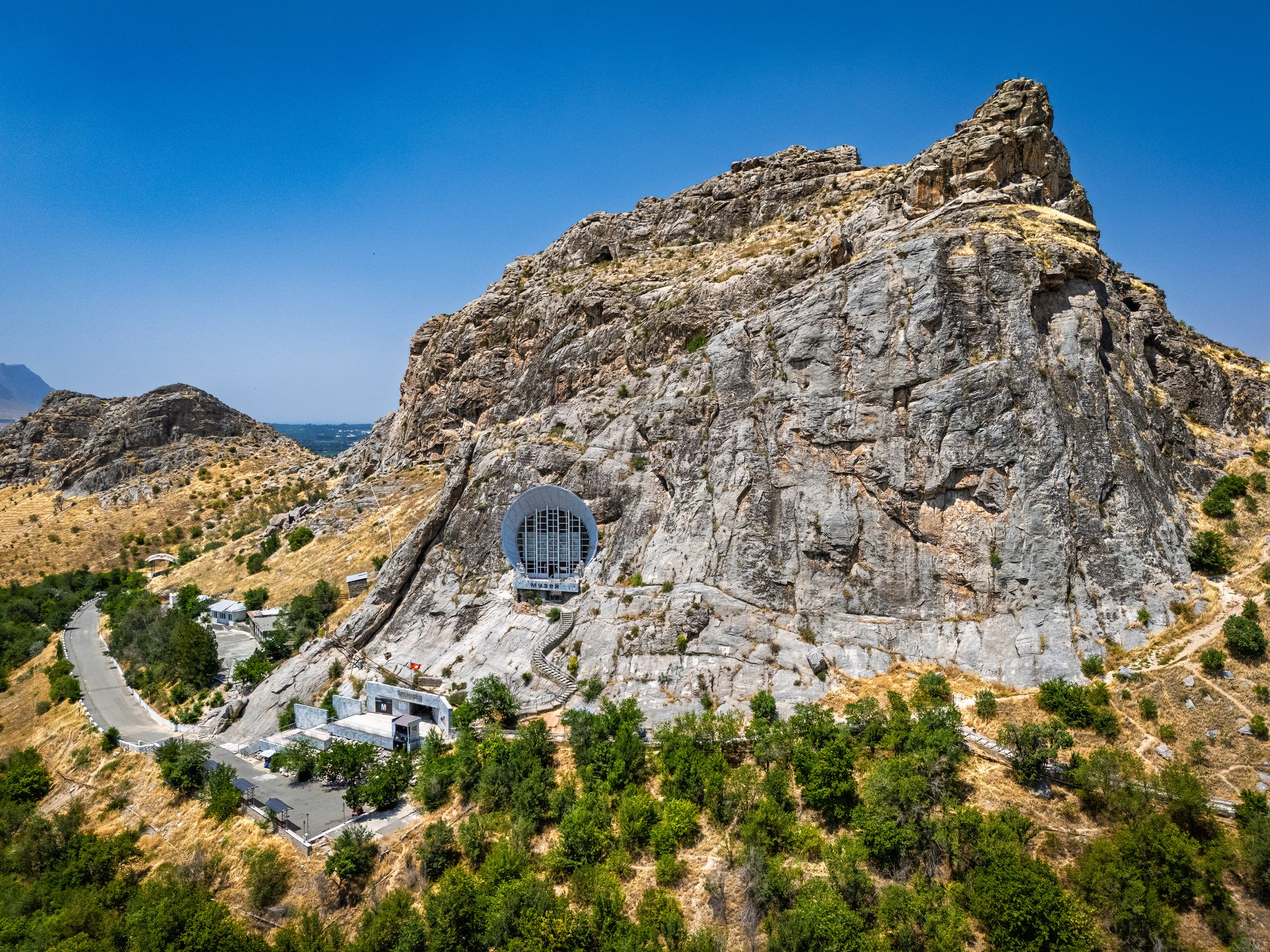
Sulaiman-Too
Last reviewed: not yet Next review
A rocky sacred mountain rising out of the city of Osh, worshipped for thousands of years and possibly Ptolemy's Silk Road Stone Tower.
Access
We haven't checked access for this place. Check the land manager's or local tourism site for hours, fees and closures, and stay off private or closed land.
Safety & respect
Stay on marked paths and behind barriers. Ground near caves, sinkholes, geysers and cliffs can be unstable or hot. Sacred site: cultural warning. Respect religious use, dress and behave as local custom asks, and photograph people or rites only with permission.
Lore note
Sulaiman-Too is Kyrgyzstan's only World Heritage Site wholly inside the country. UNESCO calls it the most complete example of a sacred mountain anywhere in Central Asia, worshipped over several millennia, first as a pre-Islamic pilgrimage site. A shrine on top is said to mark the grave of the prophet Sulayman, and women crawl through a hole in a holy rock there in hope of healthy children. Some historians think it is the Stone Tower that Ptolemy named as the midpoint of the Silk Road.
Sources
- Wikipedia, Sulayman Mountain (CC BY-SA 4.0; read 12 Nov 2026): https://en.wikipedia.org/wiki/Sulayman_Mountain
- Wikidata, Q750190 (coordinate location P625, country P17; read 12 Nov 2026): https://www.wikidata.org/wiki/Q750190
Sulaiman-Too is Kyrgyzstan’s only World Heritage Site wholly inside the country. UNESCO calls it the most complete example of a sacred mountain anywhere in Central Asia, worshipped over several millennia, first as a pre-Islamic pilgrimage site. A shrine on top is said to mark the grave of the prophet Sulayman, and women crawl through a hole in a holy rock there in hope of healthy children. Some historians think it is the Stone Tower that Ptolemy named as the midpoint of the Silk Road.
This entry is part of our world atlas. The summary above is written in our own words from the Wikipedia article, with details checked against Wikidata. It is not shown on the site map. Sacred mountain and active pilgrimage site: no pin, by our sacred-site convention. We haven’t visited this place or checked current access.