Trailhead / site map
Marfa Lights Viewing Area (US 90)
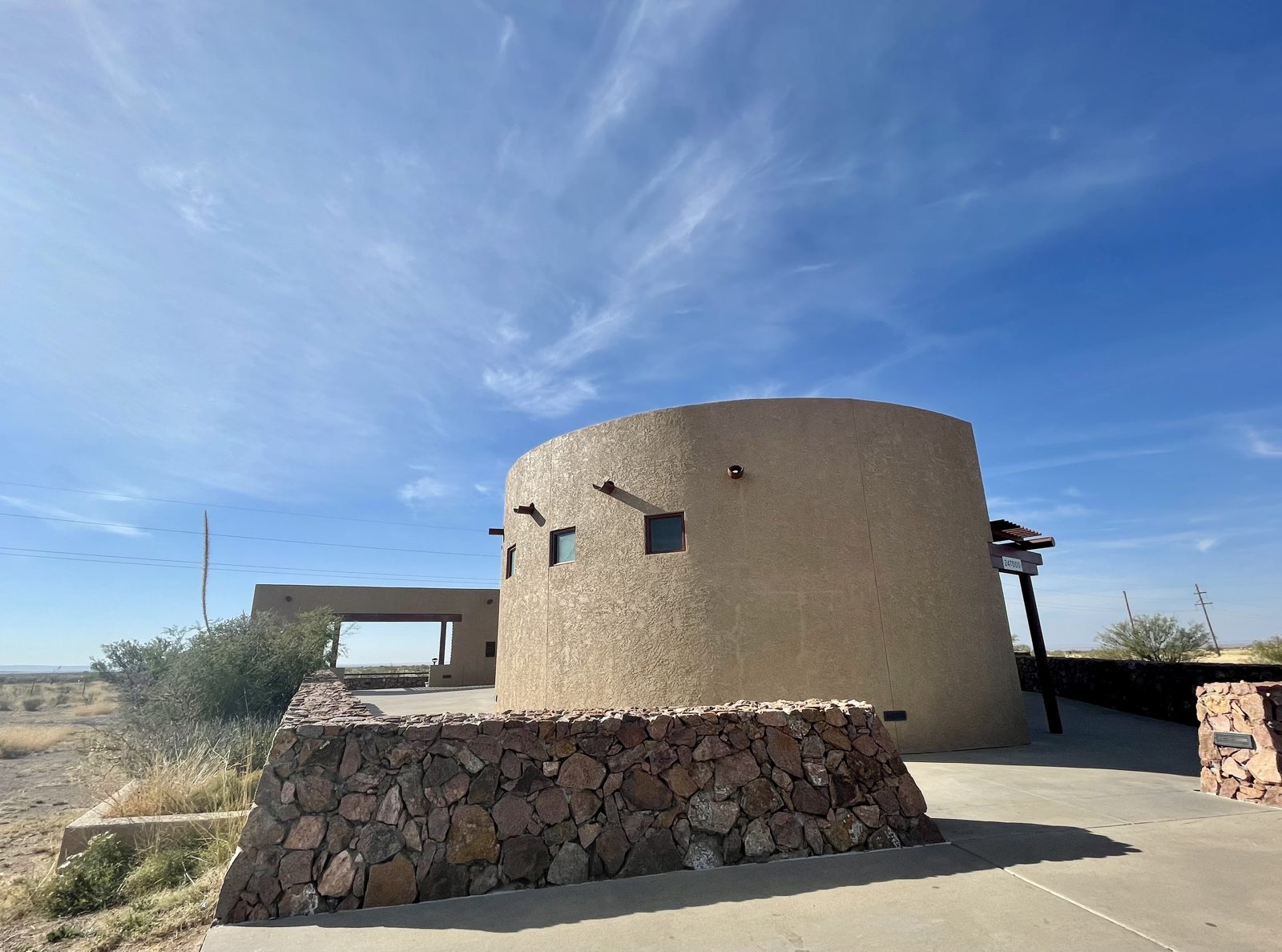
The official roadside viewing area for the Marfa Lights, 9 miles east of Marfa on US 90 toward Alpine. It's free, open after dark, and faces the stretch of horizon where student physicists showed in 2004 that at least some of the lights were car headlights on US 67.
Access
Roadside viewing area built by the Texas Department of Transportation, with a viewing center added in 2003 (Handbook of Texas). Visit Marfa calls it the official Marfa Lights Viewing Area, 9 miles east of town on US 90 toward Alpine. Free; parking, restrooms, viewing platform. Visit Marfa Visitor Center, 302 S. Highland Ave., Marfa, (432) 729-4772, for current conditions. No camping facilities are advertised by Visit Marfa or TSHA. As of Oct 2026, check with the visitor center before planning a late-night stop. No decimal pin is given because no agency publishes one; the map uses a place search.
Safety & respect
US 90 is a high-speed rural highway with little lighting. Slow down well before the turn-in, and don't stop on the shoulder to look for lights. Watch for deer, javelina and livestock on the road at night. Desert nights get cold, even after hot days, and the area is remote, so carry water and a full tank. Stay at the viewing area: the land toward the lights is private ranch land, and this page gives no route onto it.
Lore note
The Handbook of Texas traces settler accounts of unexplained lights near Paisano Pass to the 1880s and lists explanations offered over the years, from electrostatic discharge to mica, concluding that the most plausible is a mirage-like bending of light between warm and cold air layers. Visit Marfa promotes the lights as a mystery and hosts an annual Marfa Lights Festival.
Map links
Open in Google Maps (street-address search — not a published decimal pin)
Sources
- Visit Marfa — Marfa Lights (official viewing area location, festival): https://visitmarfa.com/mystery
- Julia Cauble Smith, “Marfa Lights,” Handbook of Texas Online, Texas State Historical Association (rev. 7 Sep 2017): https://www.tshaonline.org/handbook/entries/marfa-lights
- Society of Physics Students, University of Texas at Dallas (A. Stolyarov, J. Klenzing, P. Roddy; R. A. Heelis, adviser), “An Experimental Analysis of the Marfa Lights,” progress report, 10 Dec 2005 (archived copy): http://web.archive.org/web/20150731052105/http://www.spsnational.org/wormhole/utd_sps_report.pdf
- J. Stephan, B. Ghimire, B. Stapleton, J. Bunnell, “Spectroscopy applied to observations of terrestrial light sources of uncertain origin,” American Journal of Physics 77, 697–703 (2009), doi 10.1119/1.3130609
Every clear night, people line up on the platform east of Marfa and look southeast toward the Chinati Mountains, waiting for lights to appear, split, merge and vanish on the horizon. Some nights they do. The question is what they are.
The 2004 student experiment
In May 2004 about a dozen members of the University of Texas at Dallas chapter of the Society of Physics Students spent several nights here running experiments. Their progress report, dated December 2005, describes three tests:
- Video. Two cameras at the viewing area filmed the lights over several nights. Played back at high speed, the lights that seemed random in real time moved left to right along a well-defined path and appeared and disappeared at the same points on the horizon.
- Traffic counts. A counter on US 67 south of Marfa, the highway to Presidio, logged cars per hour. Traffic fell off steadily through the night, just as the number of lights did.
- A chase car. A team parked on US 67 and flashed their headlights while in radio contact with the viewing area. From the platform, the chase car’s lights appeared in exactly the same part of the horizon as the “mystery lights” and looked comparable in brightness and color. The chase team, meanwhile, saw only ordinary car headlights where they were.
Their conclusion was that all the lights they reliably observed could be attributed to car headlights on US 67 between Marfa and Presidio.
Two cautions. This is a student progress report, not a peer-reviewed paper. It also gives its observation nights as 10–14 May 2004 in one place and “11 and 13 May 2005” in its conclusion. It shows that headlights on US 67 can produce Marfa lights. It doesn’t prove that every light ever reported here was a car.
The spectroscopy study
A more instrumented look came from James Stephan and colleagues, published in the American Journal of Physics in 2009. Over 20 nights they combined a telescope, a spectrometer, video and position logging. They report that the method could clearly identify “false positives such as distant streetlamps, automotive headlamps, and fires,” and that oxygen absorption in the spectrum could measure how far away a continuous-spectrum light source was. The ledger has read the abstract, not the full paper, so we don’t summarize any further findings here.
Ledger reading
Open. Headlights on US 67 demonstrably account for many of the lights seen from this platform, and the Handbook of Texas calls a mirage-type explanation the most plausible for the rest. People who have watched for decades say some lights behave differently, and no study the ledger has read rules that out.
Viewing notes
Arrive after full dark and give your eyes time to adjust. Look southeast. If you see a light, note the time and where it sits relative to the distant flashing tower. Visit Marfa’s own page frames the lights as an open mystery. The research above frames them as mostly explained. Both are worth knowing before you watch.