October 9, 1933: The Night the Dragon Woke Up Over Europe
On the evening of October 9, 1933, observers across Europe counted hundreds of meteors a minute, and in rural Portugal the sight caused real alarm. American observatories heard about it by telegraph while it was happening, watched their own skies that night, and saw nothing.
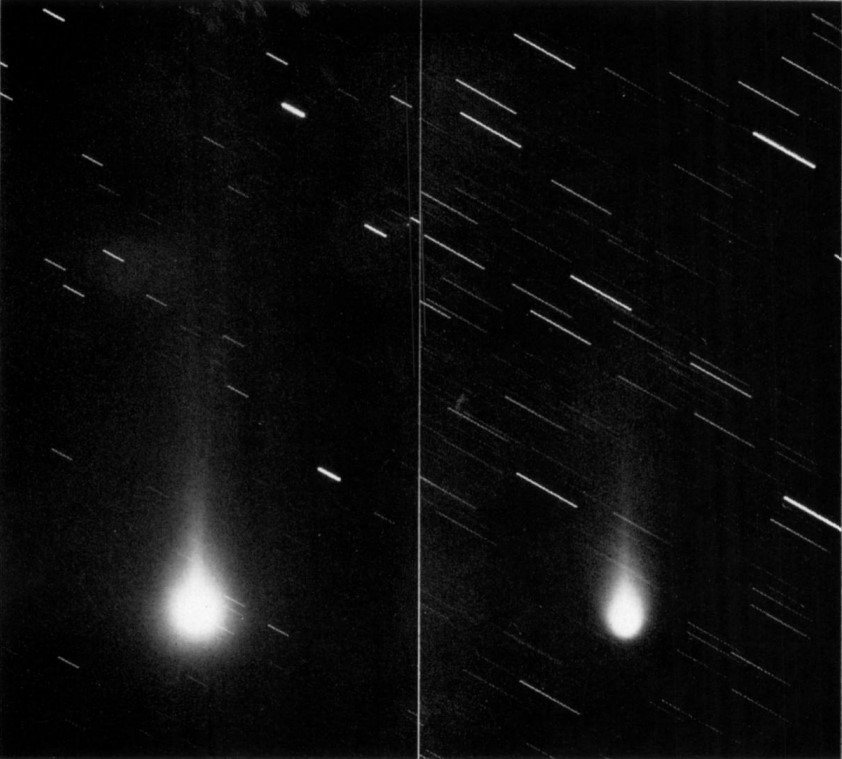
Sources Publications of the Astronomical Society of the Pacific 45 (1933), General Notes, “A brilliant meteor shower” (doi 10.1086/124386); EarthSky, Draconid meteor shower 2026 guide; comet photograph by Elizabeth Roemer, U.S. Naval Observatory, via PASP 72 (1960)
Most years the Draconids barely register. This Thursday evening, October 8, the shower peaks again, and the forecast is for a handful of slow meteors an hour (see the Sky Desk’s October viewing guide). But every so often this small shower turns into a storm, and the best documented of those came 93 years ago this week.
What happened
On the evening of October 9, 1933, between about 6:30 and 10 p.m. local time, a meteor shower of startling strength fell across western Europe. The Astronomical Society of the Pacific’s journal summed up the reports that autumn:
- At the Bergedorf observatory in Hamburg, observers counted 300 to 345 meteors a minute at the peak, and many of them were as bright as Venus.
- Stations from Leningrad to Lisbon reported displays almost as rich.
- In some country districts, especially in Portugal, the PASP note said, “the spectacle caused great alarm.”
That’s the anomaly part of this story. To people with no warning and no astronomy news, the sky suddenly filled with falling stars, many of them brilliant, for hours.
Explained within hours
The other part is how quickly it was explained. Astronomers traced the meteors back to a point, the radiant, in the constellation Draco, and immediately matched it to a weak shower seen from the same spot on the same date in 1926. That tied it to Comet Giacobini-Zinner, a small comet with a period of about six and a half years. The PASP note said the 1933 storm put the link “beyond question,” because the orbits of the comet and the meteor swarm matched closely.
The note also explained why 1933 was different from 1926. The comet’s orbit had been nudged until it crossed Earth’s path. In 1926 Earth reached the crossing point two months ahead of the comet, about 77 million miles away from it. On October 9, 1933, the comet was only about a million miles away, so Earth ran straight through the fresh, dense debris behind it.
The American side
There’s a footnote here that the Sky Desk likes. Thanks to the astronomical telegraph network, word of the storm reached observatories across America on the afternoon of October 9, while it was still going on in Europe. American astronomers kept watch as soon as it got dark. According to the PASP note, “no Draconids were seen at any American station.” By the time North America turned into the stream, Earth had passed through the dense part.
That’s a useful lesson for any sky event. A spectacular display can be real, dated, explained and over in a few hours, and someone a few time zones away can see nothing at all.
Will it happen again?
The comet is still in our neighborhood. EarthSky notes that 21P/Giacobini-Zinner passed perihelion in March 2025, and that the Draconids produced thousands of meteors an hour in 1933 and 1946. For 2026, EarthSky’s answer to “storm this year?” is “probably not … but you never know.” The predicted peak is around 6 p.m. Arizona time on Thursday, October 8, right at nightfall, and the moon is out of the way.
Ledger status
Cited. A real, alarming, well-measured event that was explained the same night. It belongs to the October Ledger and to the Sky Desk.
Sources
- “A brilliant meteor shower,” General Notes, Publications of the Astronomical Society of the Pacific 45 (1933), doi 10.1086/124386 — iopscience.iop.org. Cited as text. The journal page image isn’t reproduced.
- Bruce McClure, Deborah Byrd and Don Machholz, “Draconid meteor shower 2026: All you need to know,” EarthSky — earthsky.org
Evidence ledger
Each claim in this file, the source it rests on, and how well it holds up: 5 corroborated. What the labels mean.
| Claim | Source | Type · date | Status |
|---|---|---|---|
| On 9 Oct 1933 observers in Hamburg (Bergedorf) counted 300–345 meteors a minute at the peak. | “A brilliant meteor shower,” PASP 45, General Notes | scholarly · 1933 | corroborated |
| Stations from Leningrad to Lisbon reported nearly as rich displays, and the spectacle caused alarm in parts of Portugal. | PASP 45 (1933) | scholarly · 1933 | corroborated |
| The storm came from Comet Giacobini-Zinner, which was only about a million miles from the crossing point. | PASP 45 (1933) | scholarly · 1933 | corroborated |
| American observers watching that evening saw no Draconids. | PASP 45 (1933) | scholarly · 1933 | corroborated |
| The Draconids produced storms in 1933 and 1946, and the parent comet passed perihelion in March 2025. | EarthSky Draconid guide | secondary · 2026 | corroborated |
Discussion
Discussions activating. Per-case threads will embed here once the Giscus GitHub App is installed on the public satellite repo.
Meanwhile, join the conversation on GitHub Discussions: https://github.com/dclewis21/anomaly-ledger-community/discussions
CoS / D.C.: see Community guidelines and
SETUP.mdin the site repo for the one-click Giscus install.