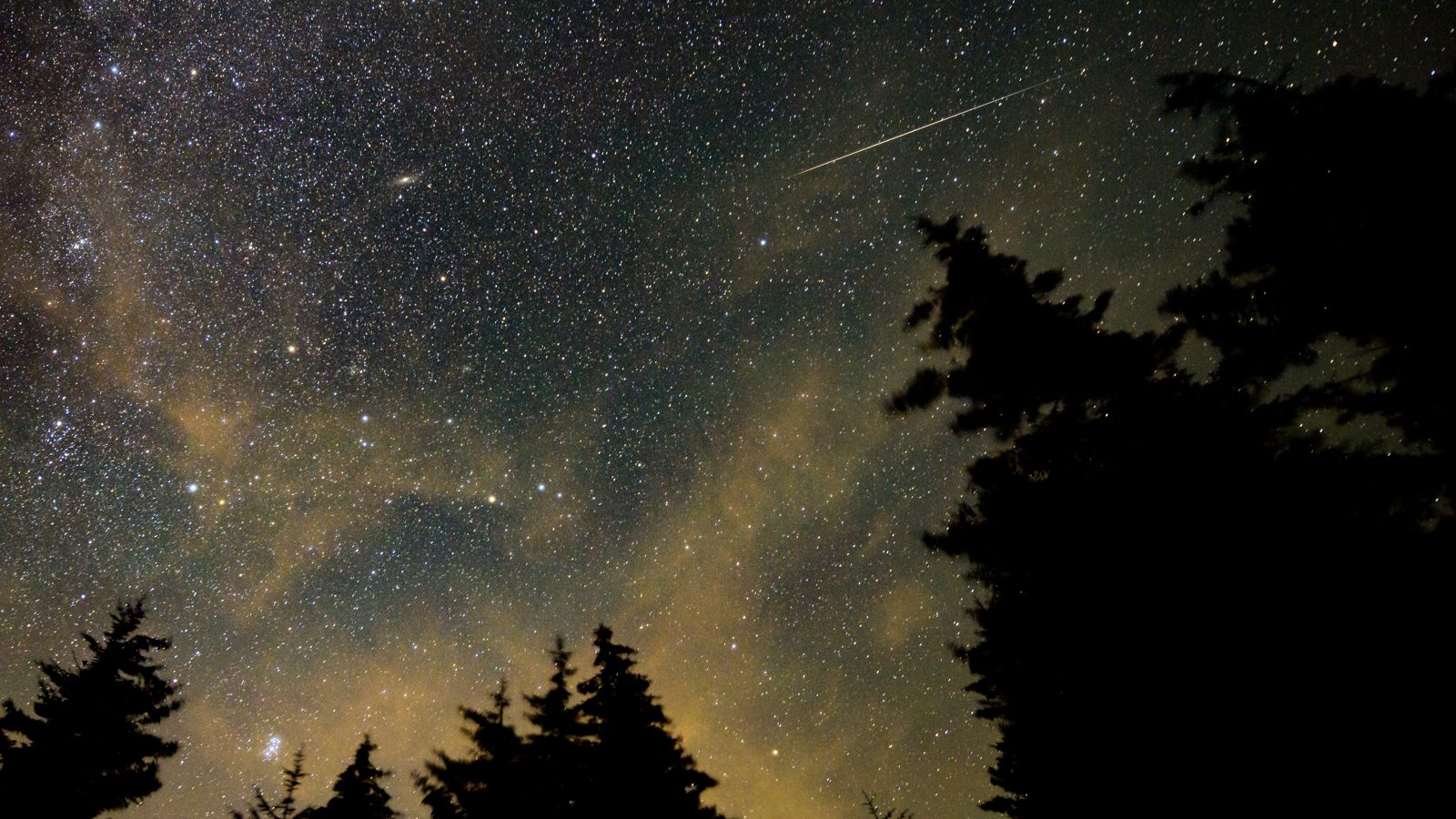
Meteor, Rocket or Satellite? A Field Guide for the Draconids and Orionids, October 2026
Two October meteor showers peak this month: the Draconids on the evening of October 8 and the Orionids before dawn around October 21–22. Here's when to look from Arizona, and how to tell a meteor or fireball from a rocket plume or a satellite.
Sources NASA Science, Orionids Meteor Shower fact page (2026 dates); EarthSky, Draconid meteor shower 2026 and Orionid meteor shower 2026 guides (peak times from the American Meteor Society and the RASC Observer’s Handbook); Jonathan McDowell, GCAT launch list
October brings two meteor showers, and with them a few reports of bright lights that a witness can’t place. This Sky Desk guide covers when to look from Arizona and what each kind of light usually looks like, so the next one gets sorted quickly.
All times are Arizona time (MST, UTC−7). Peak predictions are just predictions, and showers can come early, late or weak.
The Draconids: evening of Thursday, October 8
- Predicted peak: about 01:00 UTC on October 9, which is about 6 p.m. MST on October 8, right around nightfall in Arizona (EarthSky, using American Meteor Society predictions).
- Best window: from dark on the evening of October 8 into the early hours of October 9. The Draconids are unusual because their radiant, in the head of Draco the Dragon in the northern sky, is highest at nightfall. That makes evening better than pre-dawn for this shower.
- Moon: new moon is October 10, so the sky will be dark (EarthSky).
- What to expect: usually only a handful of slow meteors an hour. EarthSky suggests about 10 an hour under ideal skies. The shower is famous for rare storms, though. The parent comet, 21P/Giacobini-Zinner, last passed perihelion in March 2025, and EarthSky says a storm in 2026 is “probably not” likely, but not out of the question. The 1933 and 1946 returns produced thousands of meteors an hour.
- Active: roughly October 6–10.
The Orionids: before dawn, Wednesday–Thursday, October 21–22
- Peak night: October 21–22, according to NASA. The RASC Observer’s Handbook puts the peak at 18:00 UTC on October 21 (11 a.m. MST), which is daytime here, but the Orionids have a broad peak lasting several nights, so the mornings of October 21 and 22 are both worth trying (EarthSky).
- Best window: the dark hours before dawn. A bright waxing gibbous moon lights the sky for much of the night but sets a few hours before dawn on the peak mornings. Full moon is October 25–26.
- What to expect: about 10 to 20 meteors an hour under dark skies (NASA, EarthSky).
- Speed: very fast, about 66 km/s (41 miles per second), according to NASA. Fast meteors often leave glowing trains that last a few seconds, and NASA notes they can “sometimes become fireballs.”
- Parent: Halley’s Comet (1P/Halley). The shower is active from October 2 to November 7, 2026, per NASA.
- Radiant: just north of Betelgeuse in Orion, which rises in the east before midnight. You don’t need to face it. Meteors appear all over the sky.
Meteor, fireball, rocket or satellite?
A fireball is a very bright meteor. It’s still a speck of comet or asteroid material burning up, just bigger or faster. Because fireballs are rare, bright and sometimes colored or fragmenting, they’re one of the classic sources of “UAP” reports. Here’s how the common candidates usually differ:
| What you saw | Meteor or fireball | Rocket launch plume | Satellite or ISS |
|---|---|---|---|
| How long | A second or two, maybe a few seconds for a big fireball. A train can glow for seconds to minutes afterward. | Several minutes of motion, and the glowing cloud can hang in the sky much longer. Arizona observers saw the September 2025 plume linger for close to an hour. | Several minutes of steady travel. |
| Shape | A streak, sometimes breaking into pieces. | A bright point with an expanding fan, spiral or “jellyfish” cloud. | A steady point of light, with no tail. |
| Time of day | Any time it’s dark. Showers have predictable nights. | Usually within an hour or so of sunset or sunrise, when the plume is sunlit but the ground is dark. | Mostly in the first hours after dusk or before dawn. |
| How to check | Shower calendar (above). Reports from many places at once. | Look up the time in a public launch log such as Jonathan McDowell’s GCAT. | Public satellite trackers such as CelesTrak. |
Two cautions. First, distance is very hard to judge at night, and a bright meteor that seems to come down “just over the hill” is usually much farther away. Second, cameras exaggerate. Long exposures turn satellites into streaks and plane lights into lines. The table is a starting point, not a verdict.
Watching safely
Pick a legal, public, dark spot. Designated recreation areas and state parks with night access work well, but check gate hours and fire restrictions first. Bring layers, since October desert nights cool off fast. Give your eyes time to adjust to the dark, and keep the phone screen off. Don’t pull over on a highway shoulder to watch.
Ledger status
Cited. This is an explainer, not a case. It sits on the Sky Desk as the meteor half of the “was it a rocket?” check, alongside Iridium-4 (2017) and Starlink 11-20 (2025).
Sources
- NASA Science, “Orionids Meteor Shower” fact page (active Oct 2–Nov 7, 2026; peak night Oct 21–22; ~66 km/s; parent 1P/Halley; “fast meteors can also sometimes become fireballs”) — science.nasa.gov
- Bruce McClure, Deborah Byrd and Don Machholz, “Draconid meteor shower 2026: All you need to know,” EarthSky (peak 1 UTC Oct 9 per American Meteor Society; new moon Oct 10; 1933 and 1946 storms) — earthsky.org
- Deborah Byrd, “Orionid meteor shower 2026: All you need to know,” EarthSky (peak 18 UTC Oct 21 per RASC Observer’s Handbook; broad maximum; moon sets before dawn) — earthsky.org
- Jonathan McDowell, General Catalog of Artificial Space Objects (GCAT), launch list — planet4589.org
- CelesTrak (public satellite orbital data) — celestrak.org
Evidence ledger
Each claim in this file, the source it rests on, and how well it holds up: 4 corroborated · 1 unverified. What the labels mean.
| Claim | Source | Type · date | Status |
|---|---|---|---|
| The 2026 Draconid peak is predicted for about 01:00 UTC on 9 Oct, about 6 p.m. MST on 8 Oct.A prediction; showers can run early, late or weak. | EarthSky Draconid guide (American Meteor Society prediction) | secondary · 2026 | corroborated |
| New moon on 10 Oct 2026 leaves a dark sky for the Draconids. | EarthSky Draconid guide | secondary · 2026 | corroborated |
| The Orionids are active 2 Oct–7 Nov 2026, peak the night of 21–22 Oct, and hit the atmosphere at about 66 km/s. | NASA Science, Orionids fact page | official · 2026 | corroborated |
| The Orionid peak falls at 18:00 UTC on 21 Oct, with a broad maximum. | EarthSky Orionid guide (RASC Observer's Handbook) | secondary · 2026 | corroborated |
| A Draconid storm is likely in 2026.EarthSky's answer is “probably not … but you never know.” | EarthSky Draconid guide | secondary · 2026 | unverified |
Discussion
Discussions activating. Per-case threads will embed here once the Giscus GitHub App is installed on the public satellite repo.
Meanwhile, join the conversation on GitHub Discussions: https://github.com/dclewis21/anomaly-ledger-community/discussions
CoS / D.C.: see Community guidelines and
SETUP.mdin the site repo for the one-click Giscus install.