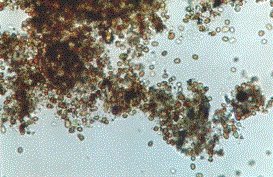
The evidence: Photomicrograph of the red-rain particles
Kerala Red Rain, 2001: Blood-Colored Rain and Alien Cells
Last reviewed Next review
We review and update every article weekly. When the record changes, so does the article. How we review
For two months in 2001 parts of Kerala, India, got rain colored red.
Verdict: The red color came from algal spores, not alien cells.
Sources Centre for Earth Science Studies & Tropical Botanic Garden and Research Institute, report for the Government of India (Nov 2001); G. Louis & A. S. Kumar, Astrophysics and Space Science 302 (2006) 175, doi 10.1007/s10509-005-9025-4; Wikipedia, 'Red rain in Kerala'
On 25 July 2001 people in Kottayam and Idukki districts of Kerala found their rainwater colored red, like diluted blood. Over the next two months red, and sometimes yellow, green or black, rain fell in patches across the state.
The government study
India’s Centre for Earth Science Studies first suspected dust from a meteor. Later analysis with the Tropical Botanic Garden and Research Institute found the particles were spores of Trentepohlia, a green alga that grows on trees and rocks in the area and turns orange-red. Why so many spores got into the rain at once is less clear.
The space theory
In 2006 physicists Godfrey Louis and A. Santhosh Kumar of Mahatma Gandhi University argued in Astrophysics and Space Science that the particles were cells from space, lacking DNA. The idea was promoted as evidence for panspermia but did not win acceptance, and in 2013 microbiologists Rajkumar Gangappa and Stuart Hogg showed DNA in the cells once the red pigment was extracted (Microbiology 159:107).
Sources
- Louis, G. & Kumar, A. S. (2006), “The Red Rain Phenomenon of Kerala and its Possible Extraterrestrial Origin,” Astrophysics and Space Science 302, 175 (the paper argues for an extraterrestrial origin; it is not a rebuttal): doi:10.1007/s10509-005-9025-4
- Gangappa, R. & Hogg, S. I. (2013), “DNA unmasked in the red rain cells of Kerala,” Microbiology 159, 107–111: doi:10.1099/mic.0.062711-0
- Wikipedia, “Red rain in Kerala”: en.wikipedia.org
Every image on this page is credited where it appears.
Verdict
Explained The red color came from algal spores, not alien cells.
Evidence ledger
Each claim in this file, the source it rests on, and how well it holds up: 2 corroborated · 1 disputed · 1 unverified. What the labels mean.
| Claim | Source | Type · date | Status |
|---|---|---|---|
| Red-colored rain fell sporadically in Kerala from 25 Jul to 23 Sep 2001. | Wikipedia, citing the CESS report | official · 2001 | corroborated |
| The color came from spores of the alga Trentepohlia, abundant locally. | Wikipedia, citing the CESS/TBGRI study (Sampath et al.) | official · 2001 | corroborated |
| The particles are extraterrestrial cells without DNA.This is the paper making the claim, not a rebuttal. Gangappa & Hogg (2013) found DNA after extracting the pigment. | Louis & Kumar (2006); rebutted by Gangappa & Hogg (2013) | scholarly · 2006 | disputed |
| A meteor airburst delivered the particles. | Louis & Kumar | scholarly · 2006 | unverified |
Update log
-
We added this case file.
-
Correction: we had said later studies identified algal DNA without a source. The study we found, Gangappa & Hogg (2013), showed DNA in the red-rain cells. It did not name an alga, so we now say only that.
Sources Gangappa & Hogg, Microbiology 159 (2013) 107, doi:10.1099/mic.0.062711-0
-
Weekly re-check of sources; no newer change to the record. Next check November 23, 2026.
Discussion
Discuss this case on the on-site Community board — no GitHub account required. Prefer a private tip for the editorial team? Submit a Sighting.
House rules: Community guidelines.