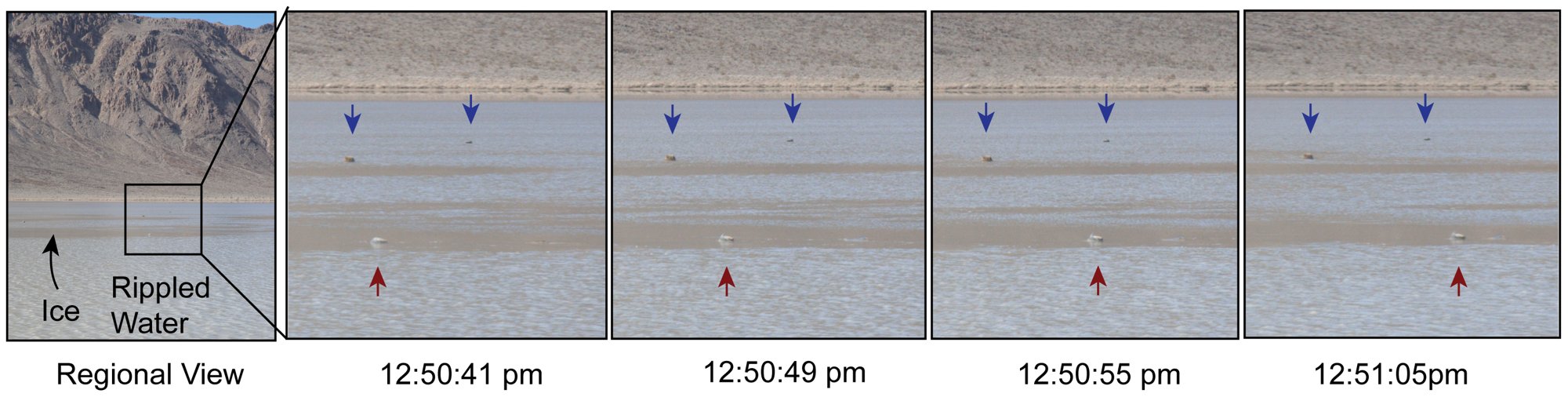
The evidence: Time-lapse frames of a rock sliding across the flooded Racetrack Playa, 9 January 2014
The Sliding Rocks of Racetrack Playa: Caught Moving at Last, Winter 2013
Last reviewed Next review
We review and update every article weekly. When the record changes, so does the article. How we review
For decades rocks on a dry lake in Death Valley left long trails and nobody saw one move. In 2013 a team finally watched it happen. We read what they recorded.
Verdict: The rocks are pushed by thin sheets of floating ice driven by light winds on the rare winters when the playa floods and freezes, and a research team filmed and GPS-tracked it happening in 2013 and 2014.
Original sources: Norris et al., 'Sliding Rocks on Racetrack Playa, Death Valley National Park: First Observation of Rocks in Motion', PLOS ONE 9(8): e105948 (2014) · Death Valley National Park (NPS), 'Mystery Solved: Mysterious sailing stones of Death Valley seen in action for the first time' (27 Aug 2014) · Reid et al., 'Sliding rocks at the Racetrack, Death Valley: What makes them move?', Geology 23 (1995): 819-822 · Sharp and Carey, 'Sliding stones, Racetrack Playa, California', GSA Bulletin 87, no. 12 (1976): 1704 (abstract)
Sources R. D. Norris, J. M. Norris, R. D. Lorenz, J. Ray and B. Jackson, 'Sliding Rocks on Racetrack Playa, Death Valley National Park: First Observation of Rocks in Motion', PLOS ONE 9(8): e105948 (2014); Death Valley National Park, National Park Service, news release of 27 August 2014; J. B. Reid Jr. et al., 'Sliding rocks at the Racetrack, Death Valley: What makes them move?', Geology 23 (1995): 819-822; R. P. Sharp and D. L. Carey, 'Sliding stones, Racetrack Playa, California', GSA Bulletin 87 (1976): 1704; Sharp, Carey, Reid, Polissar and Williams, Comment and Reply, Geology 24 (1996): 766-767
High in a remote valley of Death Valley National Park sits a dry lake bed so flat that a few centimeters of water will cover most of it. Scattered across its cracked mud are hundreds of rocks, some of them as heavy as 320 kilograms, and behind many of them run long, shallow grooves showing where they slid. Some grooves run side by side for hundreds of meters and turn together. For more than sixty years scientists argued about what moved the rocks, and in all that time nobody saw one move.
That changed in the winter of 2013. We read the paper in which the team that saw it reported what they recorded, the National Park Service’s announcement of the result, and two earlier studies that had reached opposite conclusions. The photograph at the top is the team’s own time-lapse of a rock in motion.
Sixty years of guessing
The paper dates the first report of the moving rocks to 1948 and says the question has been studied ever since. A 1995 paper in the journal Geology, by John Reid and students from Hampshire College and the University of Massachusetts, summed up where things stood: all the investigators agreed that wind was the force and that the playa had to be wet, but they did not agree on what else was needed.
One camp said wind alone could do it, if it blew hard enough over slick mud. Another said the rocks must be locked into sheets of ice that the wind pushed like rafts. The Reid team measured how hard it is to drag a rock across wet Racetrack mud and found the friction surprisingly high. By their reckoning, a 20 kilogram rock would need a sustained wind of about 80 meters per second near the ground, roughly 180 miles per hour. They also mapped tracks with a surveying instrument and found pairs of trails up to 830 meters apart with almost identical bends, which they took as a sign that the rocks had moved together, frozen into one huge sheet of ice.
The geologists Robert Sharp and Dwight Carey had argued the other way. They watched 30 marked stones for seven years and reported in 1976 that 28 of them moved, mostly during wet, stormy winters. In their best-known test they drove a ring of iron stakes into the playa around stones. One stone later slid out of the ring while another stayed inside, and they read that as evidence that the stones moved without a big ice sheet. In a 1996 exchange in Geology, Sharp and Carey congratulated the Reid team for showing that wind-driven ice sheets had carried some stones, but still held that many tracks were too delicate and too selective to have been made by ice sheets of any reasonable size.
The experiment nobody expected to work
In 2011 a team led by Richard Norris, a paleobiologist at the Scripps Institution of Oceanography, set up on the playa with Park Service permits. The Park Service could not let them use native rocks, so they brought in limestone blocks from outside the park and bored a hole in each for a motion-triggered GPS logger. They put a weather station beside the playa that logged the wind every second, and time-lapse cameras on the hills. The park’s release quotes one of the authors, Ralph Lorenz of Johns Hopkins University, who expected it to be “the most boring experiment ever.” Rocks there can sit still for a decade or more.
Two years in, they got lucky. A winter storm on 21 to 24 November 2013 dropped rain and about 20 centimeters of snow, and a shallow pond formed on the playa, about 10 centimeters at its deepest. It froze most nights. When Norris and his cousin James Norris arrived in December, the park’s release says they found the pond no more than seven centimeters deep.
What they saw
The paper describes the pattern. Rocks moved on sunny, clear days after nights below freezing. By late morning the sun had melted the ice enough for it to break up, with popping sounds across the pond, into floating panels tens of meters wide but only 3 to 6 millimeters thick. A steady light wind of about 4 to 5 meters per second (roughly 9 to 11 miles per hour) pushed the panels, and the panels pushed the rocks along the soft mud underneath. Ice piled up on the upwind side of some rocks, adding to the push.
The GPS rocks caught two events. On 4 December 2013 two of them, about 153 meters apart, started moving within six seconds of each other at 11:05 a.m., and each slid about 65 meters in 16 minutes. On 20 December a third slid 39 meters. That afternoon, as the wind pushed the water away, more than 60 fresh trails appeared on the south of the playa. Over the whole winter one instrumented rock traveled 224 meters in several moves. The photograph at the top is from 9 January 2014, when a rock slid for about 18 seconds at 1 to 2 meters a minute.
That speed is part of why the movement went unseen for so long. The GPS-tracked stones moved at about 2 to 5 meters a minute. The trails form under muddy water and only show up once the water drains or blows away. In the park’s release, James Norris said tourists may have seen it happen without realizing, because it is hard to tell a rock is moving when the rocks around it are moving too.
Why both old camps were partly right
The ice in the 2013 events was far too thin to float the rocks off the mud, so the idea of rocks lifted in thick ice was wrong. Hurricane-force wind was not needed either. But the old ice-sheet idea was close: large panels moving together can push widely spaced rocks along matching paths, as the Reid team had argued. The paper also offers an answer to the stake ring. Ice sheets crack, and a crack can separate two rocks only tens of centimeters apart. In the Sharp and Carey experiment there was a stake just upwind of the stone that stayed put, which may have shattered the ice before it reached it.
The team also found trails with no rock at the end, cut by grounded ice panels. The park’s release says the Park Service had suspected those were left by tourists who stole rocks.
Weighing it
We rate this explained. The mechanism was seen directly, photographed, and recorded by instruments, and it fits the decades of track measurements that came before. What stays uncertain is how often it happens and whether it always works the same way. The team’s cameras showed conditions like 2013 are rare, and the park’s release quotes Lorenz saying the rocks may move only about a millionth of the time and that movement may have become less frequent since the 1970s. Richard Norris added that they had not yet seen the biggest rocks move. The park also warns that the Racetrack is in a remote part of the park and that its road needs a high-clearance vehicle with heavy-duty tires.
Sources
- R. D. Norris, J. M. Norris, R. D. Lorenz, J. Ray and B. Jackson, “Sliding Rocks on Racetrack Playa, Death Valley National Park: First Observation of Rocks in Motion”, PLOS ONE 9(8): e105948 (27 Aug 2014), open access, CC BY (read 12 Nov 2026)
- Death Valley National Park, National Park Service, “Mystery Solved: Mysterious ‘sailing stones’ of Death Valley seen in action for the first time”, news release of 27 August 2014 (read 12 Nov 2026)
- J. B. Reid Jr., E. P. Bucklin, L. Copenagle, J. Kidder, S. M. Pack, P. J. Polissar and M. L. Williams, “Sliding rocks at the Racetrack, Death Valley: What makes them move?”, Geology 23, no. 9 (1995): 819-822, DOI 10.1130/0091-7613(1995)023<0819:SRATRD>2.3.CO;2 (read 12 Nov 2026)
- R. P. Sharp and D. L. Carey, “Sliding stones, Racetrack Playa, California”, GSA Bulletin 87, no. 12 (1976): 1704 (abstract read 12 Nov 2026)
- R. P. Sharp, D. L. Carey, J. B. Reid Jr., P. J. Polissar and M. L. Williams, “Sliding rocks at the Racetrack, Death Valley: What makes them move?: Comment and Reply”, Geology 24 (1996): 766-767, DOI 10.1130/0091-7613(1996)024<0766:SRATRD>2.3.CO;2 (read 12 Nov 2026)
- National Park Service, “A lone rock with its trail on the Racetrack playa” (header photo), Wikimedia Commons

Verdict
Explained The rocks are pushed by thin sheets of floating ice driven by light winds on the rare winters when the playa floods and freezes, and a research team filmed and GPS-tracked it happening in 2013 and 2014.
Update log
-
We added this case file.
-
Clarified the ice-fracture spacing and the wind speed to match the Norris et al. 2014 paper.
Sources https://journals.plos.org/plosone/article?id=10.1371/journal.pone.0105948
-
Corrected the GPS-tracked stones' speed to about 2 to 5 meters a minute, the range given in Norris et al. 2014; the 2 to 6 figure is from the park's release.
Sources https://journals.plos.org/plosone/article?id=10.1371/journal.pone.0105948
-
Weekly re-check of sources; no newer change to the record. Next check November 23, 2026.
Discussion
Discuss this case on the on-site Community board — no GitHub account required. Prefer a private tip for the editorial team? Submit a Sighting.
House rules: Community guidelines.