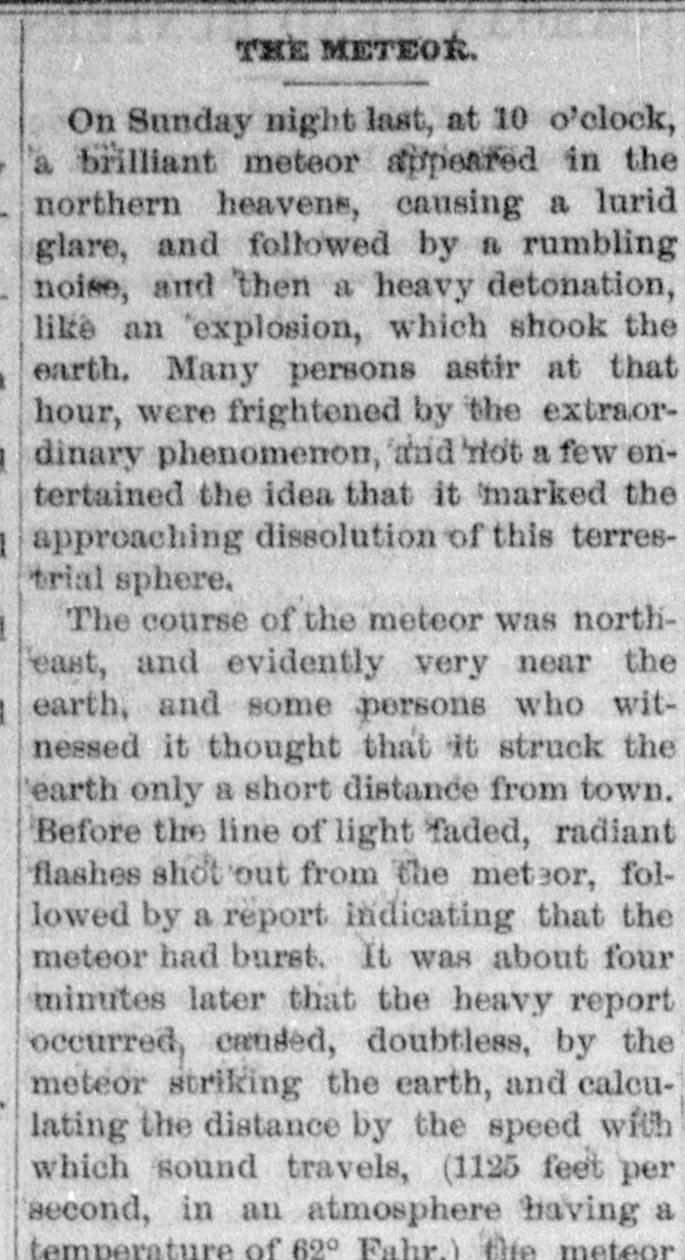
The Meteor Every Town Claimed, October 1894
At about ten on a Sunday night in October 1894, one brilliant fireball crossed Arizona Territory. Flagstaff saw it burst over the Elden mountains, Mesa “just this side of Superstition,” and Globe felt a detonation that “shook the earth.” Mohave County had it hit Wallapai mountain, and Tucson called it “the first dispatch from Mars.”
Sources Coconino Weekly Sun (Flagstaff), 11 Oct 1894, p.7; Mesa Free Press, 12 Oct 1894, p.3; Arizona Silver Belt (Globe), 13 Oct 1894, p.3; Arizona Weekly Citizen (Tucson), 13 Oct 1894, p.4; Mohave County Miner (Mineral Park), 13 Oct 1894, p.3; Arizona Republican (Phoenix), 18 Oct 1894, p.5 — all via Library of Congress, Chronicling America (OCR checked)
At about ten o’clock on the night of Sunday 7 October 1894, something lit up the sky over Arizona Territory. Over the next week, at least five local papers in towns hundreds of miles apart reported it, and each one placed it close to home.
This is a different event from the ledger’s Phoenix fireball of October 1906, twelve years later.
Five towns, one meteor
- Flagstaff. The Coconino Weekly Sun (11 Oct) said a meteor “flashed across the sky about 10 o’clock on Sunday night,” described by citizens as “larger than a whisky barrel.” It travelled from southwest to northeast and “seemed to burst when over the Elden mountains.”
- Mesa. The Mesa Free Press (12 Oct) called it “one of the most wonderful meteors ever seen here,” crossing from northwest to southeast. Its brilliance “lighted up the earth like a noonday sun,” and “just this side of Superstition it burst like a rocket into myriads of fragments.” The flight, the paper said, “was noiseless.”
- Globe. The Arizona Silver Belt (13 Oct) reported “a brilliant meteor” in the northern sky, “followed by a rumbling noise, and then a heavy detonation, like an explosion, which shook the earth.” The heavy report came “about four minutes later.” The paper worked out from the speed of sound that the meteor must have struck more than 50 miles away.
- Mohave County. The Mohave County Miner (13 Oct) said a large, brilliant meteor “collided with the topmost peak of Wallapai mountain Sunday night at 9:30,” with a display “unequalled by any ever before seen.”
- Tucson. The Arizona Weekly Citizen (13 Oct) said that “the first dispatch from Mars arrived last night,” in the shape of a heliograph message. “Others say it was only a meteor,” it added, which came across the heavens “like a million rockets in one.”
On 18 October the Phoenix Arizona Republican poked fun at the territorial papers calling it a comet, and noted that the meteor had been placed anywhere from five to fifty miles from each observer. “There is nothing on earth more delusive than the proximity of a meteor,” it said. A travelling man on a train near Tucson had seen “the same meteor” and heard “the same explosion,” and guessed it was “about ten or a hundred miles east of him.”
The Republican says “last Sunday night.” Read literally on 18 October, that would mean 14 October. Since the paper is answering the other territorial reports, the ledger reads it as the same event, but that’s an inference.
Folklore sidebar: Mars and the end of the world
The jokes were topical. In 1894 Mars was everywhere: Percival Lowell’s new observatory in Flagstaff was turned on the planet that year, and the same page of the Coconino Weekly Sun reports a visitors’ night at the observatory, where many citizens “climbed the hill to get a telescopic view of Mars and the moon.” So when Flagstaff residents called the fireball “the first signal from Mars,” and Tucson called it a dispatch, they were joking about the news of the day.
Globe’s reaction was less playful. The Silver Belt said many people were frightened, and “not a few entertained the idea that it marked the approaching dissolution of this terrestrial sphere.”
What it probably was
| Explanation | Assessment |
|---|---|
| One large, high fireball (bolide), seen across hundreds of miles, with a sonic boom heard near its path | Best fit. The same night and hour from Flagstaff, Mesa, Globe, Tucson and Mohave County. Every town thought it fell close by, which is typical of a high, bright fireball. Mesa heard nothing and Globe heard a delayed boom, which fits differing distances from the path. |
| Several separate meteors | Less likely, given the same hour in every town. |
| A comet | Rejected at the time by the Republican. |
| A signal from Mars | A joke of the period, not a claim. |
| A meteorite fall near any one town | No recovery was reported, and the reported directions conflict (southwest to northeast at Flagstaff, northwest to southeast at Mesa). No impact site can be worked out from these accounts. |
Ledger status
Explained: a single bright fireball. The sighting is well documented by independent papers, and the impact claims are unsupported. Filed as Cited, because the paper trail is the story.
Visiting
No map pin. The ledger doesn’t imply an impact site. For Flagstaff’s Mars connection, Lowell Observatory is open to the public; check its site for hours.
Sources
- Coconino Weekly Sun (Flagstaff), 11 Oct 1894, p.7 (OCR checked) — loc.gov
- Mesa Free Press, 12 Oct 1894, p.3 (OCR checked) — loc.gov
- Arizona Silver Belt (Globe), 13 Oct 1894, p.3, “The Meteor” (OCR checked) — loc.gov
- Arizona Weekly Citizen (Tucson), 13 Oct 1894, p.4 (OCR checked) — loc.gov
- Mohave County Miner (Mineral Park), 13 Oct 1894, p.3 (OCR checked) — loc.gov
- Arizona Republican (Phoenix), 18 Oct 1894, p.5 (OCR checked) — loc.gov
Evidence ledger
Each claim in this file, the source it rests on, and how well it holds up: 2 corroborated · 1 disputed · 2 debunked. What the labels mean.
| Claim | Source | Type · date | Status |
|---|---|---|---|
| A brilliant meteor was seen across Arizona Territory at about 10 p.m. on Sunday 7 Oct 1894.Five independent local papers, hundreds of miles apart, describe the same hour. Mohave County gives 9:30. | Coconino Weekly Sun, 11 Oct; Mesa Free Press, 12 Oct; Arizona Silver Belt, Arizona Weekly Citizen and Mohave County Miner, 13 Oct 1894 | period press · 11–13 Oct 1894 | corroborated |
| A heavy detonation followed about four minutes later at Globe.Consistent with a sonic boom from a large fireball. Mesa, farther from the path, called the flight “noiseless.” A traveller near Tucson also reported an explosion (Republican, 18 Oct). | Arizona Silver Belt, 13 Oct 1894, p.3 | period press · 13 Oct 1894 | corroborated |
| The meteor struck the earth near town (Flagstaff, Mesa, Globe or Wallapai mountain).Every town placed it close by, and the reported directions conflict. No meteorite recovery was reported. The ledger gives no impact site. | Coconino Weekly Sun; Mesa Free Press; Arizona Silver Belt; Mohave County Miner | period press · Oct 1894 | disputed |
| It was a comet.The Republican mocked the idea at the time. A comet doesn't cross the sky in seconds. | Arizona Republican, 18 Oct 1894, p.5 (reporting other papers) | period press · 18 Oct 1894 | debunked |
| It was a signal or dispatch from Mars.Period humour, in the year Mars fever arrived in Flagstaff. Not a claim anyone pressed. | Coconino Weekly Sun, 11 Oct 1894; Arizona Weekly Citizen, 13 Oct 1894 | period press · Oct 1894 | debunked |
Discussion
Discussions activating. Per-case threads will embed here once the Giscus GitHub App is installed on the public satellite repo.
Meanwhile, join the conversation on GitHub Discussions: https://github.com/dclewis21/anomaly-ledger-community/discussions
CoS / D.C.: see Community guidelines and
SETUP.mdin the site repo for the one-click Giscus install.