The Phoenix Fireball, October 1906
A golden-trailed fireball crossed the Salt River Valley at dinnertime on 6 October 1906 and broke up with a boom. Callers feared an explosion, the Weather Bureau observer timed it with his watch, and Tucson and Phoenix each said it passed right over them.
Sources Arizona Republican (Phoenix), 7 Oct 1906 p.3, 8 Oct 1906 p.6, 11 Oct 1906 p.5, 17 Oct 1906 p.10, 20 Oct 1906 p.7; Salt Lake Tribune, 7 Oct 1906 p.11; Arizona Silver Belt (Globe), 14 Oct 1906 p.8 — all via Library of Congress, Chronicling America
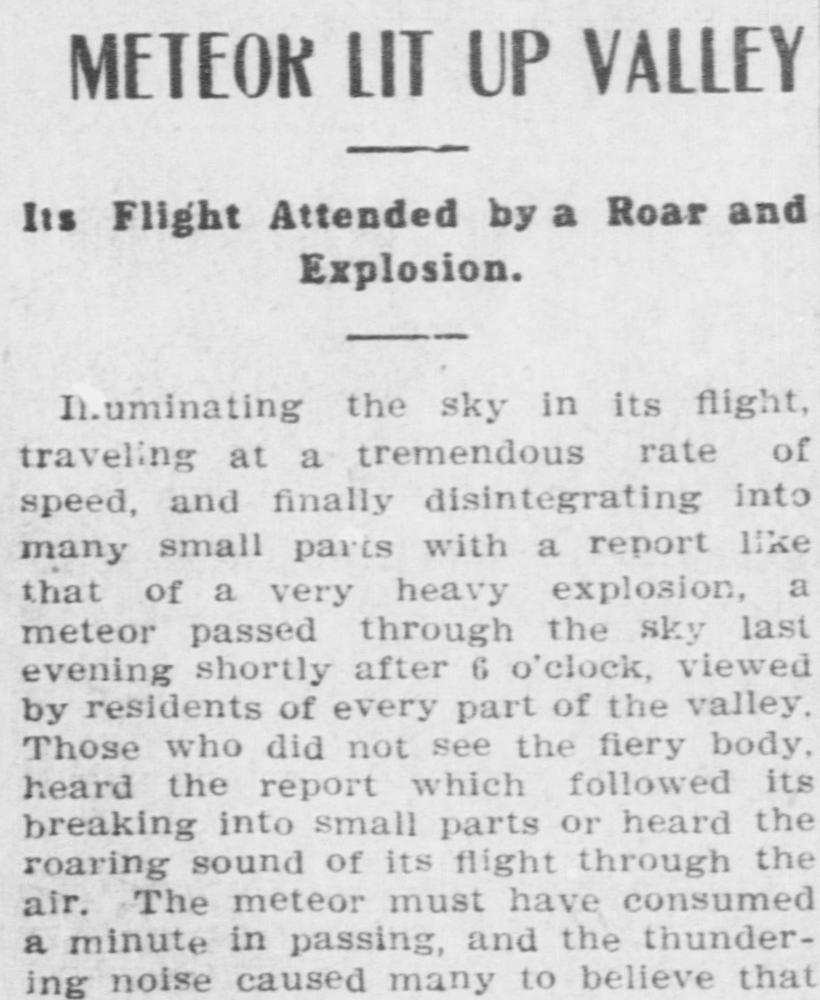
Shortly after six on a Saturday evening, 6 October 1906, a light crossed the Salt River Valley bright enough to bring people out of their houses. The next morning’s Arizona Republican ran it under the headline “Meteor Lit Up Valley,” with a sub-deck promising a roar and an explosion.
What the papers said
The first-day story reads like a town taking inventory. People across the valley had seen the light or heard the bang. Some phoned public offices because they thought something had blown up. One rancher called home to check on his stock.
On Monday the paper printed something better: a timed account from the local Weather Bureau director, Jesunofsky. He described a trail like a rocket’s, golden yellow, with the body throwing off balls of white light. By his watch the whole passage took about five seconds. Then, in his words, “About twelve seconds after the display a low rumbling noise, like thunder, was heard overhead.”
By Thursday the story had turned into an argument. Tucson papers placed the meteor between Tucson and the Rincon Mountains. Phoenix and Glendale people placed it between their two towns. The Republican drew the right lesson itself: the episode showed “the inaccuracy of the eye when anything short and sudden takes place.” A Phoenix man’s theory that it was a Russian bomb aimed at the czar was printed as the joke it was.
The news also travelled. A wire dispatch datelined Phoenix ran in the Salt Lake Tribune the next day, and Globe’s Arizona Silver Belt reprinted the opening a week later.
Added 4 Oct 2026. Letters kept coming. On 17 October the Republican printed “The Late Meteor,” a letter from O. F. Thornton at Schell Station (“a lonely desert station,” in the headline’s words), dated 12 October. Looking west from a window at about six, he saw “a fireball about the size of a large orange” sail toward Fish Creek and burst before reaching the hill. The next day a man camped between there and Roosevelt asked whether he’d seen the meteor, and that Sunday night a teamster in from Tortilla station asked the same; to each of them it seemed to explode. “How high was the meteor,” Thornton asked, “when so many observers so far apart all saw it shoot through the heavens and disintegrate?” On 20 October, under “Meteors to Burn,” the paper reported a second, smaller meteor seen on Thursday evening at about the same hour, and a reader’s “blood red star” in the southwest that turned out to be the red police signal light over city hall.
What it probably was
This is what a bright fireball (a bolide) looks like in a newspaper. It was short and brilliant, broke apart, and boomed. It was seen from towns more than 100 miles apart, and each town thought it passed overhead. That fits a large meteor coming in high over southern Arizona.
The numbers don’t all fit, though. The paper guessed the meteor was 50 to 60 miles up. Sound from that height would take minutes to arrive, not twelve seconds. Either the height, the timing or both are off, and one witness, Dr. Plath, put the gap at about a minute. We keep the disagreement visible rather than pick a number.
Ledger status
Marked cited (explained). The papers document a real, widely seen fireball and a delayed boom. There’s no mystery object here. It’s a good record of how people describe one.
Next checks: the Tucson papers the Republican cited, and any Weather Bureau Monthly Weather Review note for October 1906. No meteorite is known to be tied to this fall, and this file gives no “go look” location. Any fragments would be on private, state or tribal land.
Part of From the Archive, October 2026.
Sources
Library of Congress, Chronicling America (US newspapers, public domain):
- Arizona Republican, 7 Oct 1906, p.3, “Meteor Lit Up Valley” — loc.gov
- Arizona Republican, 8 Oct 1906, p.6, “Celestial Skyrocket of Saturday Night” (Weather Bureau account) — loc.gov
- Arizona Republican, 11 Oct 1906, p.5, “More About the Meteor” — loc.gov
- Arizona Republican, 17 Oct 1906, p.10, “The Late Meteor” (letter; signer’s name read on the page image) — loc.gov
- Arizona Republican, 20 Oct 1906, p.7, “Meteors to Burn” — loc.gov
- Salt Lake Tribune, 7 Oct 1906, p.11, “Big Meteor Explodes” (wire) — loc.gov
- Arizona Silver Belt (Globe), 14 Oct 1906, p.8 (reprint) — loc.gov
Quotations were checked on the page images by the research desk.
Evidence ledger
Each claim in this file, the source it rests on, and how well it holds up: 3 corroborated · 1 disputed · 3 unverified. What the labels mean.
| Claim | Source | Type · date | Status |
|---|---|---|---|
| A bright fireball crossed the Salt River Valley shortly after 6 p.m. on 6 Oct 1906 and broke up with a loud report. | Arizona Republican, 7 Oct 1906, p.3; Salt Lake Tribune (wire), 7 Oct 1906, p.11 | period press · 7 Oct 1906 | corroborated |
| The trail was golden yellow, the passage lasted about five seconds, and a rumble followed about twelve seconds later.One timed account. Other witnesses gave other durations. | Weather Bureau observer Jesunofsky, Arizona Republican, 8 Oct 1906, p.6 | period press · 8 Oct 1906 | corroborated |
| The meteor was 50–60 miles up.A 12-second sound delay doesn't fit that height; one of the two numbers is wrong. | Arizona Republican's own estimate | period press · 1906 | unverified |
| It passed directly over Phoenix (or over Tucson).Each town placed it overhead. Typical for fireball reports. | Arizona Republican, 11 Oct 1906, p.5 (citing Tucson papers) | period press · 11 Oct 1906 | disputed |
| Meteorite fragments from this fall were recovered.No recovery reported; the Meteoritical Bulletin wasn't searched. | Arizona Republican (speculation only) | period press · 1906 | unverified |
| Observers east of Phoenix, toward Roosevelt, saw the same fireball break up.The writer, a camper near Roosevelt and a teamster from Tortilla station each saw it explode. Second-hand for the latter two. | Arizona Republican, 17 Oct 1906, p.10 (letter from O. F. Thornton, Schell Station) | period press · 17 Oct 1906 | corroborated |
| Another large meteor was seen a week later.One couple's report of a smaller meteor on Thursday evening. A separate event, not part of the 6 Oct fall. | Arizona Republican, 20 Oct 1906, p.7 | period press · 20 Oct 1906 | unverified |
Updates
-
Two more Arizona Republican items added. On 17 Oct 1906 (p.10, “The Late Meteor”) the paper printed a letter from O. F. Thornton at Schell Station, dated 12 Oct: he saw a fireball “about the size of a large orange” burst before reaching Fish Creek hill, and a camper near Roosevelt and a teamster from Tortilla station each told him they had seen it explode. On 20 Oct (p.7, “Meteors to Burn”) the paper reported a second, smaller meteor seen on Thursday evening about 6 o'clock, plus a reader's “blood red star” that turned out to be the police signal light over city hall. Neither item changes the explanation: one bright fireball, widely seen.
Sources Arizona Republican, 17 Oct 1906, p.10 (signer's name read on the page image): https://www.loc.gov/resource/sn84020558/1906-10-17/ed-1/?sp=10 · Arizona Republican, 20 Oct 1906, p.7: https://www.loc.gov/resource/sn84020558/1906-10-20/ed-1/?sp=7
Discussion
Discussions activating. Per-case threads will embed here once the Giscus GitHub App is installed on the public satellite repo.
Meanwhile, join the conversation on GitHub Discussions: https://github.com/dclewis21/anomaly-ledger-community/discussions
CoS / D.C.: see Community guidelines and
SETUP.mdin the site repo for the one-click Giscus install.