The Kaikōura Lights, 1978: What New Zealand's Government Actually Said
In the last hours of 1978 a TV crew on a cargo flight filmed bright lights off New Zealand's Kaikōura coast, and air-traffic radar logged returns. A government cable from January 1979, now at Archives New Zealand, shows scientists debunking one film, stuck on the other, and guessing at Jupiter or Venus.
Sources Archives New Zealand, NZ Permanent Mission to the UN file ABHS 6958 W5579 Box 227 NYP 3/58/13 Part 1 (savingram from Wellington, 23 Jan 1979; Archives NZ Flickr, CC BY 2.0); RNZ, Ben Strang, 31 Jul 2021; RNZ, 23 Dec 2010; B. S. Maccabee, Applied Optics 18:2527 (1979); W. Ireland and M. K. Andrews, Applied Optics 18:3889 (1979); Maccabee, reply, Applied Optics 19:1745 (1980)
New Zealand’s most famous UFO case comes with paperwork. Not just newspaper clippings: a government cable typed up three weeks after the event, stamped on arrival at New Zealand’s mission to the United Nations, and now held at Archives New Zealand. It shows government scientists doing what this ledger tries to do: knocking out one piece of evidence, admitting they’re stuck on another, and saying so.
What happened
According to Archives New Zealand’s description of the file, on 30 December 1978 a cargo plane left Wellington with its usual load plus a television news crew, sent to look into earlier reports of unexplained lights off the Kaikōura coast. In the early hours of 31 December, the crew filmed lights from the aircraft. Air-traffic radar at both Wellington and Christchurch registered signals during the sightings. The footage went around the world.
The ledger doesn’t give dates for the earlier sightings that sent the crew up; it hasn’t seen them sourced.
The government cable, 23 January 1979
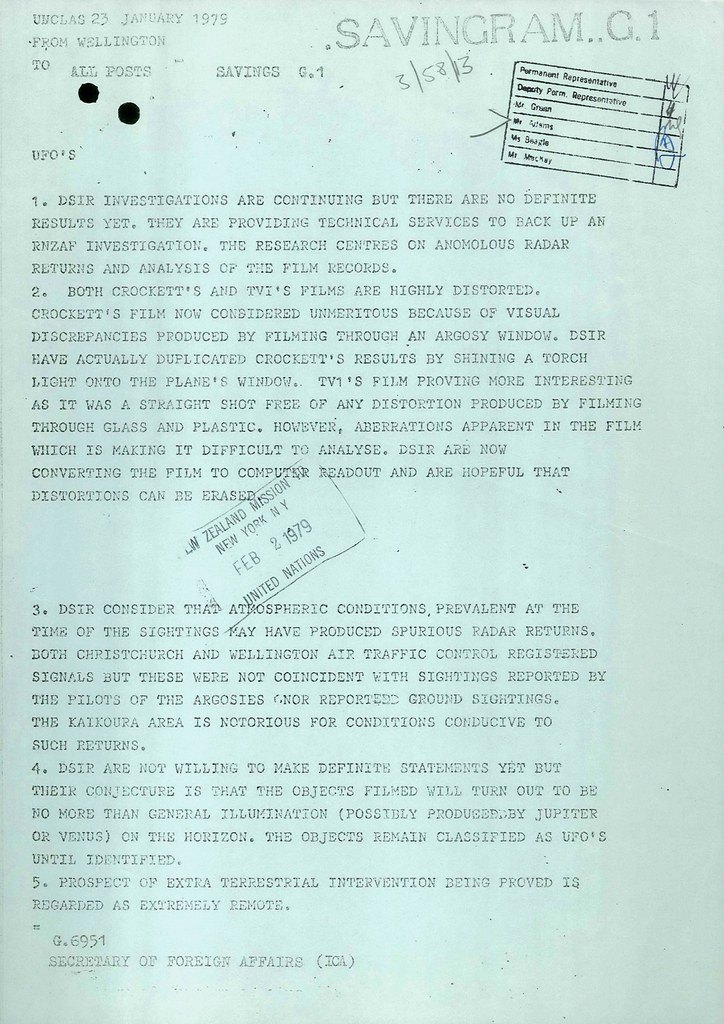
The page above is a “savingram” sent from Wellington to all New Zealand posts on 23 January 1979, stamped as received at the New Zealand Mission in New York on 2 February. Reading it directly:
- The investigation was still open. The DSIR (Department of Scientific and Industrial Research) was providing technical help to an RNZAF investigation focused on “anomolous radar returns” and the film records. It had no definite results yet.
- One film was effectively debunked. “Both Crockett’s and TV1’s films are highly distorted.” The Crockett film was “now considered unmeritous” because it was shot through an Argosy aircraft window, and DSIR had “duplicated Crockett’s results by shining a torch light onto the plane’s window.” The TV1 film was “more interesting,” a straight shot without glass in the way. But aberrations made it hard to analyse, and DSIR was converting it to computer readout.
- The radar didn’t match. DSIR thought atmospheric conditions “may have produced spurious radar returns.” Both air-traffic centres registered signals, “but these were not coincident with sightings reported by the pilots” or with ground sightings. The cable adds: “The Kaikoura area is notorious for conditions conducive to such returns.”
- A guess, clearly labelled. DSIR wouldn’t make definite statements, but “their conjecture is that the objects filmed will turn out to be no more than general illumination (possibly produced by Jupiter or Venus) on the horizon.” The objects “remain classified as UFO’s until identified.”
- The bottom line: “Prospect of extra terrestrial intervention being proved is regarded as extremely remote.”
Why was this going to the UN? RNZ, reporting on the declassified file in 2021, explains that Grenada was pushing that year for the UN to set up a body to study UFOs. New Zealand, chairing its UN regional group, hoped to see the proposal “disposed of without vote.” Grenada eventually withdrew it at the United Kingdom’s urging.
The argument in print
The dispute then moved to a physics journal. In August 1979 the US physicist Bruce Maccabee published “Photometric properties of an unidentified bright object seen off the coast of New Zealand” in Applied Optics, an analysis of the light’s brightness from the film. In December 1979 two DSIR scientists, W. Ireland and M. K. Andrews, published comments on it in the same journal, and Maccabee replied in June 1980. The ledger has confirmed those three publications but hasn’t read their full text, so it doesn’t summarize their arguments here.
In 2010, when the New Zealand Defence Force released about 2,000 pages of UFO files, RNZ asked Alan Gilmore, an astronomer at Carter Observatory at the time of the sightings. He said the lights were the result of “an unusual weather pattern which caused irregular radar reception and many mirage events.” That links Kaikōura to the ledger’s Min Min light file, where a mirage explanation is also on the table.
One explanation you’ll see online is fishing-boat lights. The ledger hasn’t found that in the government text it has read, so it isn’t listed here.
Ledger status
Disputed. Government scientists explained away one film and the radar, but in January 1979 they could only guess at the other film. A published physics debate followed. Nobody in the record claims to have proved what the TV1 lights were. The people involved are named only as they appear in the published record. No source suggests anyone faked anything.
No map pin. The sightings were made from an aircraft offshore. The case is cross-filed to the Antipodes desk and the Sky Desk.
Sources
- Archives New Zealand Te Rua Mahara o te Kāwanatanga, record of the New Zealand Permanent Mission to the United Nations, “Political Affairs - Outer Space - Unidentified Flying Objects (UFO’s),” ABHS 6958 W5579 Box 227 NYP 3/58/13 Part 1. The page reproduced here is the savingram from Wellington of 23 Jan 1979. Flickr, CC BY 2.0.
- Ben Strang, “Govt officials couldn’t explain Kaikōura lights UFO sightings, documents show,” RNZ, 31 Jul 2021. rnz.co.nz
- “Carter astronomer dismisses famous UFO sighting,” RNZ, 23 Dec 2010. rnz.co.nz
- B. S. Maccabee, “Photometric properties of an unidentified bright object seen off the coast of New Zealand,” Applied Optics 18(15):2527–2528 (1 Aug 1979), doi 10.1364/AO.18.002527. Cited as text.
- W. Ireland and M. K. Andrews, ”…: comments,” Applied Optics 18(23):3889–3890 (1 Dec 1979), doi 10.1364/AO.18.003889. Cited as text.
- B. S. Maccabee, ”…: author’s reply to comments,” Applied Optics 19:1745 (1 Jun 1980), doi 10.1364/AO.19.001745. Cited as text.
Evidence ledger
Each claim in this file, the source it rests on, and how well it holds up: 3 corroborated · 2 disputed · 1 unverified. What the labels mean.
| Claim | Source | Type · date | Status |
|---|---|---|---|
| A TV news crew on a cargo flight from Wellington filmed unexplained lights off the Kaikōura coast in the early hours of 31 Dec 1978. | Archives New Zealand item description (Flickr / DigitalNZ) | museum / archive | corroborated |
| Christchurch and Wellington air-traffic control registered radar signals, but they didn't coincide with the sightings reported by the pilots or with ground sightings. | Savingram G.1, Wellington, 23 Jan 1979 (Archives NZ ABHS 6958 W5579 Box 227 NYP 3/58/13) | official · 23 Jan 1979 | corroborated |
| DSIR reproduced the Crockett film's effect by shining a torch onto the plane's window. | Savingram G.1, 23 Jan 1979 | official · 1979 | corroborated |
| The TV1 film showed general illumination, possibly from Jupiter or Venus, on the horizon.Stated as a guess, not a finding. | Savingram G.1, 23 Jan 1979 (DSIR “conjecture”) | official · 1979 | unverified |
| The lights were an unknown object or phenomenon.Disputed in the same journal by DSIR scientists Ireland & Andrews (1979). The ledger hasn't read the letters' full text. | B. S. Maccabee, Applied Optics 18:2527 (1979); author's reply 19:1745 (1980) | scholarly · 1979–1980 | disputed |
| The lights were mirages and irregular radar under an unusual weather pattern. | Alan Gilmore (Carter Observatory), via RNZ, 23 Dec 2010 | press · 2010 | disputed |
Discussion
Discussions activating. Per-case threads will embed here once the Giscus GitHub App is installed on the public satellite repo.
Meanwhile, join the conversation on GitHub Discussions: https://github.com/dclewis21/anomaly-ledger-community/discussions
CoS / D.C.: see Community guidelines and
SETUP.mdin the site repo for the one-click Giscus install.