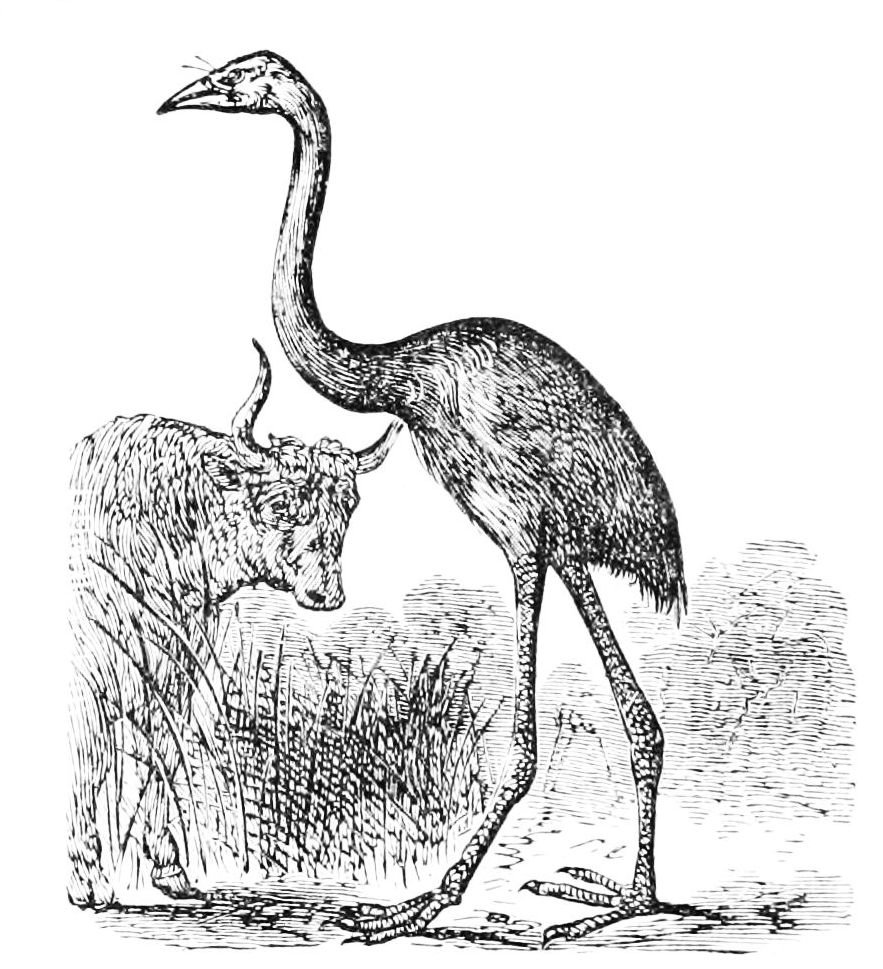
The Live Moa Reports: a Waiau Shepherd (1873) and the Browning Pass 'Capture' (1874)
In 1873 a Dunedin paper announced that a live moa had been seen “alive and in the flesh” in Southland. The runholder wrote in to say his shepherd hadn't said “moa” at all. Eighteen months later a Christchurch paper printed a letter about two moas roped near Browning Pass. They then “escaped,” and another paper called the whole thing a hoax.
Sources Otago Daily Times, 27 Mar 1873; Southland Times, 1 Apr 1873 (letter, R. W. Aitkin); Evening Post, 12 Apr 1873; The Press letter of 'R. K. M. Smythe' as reprinted in the Star, 2 Oct 1874, and Grey River Argus, 6 Oct 1874; Wanganui Chronicle, 6 Oct 1874; Timaru Herald, 7 and 21 Oct 1874; West Coast Times, 1 Dec 1874 (all via Papers Past, National Library of New Zealand); Holdaway et al., Nature Communications 5:5436 (2014)
New Zealand’s giant flightless moa had been known to European science from bones since the 1840s. By the 1870s the hope that a few might still be alive in the back country turned up regularly in the newspapers. Two episodes from those years show how such a report was born and how it fell apart. One was a sighting that its own landowner played down. The other was a capture story that never produced a bird.
1873: “seen alive and in the flesh”
On 27 March 1873 the Otago Daily Times ran “Discovery of a Live Moa.” Its source was a gentleman it trusted entirely. He said the bird had now been “seen alive and in the flesh” on a run on the west side of the Waiau River in Southland. A shepherd’s dog had flushed a huge bird out of manuka scrub. According to the account, it stood on a terrace for “fully ten minutes,” bobbing its long neck the way a disturbed black swan does. Its plumage was described as silvery grey with greenish streaks.
The story was reprinted around the colony within days.
The runholder’s reply
The man who held the run then wrote to the Southland Times. Robert W. Aitkin of Clifden, Waiau, dated his letter 28 March, and it ran on 1 April. It took most of the story apart:
- The shepherd “did not use the word moa but said a large bird.”
- As for the man’s intelligence, Aitkin “certainly would not vouch” for it.
- There was “no confirmation” yet, “although a careful search has been made both for the bird and for tracks.”
He left one door open. If the moa did survive anywhere, he wrote, the west bank of the Waiau was “as likely a place as any.”
On 12 April the Evening Post printed Aitkin’s reply together with a Lyttelton Times item. In it a Dunedin enquirer predicted the affair would “turn out to be a canard,” because everything depended on the shepherd’s word.
1874: two moas on a tether rope
Eighteen months later, Christchurch’s Press printed a letter that one of its “valued correspondents” had passed on from a friend. The Star reprinted it on 2 October 1874. The letter was signed “R. K. M. Smythe” and dated Browning Pass, 26 September. In a breezy style, Smythe said his dogs had bailed up “two immense birds” at the head of a gully. He identified them as moas, or “as Dr Haast would put it, Dinornis gigantea.” He said he had roped the larger bird around a birch tree. With help from shepherds he had walked it down to camp, with the young one trailing behind. He gave the old bird’s height as “about eight feet” and said he would bring both to Christchurch.
The Press itself said it would not be surprised to hear the contrary. On 5 October it reported a second letter: the birds had escaped. The paper’s comment, carried by telegraph to the Wanganui Chronicle, was “that is just what we expected to hear.”
The verdict of the press
Other papers were much less kind than the Press had been to itself:
- The Grey River Argus (6 October) said its own telegram about the capture had been received “with a large amount of incredulity.”
- The Timaru Herald (7 October) called the letter a “pleasing fiction.” It said the Press had lent “its assistance to a hoax,” and suggested that Smythe was “as much an airy nothing as his moas,” with the valued correspondent being the Press itself. That last point was the Herald’s suspicion. No one has proved it.
- The Herald’s monthly summary for 21 October was blunter still: “we do not believe a word of it.”
- On 1 December the West Coast Times reprinted an Adelaide columnist. He said he had been fooled too often by bunyip stories to swallow two moas, and would take them with “the original pinch” of salt.
Legend and record
| Claim | What the record shows |
|---|---|
| 1873 sighting | One unnamed shepherd, a large bird, and no tracks. The person who knew him best wouldn’t vouch for him and said he never used the word “moa.” Unconfirmed. |
| 1874 capture | One letter from a man no one could identify, and a convenient escape. No specimen, and open accusations of a hoax at the time. Debunked. |
| The science | A 2014 radiocarbon study (Holdaway and colleagues) puts the extinction of the moa in the South Island in the early-to-mid 15th century CE. It attributes the extinction to hunting and habitat loss by a small early Polynesian population. That is more than four centuries before either report. |
The ledger hasn’t seen the Press originals of 2 and 5 October 1874. The text above comes from the Star, Grey River Argus and telegraph reprints. “Smythe” may well be a pseudonym, so this page doesn’t treat him as an identified person. The ledger has placed no map pins: the 1873 run was private farmland, and Browning Pass is named only as the letter’s dateline.
Ledger status
Hoax. The 1874 capture letter was treated as a hoax at the time, and nothing ever came of it. The 1873 sighting was a large bird that only the newspaper’s informant called a moa. Neither is compatible with the dated extinction record. It’s part of the Antipodes desk.
Sources
- “Discovery of a Live Moa,” Otago Daily Times, 27 Mar 1873 — Papers Past
- “The Moa” (letter, Robt. W. Aitkin, Clifden, Waiau, 28 Mar), Southland Times, 1 Apr 1873 — Papers Past
- “The Moa Story,” Evening Post, 12 Apr 1873 — Papers Past
- “Reported Capture of Two Live Moas” (from The Press), Star, 2 Oct 1874 — Papers Past
- “The Moas,” Grey River Argus, 6 Oct 1874 — Papers Past
- “Christchurch” (telegram, 5 Oct), Wanganui Chronicle, 6 Oct 1874 — Papers Past
- “Notes,” Timaru Herald, 7 Oct 1874 — Papers Past
- “Notes for the Month,” Timaru Herald, 21 Oct 1874 — Papers Past
- “The Canterbury Moas,” West Coast Times, 1 Dec 1874 — Papers Past
- R. N. Holdaway, M. E. Allentoft, C. Jacomb, C. L. Oskam, N. R. Beavan & M. Bunce, “An extremely low-density human population exterminated New Zealand moa,” Nature Communications 5:5436 (2014) — doi:10.1038/ncomms6436
Evidence ledger
Each claim in this file, the source it rests on, and how well it holds up: 1 unverified · 4 debunked. What the labels mean.
| Claim | Source | Type · date | Status |
|---|---|---|---|
| A shepherd on the Waiau saw a live moa in early 1873.The shepherd isn't named. His story survives only through the ODT's informant and the runholder's paraphrase. | Otago Daily Times, 27 Mar 1873 (an unnamed informant) | period press · 27 Mar 1873 | unverified |
| The shepherd himself called the bird a moa.Aitkin: he “did not use the word moa but said a large bird.” | Letter of Robt. W. Aitkin, Clifden, Waiau, Southland Times, 1 Apr 1873 | period press · 1 Apr 1873 | debunked |
| A search on the run turned up the bird or its tracks.No confirmation, he wrote, “although a careful search has been made both for the bird and for tracks.” | Aitkin letter, 28 Mar 1873 | period press · 1 Apr 1873 | debunked |
| 'R. K. M. Smythe' roped two live moas near Browning Pass in September 1874.No specimen ever reached Christchurch. A second letter said the birds had escaped. The Timaru Herald called it a hoax and suspected Smythe didn't exist. | Letter dated 26 Sep 1874 in The Press, reprinted in the Star, 2 Oct 1874 | period press · 2 Oct 1874 | debunked |
| Moa survived in New Zealand into the 1870s.Radiocarbon analysis puts South Island extinction in the early-to-mid 15th century CE (68% HPD 1406–1446 CE). | Holdaway et al., Nature Communications 5:5436 (2014) | scholarly · 7 Nov 2014 | debunked |
Discussion
Discussions activating. Per-case threads will embed here once the Giscus GitHub App is installed on the public satellite repo.
Meanwhile, join the conversation on GitHub Discussions: https://github.com/dclewis21/anomaly-ledger-community/discussions
CoS / D.C.: see Community guidelines and
SETUP.mdin the site repo for the one-click Giscus install.