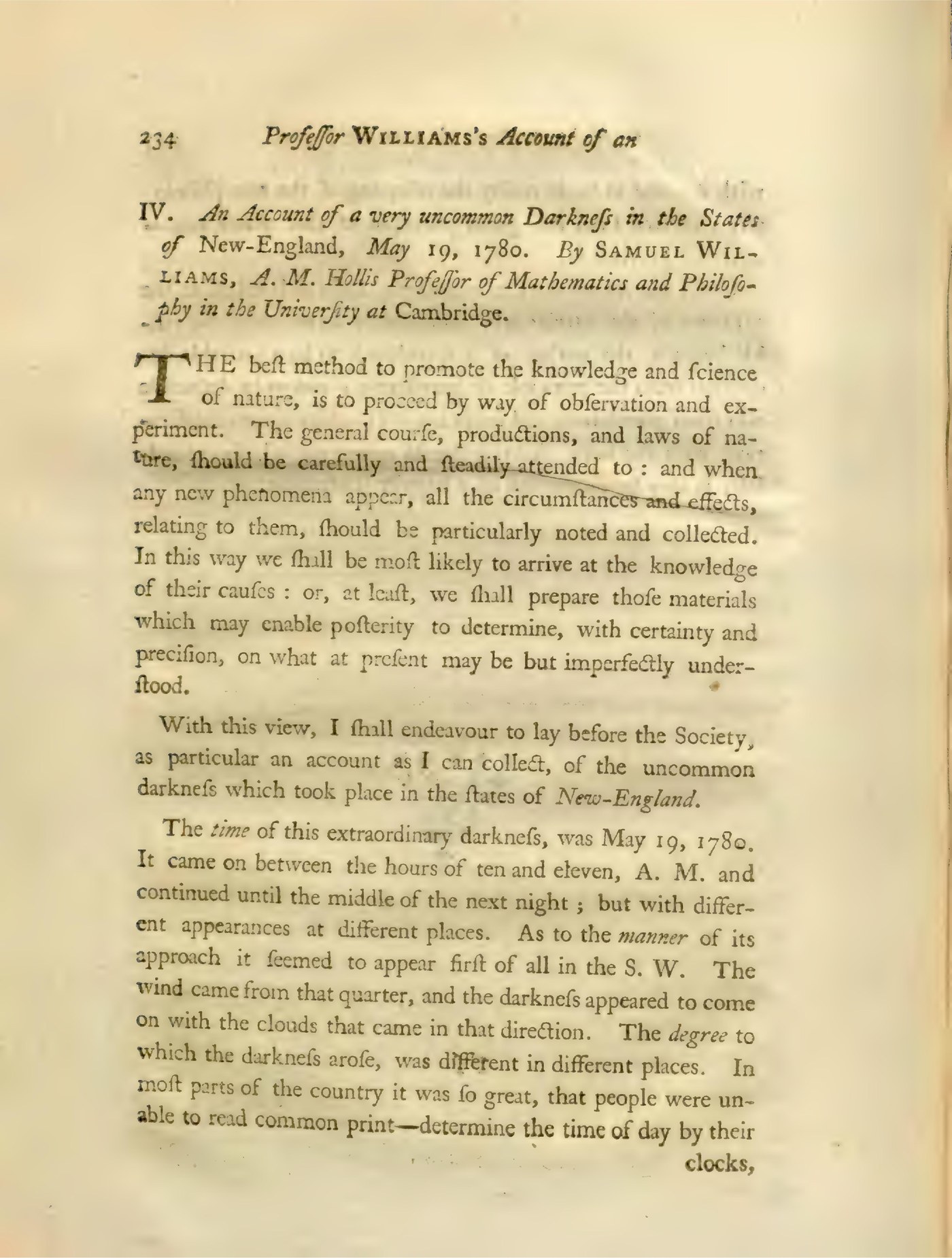
The evidence: Opening page of Samuel Williams's 1785 Academy memoir on the New England darkness of 19 May 1780
New England's Dark Day, 19 May 1780: When Noon Needed Candles
Last reviewed Next review
We review and update every article weekly. When the record changes, so does the article. How we review
On 19 May 1780, noon needed candles across New England. We read Williams, a contemporary account sent to Adams, and the tree-ring study that traced the smoke.
Verdict: The darkness was real and widespread; smoke from large forest fires, carried over New England and mixed with low cloud and fog, is the cause that fits both the 1780 observers and the modern fire-scar evidence.
Original sources: Samuel Williams, 'An Account of a very uncommon Darkness in the States of New-England, May 19, 1780', Memoirs of the American Academy of Arts and Sciences 1 (1785), pp. 234-246, Internet Archive · Williams memoir, modern transcription (Bill Thayer / University of Chicago) · Cotton Tufts, Enclosure No. 2: Account of the Dark Day in May 1780, sent to John Adams, Founders Online · McMurry, Stambaugh, Guyette and Dey, 'Fire scars reveal source of New England's 1780 Dark Day', International Journal of Wildland Fire 16 (2007), 266-270, DOI 10.1071/WF05095 · US Forest Service Treesearch record for McMurry et al. 2007 (abstract) · Thomas J. Campanella, "'Mark Well the Gloom': Shedding Light on the Great Dark Day of 1780", Environmental History 12 (January 2007), MIT-hosted PDF
Sources Samuel Williams, Memoirs of the American Academy of Arts and Sciences vol. 1 (1785), pp. 234-246; Cotton Tufts, Account of the Dark Day enclosed to John Adams, 25 July 1780 (Founders Online); Erin R. McMurry, Michael C. Stambaugh, Richard P. Guyette and Daniel C. Dey, International Journal of Wildland Fire 16 (2007); Thomas J. Campanella, Environmental History 12 (January 2007)
On Friday morning, 19 May 1780, daylight failed across New England. By midday, people lit candles to eat, to read, and to keep house. Birds sang evening songs and went quiet. Fowls went to roost. Cocks crowed as at dawn. The gloom held into the night that followed.
We went back to the long report that Samuel Williams, the Hollis Professor of Mathematics and Philosophy at Cambridge, wrote for the new American Academy of Arts and Sciences, printed in its first volume of Memoirs in 1785. We also read a contemporary account that Cotton Tufts of Weymouth enclosed to John Adams that July, and a 2007 tree-ring study that tied the haze to wildfires far to the north and west. The header engraving is Paul Revere’s view of the Cambridge colleges where Williams taught. The evidence block is the opening page of Williams’s own memoir.
What Williams recorded
Williams dated the darkness to 19 May 1780. It came on, he wrote, between ten and eleven in the morning and lasted until the middle of the next night, with different looks in different places. It seemed to arrive from the southwest, on a southwest wind, with the clouds that came from that quarter.
In most of the country, he said, people could not read common print, tell the time from clocks or watches, dine, or manage domestic business without candles. In some places they could not read outdoors for several hours. The darkness reached, by the reports he gathered, as far east as Falmouth, west to the far parts of Connecticut and to Albany, south along the seacoasts, and north as far as the settlements then ran. At Cambridge he put its duration at least fourteen hours. Candles were lit indoors; birds disappeared after their evening songs; fowls roosted; cocks crowed; objects could be told apart only at a very short distance; “every thing bore the appearance and gloom of night.”
For several days beforehand, he and others had seen an air full of smoke and vapor. The sun and moon looked remarkably red and dull, especially near the horizon. On the day itself, rain water saved in tubs carried a light scum that felt, when rubbed, like the black ashes of burnt leaves, with a strong sooty smell. On the Merrimack River he found the same black ash floating in a band along the shore. Clean paper left out in the air and rain came back sullied and greasy feeling, yet showed no sulfurous or nitrous particles when burned.
Williams’s explanation was already a fire explanation. Clearing fires in the new settlements, he wrote, had been kept up that spring more than usual: in the county of York, in western New Hampshire, in the western parts of Massachusetts, and in Vermont, for two or three weeks, with some fires raging for days before they could be put out. With clear weather, heavy air, and small variable winds, the smoke and vapor had collected until the atmosphere was heavily charged. On the 19th the barometer was falling, and the vapors sat low. That quantity of vapor near the ground, he argued, was enough to produce what people saw, without other causes. He compared it with earlier dark days, including a 1762 darkness at Detroit whose correspondents described air full of smoke that smelled like burning wood and straw, and candles needed at dinner.
A second contemporary account
Cotton Tufts, a Massachusetts physician and Academy charter member, sent John Adams an enclosure dated with the rest of his 25 July 1780 letter. He said darkness came on about nine in the morning, and that by eleven he needed a candle to read or write. Candles stayed necessary for family business until past three in the afternoon. The clouds looked brassy; a disagreeable smell was compared to a chimney on fire or to swamps burning. Prior to the day, he wrote, woods from Ticonderoga for thirty miles downward had been on fire for some time, with little rain and winds chiefly from the west and northwest. Rain caught in tubs left a scum like burnt leaves. He also quoted observers at Ipswich Hamlet: by half past eleven, large print could not be read in a bright room; at noon a candle cast a sharp enough shade for profiles; at about two they dined with two candles on the table and the windows open; dunghill fowls roosted and night birds called.
Newspapers that week treated the day as news and as a puzzle. Thomas J. Campanella’s 2007 history of the episode, drawing on period papers, notes that the Connecticut Courant of 23 May 1780 asked readers for exact times, cloud colors, and other visible effects, and that Boston’s Independent Chronicle printed a detailed Ipswich letter on 25 May that blamed smoke from woods that had been burning for many days, mixed with ordinary exhalations and condensed by opposing winds. Those pulp debates match what Williams and Tufts already had in hand: soot, smell, and fire.
What the tree rings added
In 2007, Erin R. McMurry, Michael C. Stambaugh, Richard P. Guyette and Daniel C. Dey published “Fire scars reveal source of New England’s 1780 Dark Day” in the International Journal of Wildland Fire. Using written accounts together with fire-scar evidence from tree rings, they argued that wildfire was the likely source of the Dark Day. The Treesearch abstract and the paper’s framing point to major 1780 burning, including in the Algonquin Highlands of southern Ontario, with smoke able to travel hundreds of miles under the right weather, as later “dark” or “yellow” days from Canadian and Lake States fires also did. A low-pressure system, they suggested, could have carried dense smoke into New England; fires farther south in the eastern United States may have added to the load. That lines up with Williams’s southwest approach, the soot of burnt leaves, and Tufts’s report of long fires down from Ticonderoga.
Sources
- Samuel Williams, “An Account of a very uncommon Darkness in the States of New-England, May 19, 1780,” Memoirs of the American Academy of Arts and Sciences 1 (Boston: Adams and Nourse, 1785), pp. 234-246: Internet Archive; transcription at Bill Thayer / University of Chicago; JSTOR 25053760 (read 6 Nov 2026)
- Cotton Tufts, Enclosure No. 2, “Account of the Dark Day in May 1780,” with his letter to John Adams of 25 July 1780, Founders Online, National Archives: founders.archives.gov (read 6 Nov 2026)
- Erin R. McMurry, Michael C. Stambaugh, Richard P. Guyette and Daniel C. Dey, “Fire scars reveal source of New England’s 1780 Dark Day,” International Journal of Wildland Fire 16 (2007): 266-270, DOI 10.1071/WF05095; US Forest Service Treesearch record: research.fs.usda.gov/treesearch/41025 (read 6 Nov 2026)
- Thomas J. Campanella, “‘Mark Well the Gloom’: Shedding Light on the Great Dark Day of 1780,” Environmental History 12 (January 2007): 35-58, MIT-hosted PDF: web.mit.edu (read 6 Nov 2026)
Weighing it
People across a wide belt of New England really did lose daylight on 19 May 1780. That is not folklore. Williams, Tufts, and the Ipswich observers agree on candles at noon, roosting birds, sooty rain, and a sky that had looked smoky and red for days. Some readers then reached for judgment day, comets, or planets. The observers who smelled burnt leaves and watched ash fall already had the better lead.
Williams blamed settlement clearing fires in northern New England and nearby frontiers. Tufts pointed to long burns down from Ticonderoga. McMurry and colleagues, more than two centuries later, found fire scars that support large 1780 burns to the north and west, including in Ontario’s Algonquin Highlands, with weather that could push the smoke east. Details of every fire’s share of the plume are still a matter of reconstruction, but the mechanism is not a mystery: smoke, fog, and cloud thick enough to turn day into night. We mark the case explained.
Every image on this page is credited where it appears.
Verdict
Explained The darkness was real and widespread; smoke from large forest fires, carried over New England and mixed with low cloud and fog, is the cause that fits both the 1780 observers and the modern fire-scar evidence.
Update log
-
We added this case file.
-
Weekly re-check of sources; no change to the record since filing. Next check November 23, 2026.
Discussion
Discuss this case on the on-site Community board — no GitHub account required. Prefer a private tip for the editorial team? Submit a Sighting.
House rules: Community guidelines.