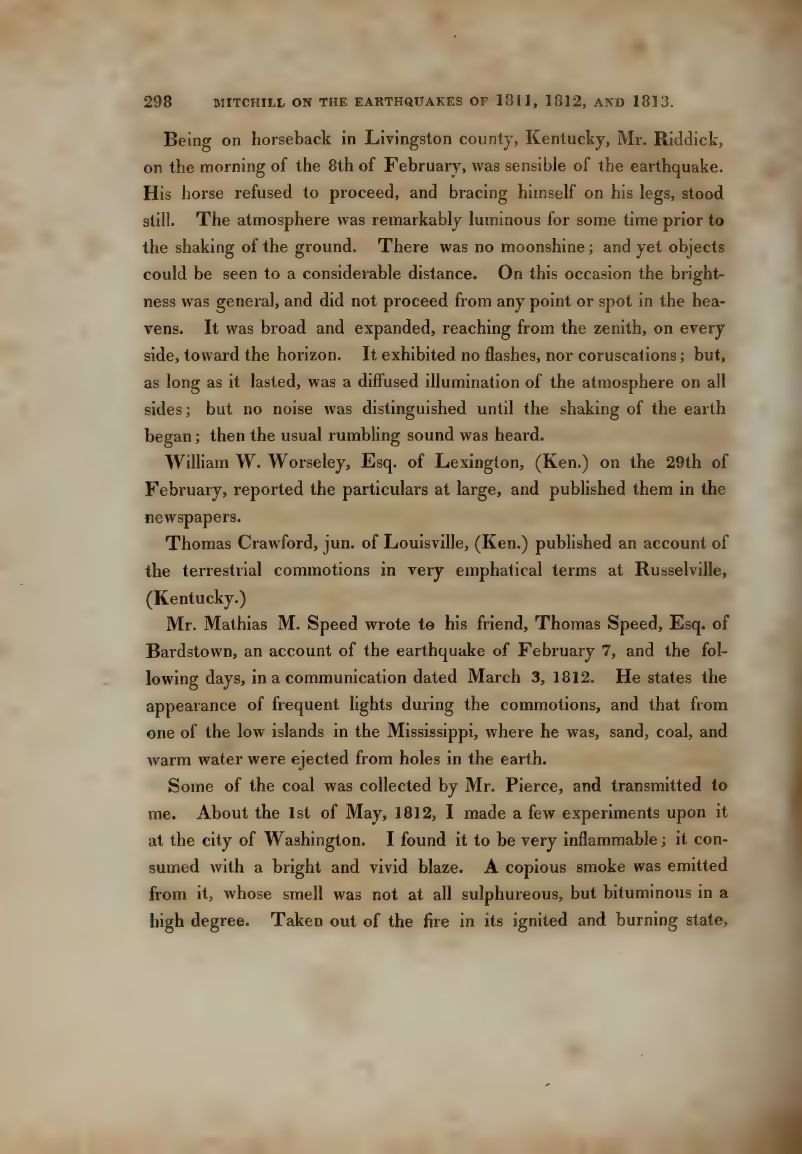
The evidence: Page 298 of Samuel L. Mitchill's 1815 earthquake narrative, with Mr. Riddick's report of a luminous sky in Livingston County, Kentucky, and Mathias Speed's report of frequent lights
The New Madrid Earthquake Lights, 1811-12: Flashes, Glows and Sparks from the Ground
Last reviewed Next review
We review and update every article weekly. When the record changes, so does the article. How we review
During the New Madrid quakes of 1811-12, people from St. Louis to Georgia reported flashes and glows. We read the 1815 letters and the modern lights catalog.
Verdict: The light reports are real and came from many places, but they are scattered, mixed with ordinary storms and fires, and too thin to say whether any were true earthquake lights.
Original sources: Samuel L. Mitchill, 'A detailed narrative of the earthquakes which occurred on the 16th day of December, 1811', Transactions of the Literary and Philosophical Society of New-York 1 (1815), Internet Archive · Myron L. Fuller, The New Madrid Earthquake, U.S. Geological Survey Bulletin 494 (1912), PDF · Thériault, St-Laurent, Freund and Derr, 'Prevalence of Earthquake Lights Associated with Rift Environments', Seismological Research Letters 85 (2014), DOI 10.1785/0220130059 · Electronic supplement to Thériault et al. 2014 (case catalog, New Madrid entry) · Friedemann Freund, 'Moses' burning bush explained? The mysterious physics behind earthquake lights', The Conversation (2014)
Sources Samuel L. Mitchill, 'A detailed narrative of the earthquakes which occurred on the 16th day of December, 1811', Transactions of the Literary and Philosophical Society of New-York 1 (1815), pp. 281-307; Myron L. Fuller, The New Madrid Earthquake, USGS Bulletin 494 (1912), pp. 44-47; Robert Thériault, France St-Laurent, Friedemann T. Freund and John S. Derr, Seismological Research Letters 85 (2014), 159-178, and electronic supplement
In the early hours of 16 December 1811, the first of the great New Madrid earthquakes shook the Mississippi Valley. Two more large shocks followed on 23 January and 7 February 1812, with hundreds of smaller ones in between. Alongside the cracked ground, sand blows and sunken land, people wrote down something stranger: lights. Flashes on the horizon, a glowing sky with no moon, and, in one account, sparks coming out of the earth.
We went back to the earliest collection of those letters, the narrative that the New York physician and naturalist Samuel L. Mitchill printed in 1815. We then read how the U.S. Geological Survey geologist Myron L. Fuller weighed the same reports a century later, and how a 2014 study of earthquake lights around the world counted New Madrid among its cases. The evidence block is a page from Mitchill’s own volume. The header is a woodcut Henry Howe published in 1851, whose caption borrows a witness’s line about flashes of lightning making “the darkness doubly horrible.”
What the witnesses reported
Mitchill gathered newspaper items, letters and conversations from across the country. The light reports in his narrative are short, and they come from far apart.
At St. Louis, a Mr. Riddick told Mitchill that the shocks came after a remarkable calm. The air had “a dingy and lurid aspect,” and gleams and flashes of light showed again and again around the horizon. Riddick turns up a second time, on horseback in Livingston County, Kentucky, on the morning of 8 February 1812. His horse braced its legs and refused to move. Before the ground began to shake, he said, the sky was remarkably bright. There was no moon, yet he could see a long way. The light did not come from any one spot. It spread from the zenith down to the horizon on every side, with no flashes, and only when the shaking began did he hear the usual rumble.
At Knoxville, Tennessee, two flashes “very much like distant lightning” were seen to the north, about a minute apart, at the end of the first and longest shock. At Savannah, Georgia, the first shock was said to have been preceded by a flash of light and a rattling noise. Pittsburgh reported flashes toward the southwest on 7 February, like those seen on 16 December. Mathias Speed, writing from one of the low islands in the Mississippi, described “frequent lights during the commotions” along with sand, coal and warm water thrown out of holes in the ground.
The most vivid report is secondhand. William Shaler of New Orleans passed on what the master of a Kentucky boat told him. On 7 February 1812, at three in the morning, the boat was tied up about thirteen miles above New Madrid. The man woke to a roaring noise, saw the trees on the bank falling and whipping about, and saw “many sparks of fire emitted from the earth.” He cut his cable and ran for the middle of the river.
Mitchill also printed a letter from North Carolina describing “three large extraordinary fires, in the air” on the night of 20 February 1812, each as big as a burning house and lasting several hours. The same letter writer reported a meteor that dropped a white thing shaped like a duck, so we give that account little weight.
How Fuller weighed them
In 1912 Fuller wrote the U.S. Geological Survey’s standard report on the earthquakes. He wrote that the light flashes and glows “seem so improbable” that he would have dismissed them, except that they came from so many places. He added Senator Lewis F. Linn’s description of the shocks coming with flashes of electricity “ever and anon,” and a line from a witness named Dillard about flashes like an explosion of gas or lightning passing from cloud to cloud.
Fuller did not think the flashes were all imagined, but he doubted that anything unusual had happened. His main explanation was thunderstorms, which he said were rare for December but were on record at the time, especially in South Carolina. He also raised brush and wood fires, and magnetic disturbances like the aurora-style glows ship captains reported during a Mexican earthquake in 1907. He added a point that cuts against the lights: in the New Madrid area itself, where the weather was clear, the more careful accounts did not mention them. In his overview he went further and put the flashes down to the popular belief that the quakes were volcanic.
The modern view
In 2014 Robert Thériault, France St-Laurent, Friedemann Freund and John Derr published a review of earthquake light reports in Seismological Research Letters. Out of a much larger pile of reports from Europe and the Americas, they kept 65 earthquakes with the most reliable descriptions, and New Madrid is on their list. Their supplement summarizes the same Mitchill and Fuller reports, plus a later account of flashes from the mountains of North Carolina. They found that most of their cases came from quakes inside plates, in old rift zones, and New Madrid sits on just such a buried rift. Freund’s proposed cause is that stressed rock releases electric charge that can reach the surface and light the air. That idea is still debated.
We noticed two small slips when we compared the sources. Fuller’s printed text names the Livingston County witness “Kiddick,” while Mitchill’s page clearly reads Riddick. The 2014 supplement ties the “sparks of fire” to the first shock of 16 December, but Shaler’s letter dates them to 7 February.
Sources
- Samuel L. Mitchill, “A detailed narrative of the earthquakes which occurred on the 16th day of December, 1811,” Transactions of the Literary and Philosophical Society of New-York 1 (1815), pp. 281-307; light reports on pp. 286-288, 297-298 and 300: Internet Archive (read 8 Nov 2026)
- Myron L. Fuller, The New Madrid Earthquake, U.S. Geological Survey Bulletin 494 (Washington, 1912), pp. 9, 44-47: USGS PDF (read 8 Nov 2026)
- Robert Thériault, France St-Laurent, Friedemann T. Freund and John S. Derr, “Prevalence of Earthquake Lights Associated with Rift Environments,” Seismological Research Letters 85 (2014): 159-178, DOI 10.1785/0220130059, with its electronic supplement (supplement read 8 Nov 2026)
- Friedemann Freund, “Moses’ burning bush explained? The mysterious physics behind earthquake lights,” The Conversation (2014) (read 8 Nov 2026)
Weighing it
The reports are genuine in the sense that people wrote them down at the time, in places hundreds of miles apart. That is what kept Fuller from throwing them out. But almost every one has an ordinary rival: winter storms were moving across the country, settlers and hunters burned brush, and people who believed the quakes were volcanic were primed to see fire. The single report of sparks from the ground reached print thirdhand. Riddick’s diffuse glow before the 8 February shock is the hardest to explain away, and it is the kind of report the 2014 catalog counts as an earthquake light. One witness is not enough, so we leave this open.
Verdict
Open The light reports are real and came from many places, but they are scattered, mixed with ordinary storms and fires, and too thin to say whether any were true earthquake lights.
Update log
-
We added this case file.
-
Weekly re-check of sources; no change to the record since filing. Next check November 23, 2026.
Discussion
Discuss this case on the on-site Community board — no GitHub account required. Prefer a private tip for the editorial team? Submit a Sighting.
House rules: Community guidelines.