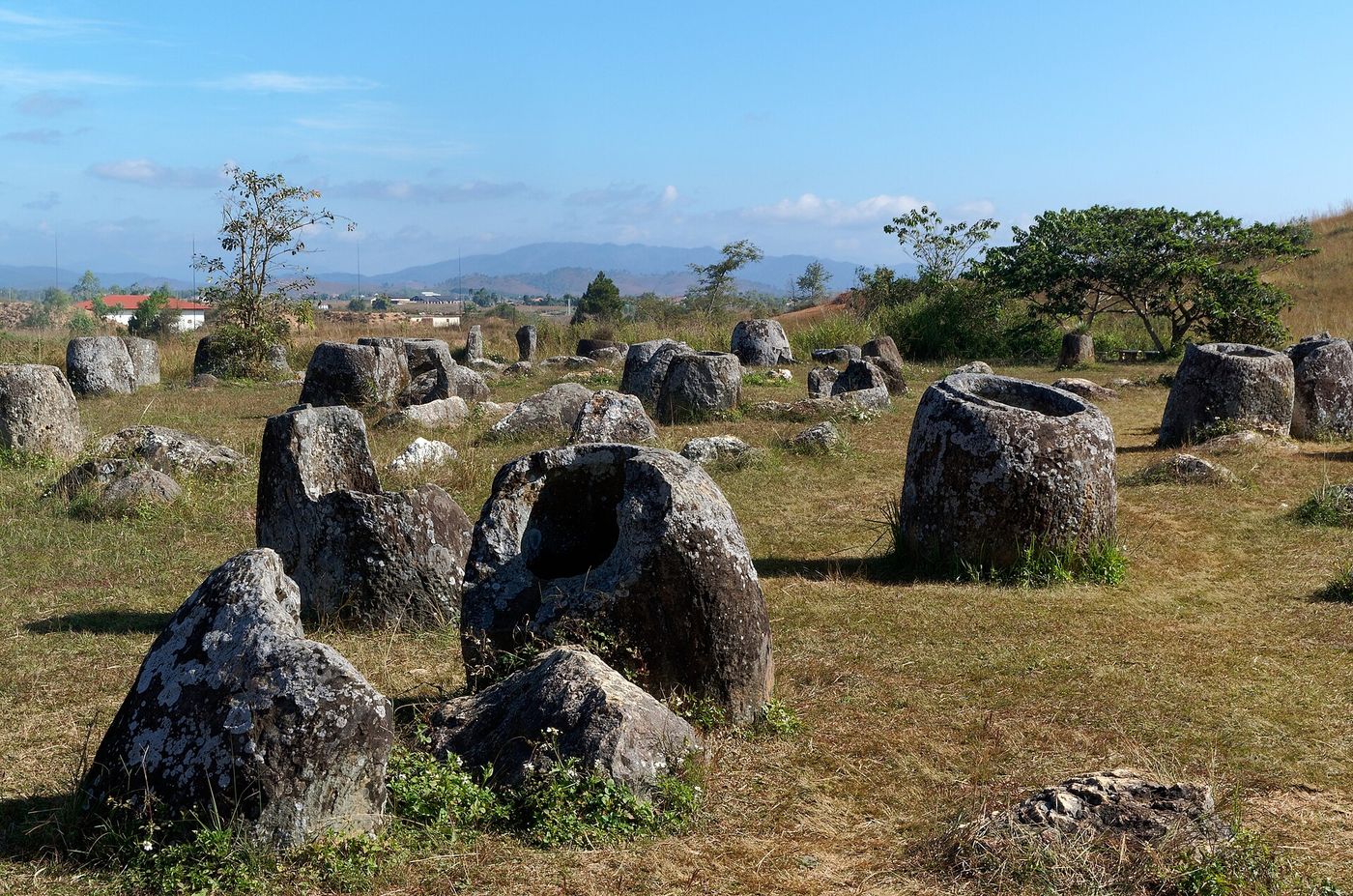
The evidence: Stone jars at Site 1 on the Plain of Jars
The Plain of Jars, Laos: 2,100 Stone Jars, and Nobody Knows Who Carved Them
Last reviewed Next review
We review and update every article weekly. When the record changes, so does the article. How we review
Huge stone jars stand on the hills of northern Laos. A local story says a chief had them made for liquor. We read the digs, the dates and the Lao record.
Verdict: The jars are real megaliths bound up with burial rites, perhaps set in place as early as 1240 BCE, but who carved them and exactly what they held is still unknown.
Original sources: UNESCO World Heritage Centre, 'Megalithic Jar Sites in Xiengkhuang: Plain of Jars' (no. 1587, inscribed 2019) · Shewan et al., 'Dating the megalithic culture of Laos', PLOS ONE (2021), open full text · Lao News Agency (KPL), report on the 11 jar sites inscribed as World Heritage, 31 July 2019 (Lao) · Laopedia, 'Thong Hai Hin' (Plain of Jars), Lao-language encyclopedia entry
Sources UNESCO World Heritage Centre, 'Megalithic Jar Sites in Xiengkhuang: Plain of Jars' (list no. 1587, inscribed 2019); Shewan et al., 'Dating the megalithic culture of Laos: Radiocarbon, optically stimulated luminescence and U/Pb zircon results', PLOS ONE 16(3): e0247167 (2021); University of Melbourne news release, March 2021; Tom Metcalfe, Live Science, 28 April 2021; Lao News Agency (KPL), 31 July 2019 (Lao); Laopedia, 'Thong Hai Hin' (Lao)
On the high plateau of Xieng Khouang Province in northern Laos, stone jars stand in the grass by the hundred. Some are a meter tall, some are three. Some still have their stone lids nearby; many are cracked, tipped over or broken. They are cut from solid rock, much of it sandstone, and they sit alone or in groups of up to several hundred on the hills around a wide grassy plain. In Lao the place is called Thong Hai Hin, the field of stone jars. In English it is the Plain of Jars.
The jars are not a legend. They are there, they have been measured and counted, and since 2019 the jar sites have been on the UNESCO World Heritage list. What is still unknown is who made them, how the biggest ones were moved, and what exactly went inside. We read the UNESCO listing, the main scientific paper on dating the jars, the university release and a science news report on it, a 2019 report from the Lao News Agency, and the entry in Laopedia, the Lao-language encyclopedia.
What is there
UNESCO says the plain “gets its name from more than 2,100 tubular-shaped megalithic stone jars used for funerary practices in the Iron Age.” The listed property is 15 components, at 11 sites according to the Lao News Agency, and together they hold 1,325 of those jars, along with stone disks that may have been lids, secondary burials, grave markers, quarries and grave goods. UNESCO dates the sites to “between 500 BCE and 500 CE (and possibly up to as late as 800 CE)” and calls the jars “the most prominent evidence of the Iron Age civilisation that made and used them, about which little is known.”
The Lao News Agency report from 31 July 2019, written in Lao, goes site by site. In our translation, it says Site 1, about 8 km from the provincial town, is the most surveyed and excavated, with 334 jars, 30 lids and 303 stones marking graves, in five groups over about 34 hectares. Site 52, on a forested ridge, has 404 jars. Site 21, at Phou Keng, is a quarry of about 20 hectares that the report says has been confirmed by science as the place that supplied the jars for Site 1. The University of Melbourne puts the jars at “weighing up to 20 tonnes”. The sources give different details for Site 1: in our translation, the Lao News Agency puts it about 8 km from the provincial town and counts 334 jars, PLOS ONE puts it 4 km southwest of Phonsavan and counts 316 megaliths, and Live Science says it lies just west of Phonsavan and holds about 400.
In our translation, the report also notes that there is only one jar in the province with a carved figure of this kind. The Lao text describes it as a standing human figure with its arms raised toward the sky. The Live Science article, captioning a photo from the research team, describes what appears to be the same carving as “a frog-like creature that has been likened to a figure in ancient rock carvings in southern China.” We note the two readings and do not pick one.
The local story
Laopedia gives the story people in the area tell. In our translation of the Lao text: according to local people, Khun Cheuang defeated Chao Angkha, the ruler of Xieng Khouang, in the 5th or 6th century, and to celebrate the victory he ordered his troops and people to make the stone jars to hold liquor. Laopedia adds that people also believed the jars were made from a mix of sand, sugar and cow hide, then baked in a kiln in a cave near Site 1.
That is a story about a hero, and Laopedia presents it as a local belief, not as history. It is worth keeping, because it is what the people who live beside the jars said about them. But nothing found in the ground supports jars for a victory feast. And the jars are cut stone, not something molded and fired.
What the digs found
The first serious work at the jars was done in the 1930s by the French researcher Madeleine Colani of the École française d’Extrême-Orient. The 2021 PLOS ONE paper, by Louise Shewan, Dougald O’Reilly, Thonglith Luangkhoth of the Lao Department of Heritage and others, sums up her finds at Site 1: fragments of human bone, glass and carnelian beads, pottery including burial jars, ear disks, iron and bronze tools and jewelry. Colani thought the sites belonged to the Iron Age, about 500 BCE to 500 CE. In our translation, the Lao News Agency adds that in 1935 she dug around the single large jar at Site 28 and found it empty inside, with stone tools, pottery shards, glass beads, bone fragments, iron bracelets and charcoal around it.
Live Science reports that Colani said in 1935 that she had found human remains in some of the jars, “but modern archaeologists have not found datable human bones or teeth in any of the stone jars.” So the bones are around the jars, not in them, at least in the modern digs.
The new digs at Site 1 in 2016 found three kinds of burial among the jars: a full body laid out, bundles of bones buried after the flesh was gone, and bones placed in ceramic pots. In the paper’s words, “The three excavation units produced a minimum number of 18 individuals including a large proportion (>60%) of subadults (younger than 15 years of age).” The researchers found no sign that anyone lived there. Live Science adds that the buried pots were marked on the surface by distinctive quartz boulders.
Dating stone
You cannot carbon-date a carved rock, which is why the age of the jars has been so hard to pin down. The team tried three methods.
First, radiocarbon on charcoal and bone from the burials. Human bone from Site 1 dated to between about 772 and 1219 CE, and most of the charcoal pointed to activity, including burials, between the late 9th and 13th centuries CE. That is far later than the Iron Age date for the jars. A charcoal sample from right under one Site 1 jar came out at 1168 to 1264 CE, but the paper warns that two secondary burials nearby had disturbed the ground.
Second, optically stimulated luminescence, which measures when grains of soil last saw sunlight. Under two jars at Site 2 the four samples agreed, giving an age range the paper puts at “1240 BC to 660 BC”. When Live Science spoke to Shewan, she gave the two jars separately: “Directly under one jar, we had a date range of 1350 to 730 B.C., and under another we had 860 to 350 B.C.” Either way, the jars at that site look much older than the burials beside them.
Third, the age of tiny zircon crystals in the stone. The zircons in a jar at Site 1 matched rock and an unfinished jar at the Phou Keng quarry about 8 km away, which makes that quarry the likely source. How a jar weighing tonnes got from there to the site is not known. As the paper puts it: “Whether the completed jars were dragged on some form of wooden rollers or sledge remains speculative.”
Shewan’s summary, in the university release, is that “these sites have maintained enduring ritual significance from the period of their initial jar placement into historic times”. O’Reilly told Live Science they cannot yet say whether the later burials were made by the jar makers’ descendants or by someone else: “Whether they were culturally related to the people who made the jars is a question that we can’t define yet”.
What the jars were for
Here is the honest gap. Every serious source ties the jars to the dead. Live Science sums up the leading idea: the jars were “likely used to expose the dead to the elements until only their bones were left to be buried”. That fits the bundles of bones in the ground. But no one has found the proof inside a jar, and the paper itself says plainly: “Although the original purpose of the megalithic jars remains to be determined, the present research indicates a long history of activity at the sites.”
Why so little is known
Part of the answer is war. The plain was bombed in wartime, and unexploded ordnance still lies in the ground. The PLOS ONE paper says limited research has been done “owing mostly, to the presence of unexploded ordnance (UXO)”, and that, as of the 2021 paper, “Of the more than 100 identified jar sites, less than 10% have been cleared and are accessible for ‘traditional’ archaeological investigation.” UNESCO notes that some features of the sites “have been damaged in the past by bombing and other effects of war, and by cattle grazing.” Most of the jar sites have never been dug at all.
Sources
- UNESCO World Heritage Centre, “Megalithic Jar Sites in Xiengkhuang: Plain of Jars”, World Heritage List no. 1587, inscribed 2019, description and Outstanding Universal Value (read 18 Nov 2026)
- Louise Shewan, Dougald O’Reilly, Richard Armstrong, Phillip Toms, John Webb, Nancy Beavan, Thonglith Luangkhoth, Jamie Wood, Siân Halcrow and Kate Domett, “Dating the megalithic culture of Laos: Radiocarbon, optically stimulated luminescence and U/Pb zircon results”, PLOS ONE 16, no. 3 (2021): e0247167, DOI 10.1371/journal.pone.0247167, CC BY 4.0 (read 18 Nov 2026)
- University of Melbourne, “Researchers solve more of the mystery of Laos megalithic jars”, news release, March 2021 (read 18 Nov 2026)
- Tom Metcalfe, “‘Plain of Jars’, one of the most mysterious archaeological sites, reveals its true age”, Live Science, 28 April 2021 (read 18 Nov 2026)
- Lao News Agency (KPL), “ທົ່ງໄຫຫີນແຂວງຊຽງຂວາງ ເຂົ້າເປັນມໍລະດົກໂລກ ກວມເອົາ 11 ແຫລ່ງໄຫຫີນ” (The Plain of Jars of Xieng Khouang Province becomes World Heritage, covering 11 jar sites), 31 July 2019, in Lao; our translation (read 18 Nov 2026)
- Laopedia, “ທົ່ງໄຫຫີນ” (Thong Hai Hin, the Plain of Jars), Lao-language encyclopedia entry, section on local belief; our translation (read 18 Nov 2026)
Weighing it
We are sure of the basics. The jars are real, there are more than 2,100 of them across more than 100 sites, they were cut from local stone, at least some came from a quarry kilometers away, and they are bound up with the dead: graves, grave markers and bone lie all around them. The local story of Khun Cheuang and his victory liquor is a story, and nothing in the ground backs it. What remains open is the part that makes the place famous. The best dates suggest the jars at one site were set in place around 1240 to 660 BCE, but that rests on soil under just two jars, and most of the burials beside the jars are well over a thousand years younger. Nobody yet knows who the jar makers were, whether the later people who buried their dead there were their descendants, how the heaviest jars were moved, or what the jars themselves held; the idea that bodies were left in them until only bones remained is the leading one, not a proven one. As of the 2021 paper, fewer than one site in ten had been cleared of unexploded ordnance, so much of the answer is probably still in the ground. We file the Plain of Jars as open.
Verdict
Open The jars are real megaliths bound up with burial rites, perhaps set in place as early as 1240 BCE, but who carved them and exactly what they held is still unknown.
Update log
-
We added this case file.
-
Weekly re-check of sources; no change to the record since filing. Next check November 23, 2026.
Discussion
Discuss this case on the on-site Community board — no GitHub account required. Prefer a private tip for the editorial team? Submit a Sighting.
House rules: Community guidelines.