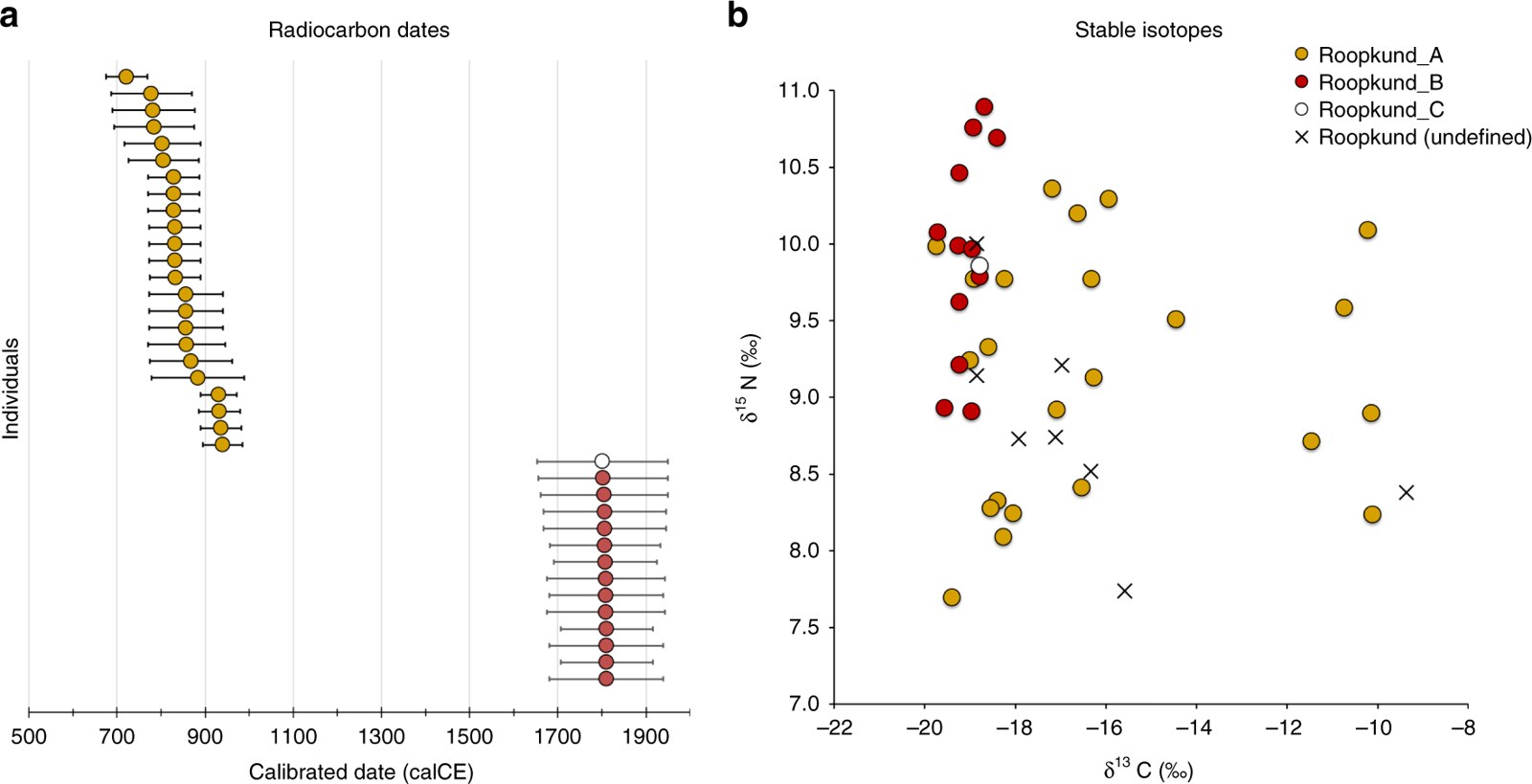
The evidence: Radiocarbon dates and stable-isotope measurements for Roopkund individuals (Harney et al. 2019, Fig. 3)
Roopkund Skeleton Lake: Many Deaths, Centuries Apart
Last reviewed Next review
We review and update every article weekly. When the record changes, so does the article. How we review
Hundreds of skeletons rim a tiny Himalayan lake. DNA and radiocarbon show South Asian and eastern Mediterranean groups who died about a thousand years apart.
Verdict: The bones are real and come from several groups who died centuries apart; ancient DNA and radiocarbon rule out one single catastrophe, while the exact causes of death remain open.
Original sources: Harney, É. et al., 'Ancient DNA from the skeletons of Roopkund Lake reveals Mediterranean migrants in India', Nature Communications 10:3670 (2019), DOI 10.1038/s41467-019-11357-9 (CC BY 4.0) · The Hindu, 'Skeletons at Roopkund lake have Mediterranean origins, reveals study' (CCMB / K. Thangaraj briefing, Hyderabad) · Soutik Biswas, 'The mystery of India’s ‘lake of skeletons’', BBC News, 28 February 2021 · Penn State Institutes of Energy and the Environment, 'The Secrets of Skeleton Lake' (radiocarbon lab role) · Wikimedia Commons file page for the header photograph of Roopkund Lake (Schwiki, CC BY-SA 4.0)

Sources Harney et al., Nature Communications 10:3670 (2019), DOI 10.1038/s41467-019-11357-9; The Hindu (CCMB/Thangaraj briefing, 20-21 Aug 2019); BBC News, Soutik Biswas (28 Feb 2021); Penn State IEE, Secrets of Skeleton Lake
High in the Garhwal Himalaya of Uttarakhand, India, a glacial pond about forty meters across sits at roughly 5,029 meters. Local names and tourist copy call it Roopkund, Skeleton Lake, or Mystery Lake. When the ice retreats, hundreds of human skeletons lie around and in the water. We do not pin the site, and we show no photographs of the remains. The header is a landscape of the lake alone. The evidence block is a scientific figure from the 2019 ancient-DNA study: radiocarbon dates and diet isotopes, not bones.
What the 2019 study found
We read Harney and colleagues in Nature Communications (20 August 2019; CC BY 4.0). Sampling work began from remains held by the Anthropological Survey of India in Kolkata, with ancient DNA lab work at CSIR-Centre for Cellular and Molecular Biology in Hyderabad and at Harvard Medical School. The authors reported genome-wide data from 38 individuals.
They found three genetic clusters:
- Roopkund_A (23 people): ancestry within the range of present-day South Asians, not a single tight endogamous group.
- Roopkund_B (14 people): ancestry typical of the eastern Mediterranean; in their West Eurasian PCA and qpWave tests, the closest present-day match among tested groups was Crete. That does not prove the travelers came from Crete itself.
- Roopkund_C (1 person): Southeast Asian-related ancestry, modeled in the paper as largely Malay-related with a Vietnamese-related component.
Among the 38 with genome-wide data there were 23 genetic males and 15 genetic females. The authors reported no relative pairs at third degree or closer, and they found no DNA evidence of bacterial pathogens in the bone powder they tested (they caution that absence of evidence is not proof against disease).
Radiocarbon dating on the same bone powders, with collagen extracted and purified at the Pennsylvania State University AMS radiocarbon facility and the 14C measurements performed at UCIAMS (University of California, Irvine), put the South Asian-related Roopkund_A individuals around the seventh to tenth centuries CE (~800 CE in the paper’s summary), with non-overlapping dates that imply more than one deposition even within that earlier cluster. The Roopkund_B and Roopkund_C individuals date around the seventeenth to twentieth centuries CE (~1800 CE). Stable carbon and nitrogen isotopes also split with the genetic groups: group B (and C) look like a C3 terrestrial diet; group A shows a wider mix including C4 signals consistent with millet or animals foddered on it.
Those results overturn the long-running idea that everyone at the lake died in one shared catastrophe.
Earlier stories and Indian lab briefings
Press and folklore had offered a king and queen struck down on a Nanda Devi pilgrimage, an army or merchant party caught in a storm, epidemic burial, or even nineteenth-century soldiers. Osteological notes reprinted with the 2019 paper (an older unpublished physical-anthropology assessment) had already hinted at more than one body type and at unhealed compression fractures that some readers tied to violent hail; the genetic work now shows those bones were never one traveling party.
When the paper landed, CSIR-CCMB leaders in Hyderabad briefed reporters. The Hindu (20-21 August 2019) quoted chief scientist K. Thangaraj on Indian, eastern Mediterranean (Greece/Crete-linked), and Southeast Asian signals, radiocarbon separations of about a thousand years, the absence of weapons and of bacterial DNA in their screening, and the still-open question of why Mediterranean-linked people were at the lake. BBC News correspondent Soutik Biswas later summarized the same study for a general audience (28 February 2021), including Harney’s line that the deaths cannot be explained as a single event. Penn State’s research write-up walks through how the radiocarbon lab first saw dates a millennium apart and how those dates lined up with the genetic labels Roopkund_A and Roopkund_B.
Accounts of who first reported the lakeside bones in the mid-twentieth century differ by outlet (some name an Indian forest official around 1942; others point to 1950s Anthropological Survey expeditions). We treat the mid-century discovery narrative as background and rest the verdict on the biomolecular paper and the Indian and international reporting that cite it.
Pilgrimage context, without a pin
Harney and colleagues note that Roopkund sits on a route used today by the Nanda Devi Raj Jat pilgrimage, held every twelve years, and that temple inscriptions in the wider region between the eighth and tenth centuries hint at earlier sacred traffic even though reliable written descriptions of the modern pilgrimage appear only much later. They treat a mass death during pilgrimage as a plausible reading for at least some of the earlier South Asian-related individuals. The later eastern Mediterranean group is harder to place: the paper says a large party from that ancestry joining a Hindu pilgrimage would be surprising, and it leaves archival work on foreign travelers in the Himalaya over the last few centuries as an open task.
Because the site is a human-remains landscape on a sacred mountain pilgrimage route, we keep it off the public map.
Sources
- Éadaoin Harney et al., “Ancient DNA from the skeletons of Roopkund Lake reveals Mediterranean migrants in India,” Nature Communications 10, Article 3670 (2019), DOI 10.1038/s41467-019-11357-9; open access HTML (CC BY 4.0; read 7 Nov 2026)
- The Hindu, “Skeletons at Roopkund lake have Mediterranean origins, reveals study,” Hyderabad briefing with CSIR-CCMB director Rakesh Mishra and K. Thangaraj: thehindu.com (read 7 Nov 2026)
- Soutik Biswas, “The mystery of India’s ‘lake of skeletons’,” BBC News, 28 February 2021: bbc.com/news (read 7 Nov 2026)
- Penn State Institutes of Energy and the Environment, “The Secrets of Skeleton Lake” (radiocarbon dating role of Brendan Culleton / Penn State AMS): psu.edu (read 7 Nov 2026)
- Header photograph: Schwiki, “Roopkund Lake,” 24 August 2014, Wikimedia Commons, CC BY-SA 4.0, file page (no remains visible; read 7 Nov 2026)
Weighing it
The popular single-storm, single-party story does not survive the genetics or the dates. At least two main deposition periods, roughly a thousand years apart, and three ancestry clusters are on the record from a multi-lab study that Indian institutions helped lead and sample. Diet isotopes track those clusters. That is enough to mark the composition of the site explained.
What killed each group is still not settled. Hail, slips on ice, altitude, weather, and other accidents remain hypotheses; pathogen DNA was not recovered from the powders tested, and no weapon assemblage supports a battle story. Why people with eastern Mediterranean-related ancestry were in this high basin around 1800 CE is an open historical question. We keep the pin off and the remains off camera.
Every image on this page is credited where it appears.
Verdict
Explained The bones are real and come from several groups who died centuries apart; ancient DNA and radiocarbon rule out one single catastrophe, while the exact causes of death remain open.
Update log
-
We added this case file.
-
Weekly re-check of sources; no change to the record since filing. Next check November 23, 2026.
Discussion
Discuss this case on the on-site Community board — no GitHub account required. Prefer a private tip for the editorial team? Submit a Sighting.
House rules: Community guidelines.