The Red Ghost: Arizona's Camel With a Dead Man on Its Back
For about a decade, frontier Arizona told stories of a huge red animal carrying a corpse. An 1893 newspaper said a rancher finally shot it, and it was a camel, laced with knotted rawhide. The camels were real. Almost everything else rests on a single story.
Sources Mohave County Miner (Mineral Park, A.T.), 25 Feb 1893, p.3, “The Phantom that Terrified all Arizona for a Time” (Library of Congress, Chronicling America); Robert Froman, “The Red Ghost,” American Heritage 12:3 (April 1961); Report of the Secretary of War… respecting the purchase of camels for the purposes of military transportation (U.S. Senate, 1857); Arizona Weekly Citizen (Tucson), 25 Aug 1883, p.3
Locale map
Arizona has a lot of ghost stories. The Red Ghost is one of the few where the “ghost” turned out to be a real animal, a camel. The trouble is everything around it. The rider, the death that started the legend and most of the sightings come down to one printed story, retold for more than a century.
Single-origin story. Every version the ledger has found goes back to one narrative, printed in the Mohave County Miner on 25 February 1893 and retold since, most fully by American Heritage in 1961. There’s independent evidence that camels roamed Arizona. There’s none yet for the dead rider, and none for the 1883 death that supposedly started it all.
The camels were real
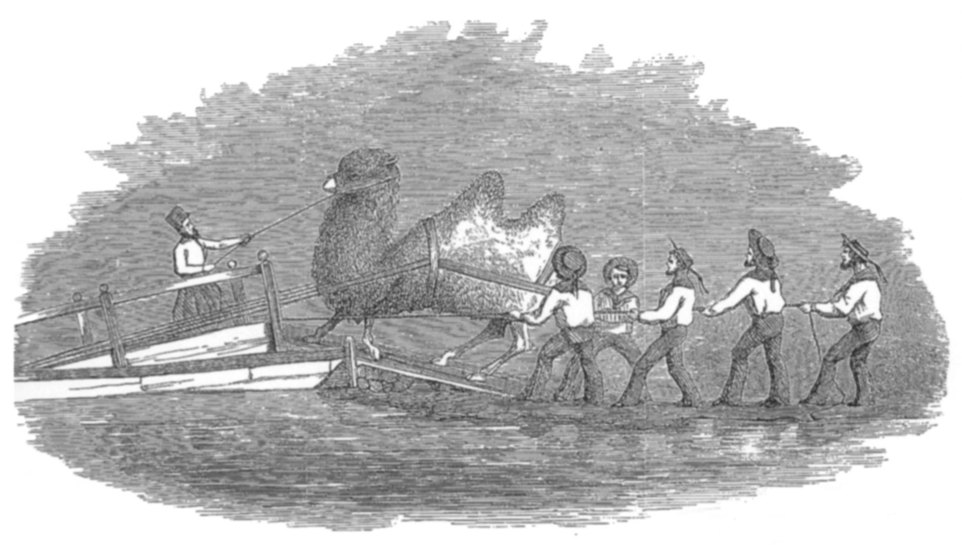
In the 1850s the U.S. War Department bought camels to test them as pack animals for the Army in the desert Southwest. The Secretary of War’s 1857 report to the Senate documents the purchase, and the engraving above comes from it. The experiment didn’t last. Robert Froman’s 1961 American Heritage history says the Army formally gave it up in 1863. Some of the animals were auctioned, and others strayed or were turned loose. Hadji Ali, known as Hi Jolly, one of the handlers brought over with them, ended up releasing the last of his camels in Arizona in the late 1860s.
So a camel loose in 1880s Arizona was entirely possible. The Arizona Weekly Citizen of Tucson, 25 August 1883, carried an item about Los Angeles men organizing a camel hunt in the Gila bottoms. That’s an independent sign that people believed feral camels were out there that very year.
The story, as later told
Froman’s version runs roughly like this:
- Spring 1883, Eagle Creek. At a sheep ranch in southeastern Arizona, a woman going for water was found trampled. There were huge cloven hoofprints and long red hairs caught in the willows. Froman says a coroner’s jury returned a verdict of “death in some manner unknown.”
- Chase Creek, days later. Two prospectors said something impossibly tall knocked their tent down in the night and crashed off into the brush.
- Salt River country, a month later. A rancher looking for strays saw a big reddish animal across a ravine, recognized it as a camel, and thought it carried something on its back that looked like a man.
- Near the Verde. Prospectors fired at the camel. As it ran, something fell from its back. Froman quotes the Miner: a human skull with a few shreds of flesh and hair still attached.
- Later sightings grew wilder. A freighting camp claimed a 30-foot winged beast. Froman notes that the camp’s cargo included whiskey. Then a cowhand at an Anchor-brand outfit east of Phoenix roped the camel at a corral, and it charged and knocked down horse and rider. It was the last time anyone reported the burden on its back.
Froman himself admits the weakness: “the only contemporary account of this career seems to be the one in the Miner.” He also says the Miner reported the 1883 inquest. The ledger and its research desk haven’t found any 1883 report of the Eagle Creek death. For now, that death rests only on later retellings.
The 1893 report
Here’s what the Mohave County Miner actually printed on 25 February 1893, as reproduced by Froman and checked against the Library of Congress page by the ledger’s research desk. A rancher named Mizoo Hastings, who lived above the gold camp of Ore on the San Francisco River, woke up to see “a big red camel” in his turnip patch, shot it from his cabin window, and found it scarred and covered with “a perfect network of knotted rawhide strips.” Some strands had cut into its flesh. The same report said Arizona’s camels descended from a bunch the government had turned loose.
The tone is worth noticing. The piece is a lively, tongue-in-cheek feature (“Another ghost is laid”), reportedly reprinted from a San Francisco paper. The ledger hasn’t verified that origin.
What’s established, and what isn’t
- Established: the Army imported camels; feral camels were believed to be in Arizona in 1883; an 1893 newspaper reported a rawhide-scarred red camel shot on the San Francisco River.
- Unverified: that the Hastings camel was the same animal as earlier sightings; that it ever carried a man; who he was and how he got there; the Eagle Creek death; the Verde skull.
Froman speculates about who tied the rider on. The ledger doesn’t repeat that. No source names a man, a date or a place for it.
Ledger status
Folklore, with a real animal at its core. Treat the corpse, the killing and the long chain of sightings as one newspaper story and its retellings until an independent 1880s record turns up. The next step is the Arizona Silver Belt (Globe) and the Clifton Clarion for spring 1883.
Visit: the Verde Valley is one of the story’s named sighting areas. The legal, public place to learn about Arizona’s frontier Army there is Fort Verde State Historic Park. No sighting locations are mapped. The ranch and creek sites are vague and their land status is unknown.
Sources
Primary:
- Mohave County Miner (Mineral Park, Arizona Territory), 25 Feb 1893, p.3, “The Phantom that Terrified all Arizona for a Time.” Library of Congress, Chronicling America. Text checked from the LoC OCR by the ledger’s research desk. The ledger quotes the passages Froman reproduces.
- Arizona Weekly Citizen (Tucson), 25 Aug 1883, p.3 (camel-hunt item). Library of Congress, Chronicling America. Checked from the LoC OCR by the research desk.
- Report of the Secretary of War, communicating… information respecting the purchase of camels for the purposes of military transportation (U.S. Senate, 1857). Internet Archive.
Secondary:
- Robert Froman, “The Red Ghost,” American Heritage 12:3 (April 1961). americanheritage.com.
Evidence ledger
Each claim in this file, the source it rests on, and how well it holds up: 2 corroborated · 3 unverified. What the labels mean.
| Claim | Source | Type · date | Status |
|---|---|---|---|
| The U.S. War Department bought camels in the 1850s for desert military transport. | Report of the Secretary of War respecting the purchase of camels (U.S. Senate, 1857) | official · 1857 | corroborated |
| Feral camels were believed to be roaming Arizona in 1883.Supports the animal, not the Red Ghost story itself. | Arizona Weekly Citizen (Tucson), 25 Aug 1883, p.3 (camel-hunt item) | period press · 1883 | corroborated |
| Rancher Mizoo Hastings shot a big red camel in his turnip patch on the San Francisco River, its hide covered in knotted rawhide strips.One printed account; no second witness or record found. | Mohave County Miner, 25 Feb 1893, p.3 | period press · 1893 | unverified |
| The camel carried a man's remains, and prospectors on the Verde found a skull that fell from it.Single narrative origin. | Mohave County Miner as quoted by Froman, American Heritage (1961) | secondary · 1961 | unverified |
| In spring 1883 the Red Ghost trampled a woman to death at a sheep ranch on Eagle Creek.No 1883 newspaper or inquest record of the death has been found; it rests on later retellings. | Robert Froman, American Heritage (April 1961) | secondary · 1961 | unverified |
Discussion
Discussions activating. Per-case threads will embed here once the Giscus GitHub App is installed on the public satellite repo.
Meanwhile, join the conversation on GitHub Discussions: https://github.com/dclewis21/anomaly-ledger-community/discussions
CoS / D.C.: see Community guidelines and
SETUP.mdin the site repo for the one-click Giscus install.