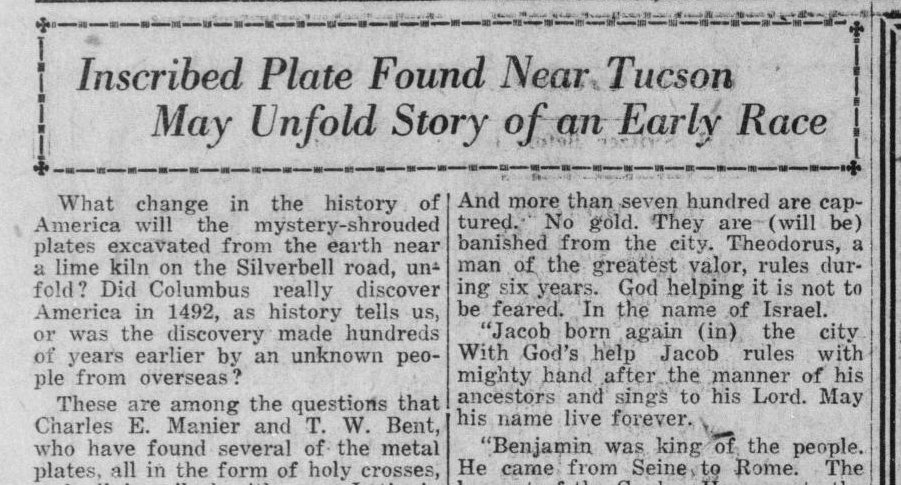
The Tucson Lead Crosses and the Kingdom of Calalus
Between 1924 and 1930, lead crosses and swords with Latin inscriptions came out of the caliche beside an old lime kiln on Silverbell Road. They seemed to tell of a Roman-Jewish colony in eighth-century Arizona. The 1925 skeptics had it right: they're a hoax.
Sources Coconino Sun (13 Mar 1925); St. Johns Herald (2 Jul 1925); Bozeman Courier (12 Aug 1925; 22 Jan 1926); Evening Star, Washington (14 Dec 1925); Intermountain Jewish News (24 Dec 1925), all via Library of Congress, Chronicling America; Arizona Historical Society, Bent Family Collection finding aid (MS 1122); Pima County Public Library; Archaeology Southwest (2009); Don Burgess, Journal of the Southwest 51:1 (2009)
In September 1924 Charles E. Manier came across a piece of metal sticking out of the ground by a ruined lime kiln on Silverbell Road, about seven miles north of Tucson, on land owned by Thomas W. Bent. He dug it out of the caliche, the hard, lime-cemented soil of the desert, and found a lead cross covered in lettering. Over the next several years Manier, Bent and others pulled out more crosses, swords, spear points and a carved caliche plaque. The inscriptions, in Latin with some Hebrew, seemed to describe a lost kingdom in the American desert between about A.D. 775 and 900.
How many objects there were depends on whom you ask. The Arizona Historical Society’s finding aid says 24 came out of the site over two years. Archaeology Southwest’s 2009 program notes say 31. The Pima County Public Library says 32. The ledger reports the range rather than picking one.
What the inscriptions said
Arizona papers printed a translation credited to Prof. Frank H. Fowler of the University of Arizona’s classics department. The Coconino Sun ran it on 13 March 1925, and the St. Johns Herald repeated the same text that July. The lines tell of being carried over the sea to “Calalus, an unknown land,” of a war with a people called the “Toltezus,” of rulers named Theodorus, Jacob and Israel, and of a captured city. The Sun listed A. E. Douglass of the Steward Observatory and Karl Ruppert of the state museum among the scientists who had taken an interest, and it noted that the university’s experts first suspected the work of an educated hermit.
By December 1925 the story was national. An Associated Press dispatch out of Tucson, carried by the Washington Evening Star on 14 December, quoted the excavation director, former UA geology professor C. J. Sarle, on his theory that Roman Jews had landed around 775, made alliances with or conquered local people, and ruled for about a century before being overthrown. Byron Cummings, head of the university’s archaeology department, was quoted saying the Latin “closely resembled” that of the period.
The skeptics, 1925
Doubts appeared in print almost as fast as the claims did.
- In August 1925 the Bozeman Courier reported that University of Chicago classicist Charles H. Beeson had reviewed the inscriptions. He found nothing that identified the writer and suggested that a Spanish priest, or wandering adventurers, might account for them.
- The same 14 December wire story that carried Sarle’s theory ended with New York experts. Clarence L. Hay of the American Museum of Natural History said the relics “impressed him as fraudulent.” Columbia’s Richard Gottheil, a scholar of Semitic languages, called the find a hoax.
- On 24 December Denver’s Intermountain Jewish News columnist Wm. Z. Spiegleman wrote that Jews carrying crosses, crescents and menorahs together “seems highly improbable.”
What later work found
Modern sources agree. The Pima County Public Library summary says researchers now consider the items forgeries. The Arizona Historical Society’s finding aid lists the main objections: some objects use “A.D.” dating before that convention was common, the inscriptions include modern words, and a sculptor familiar with the classics was said to have lived on the site for about a decade in the 1880s–90s.
The fullest study is Don Burgess’s “Romans in Tucson? The Story of an Archaeological Hoax” (Journal of the Southwest, Spring 2009). We have not read the full paper. A published transcription of its conclusion lists reasons that Burgess says go back to Cummings’s own advice against the university buying the objects. Lead can’t hold a cutting edge, and there’s no evidence lead weapons were ever made. The metal resembles common pot metal. The weapons show tool marks. There are no burials or battle remains at the site. One trench wall had a hole made for inserting an object. And most of the inscriptions match passages in standard Latin grammar textbooks of the time. The caliche deposit is also far older than any medieval colony could be.
Who made the objects is unresolved in the sources we read, and the ledger isn’t naming anyone.
Competing explanations
- A genuine record of an eighth-century Roman-Jewish colony. Championed by Sarle and Bent. No settlement, burials, battle debris or matching artifacts have ever been found, and the language and metal argue against it.
- Later Spanish or colonial-era objects. Beeson’s 1925 suggestion. It would take the date down by centuries but leaves the textbook Latin and the trench evidence unexplained.
- A modern forgery planted in the kiln site. The consensus of the custodial and scholarly sources: textbook phrasing, ordinary lead alloy, tool marks, and signs of insertion into the deposit.
- Honest mistakes by the finders. It’s possible to be wrong in good faith. According to the AHS finding aid, Bent went on believing in the finds throughout the controversy and wrote a long defense of them in 1928. That speaks to sincerity, not to authenticity.
Ledger status
Marked hoax. The objects are real and in the Arizona Historical Society’s collection, which received them along with Bent’s papers from his son in 1994. The Pima County Public Library notes they aren’t on display. The kingdom of Calalus is not real. What’s worth keeping is the archive itself: a 1925 news cycle where the doubts were printed right beside the hype, if anyone read to the end of the story.
Visiting: this file gives no location for the kiln site. It’s a ruin of unverified ownership and access, with unstable masonry and broken ground. Please don’t go looking for it.
Sources
Library of Congress, Chronicling America:
- The Coconino Sun (Flagstaff, Ariz.), 13 Mar 1925, p.12, “Inscribed Plate Found Near Tucson May Unfold Story of an Early Race” — loc.gov
- The St. Johns Herald (St. Johns, Ariz.), 2 Jul 1925, p.4 (same translation text) — loc.gov
- The Bozeman Courier (Bozeman, Mont.), 12 Aug 1925, p.11 (Beeson’s review) — loc.gov
- Evening Star (Washington, D.C.), 14 Dec 1925, p.3, “Experts Question Relics in Arizona” (wire: Sarle, Cummings; Hay, Gottheil) — loc.gov
- Intermountain Jewish News (Denver), 24 Dec 1925, p.7 (report) and p.4 (“Seeking ‘Calalus,’” Wm. Z. Spiegleman) — p.7 · p.4
- The Bozeman Courier, 22 Jan 1926, p.3, “Hebrew Relics Raise Doubts” (wire repeat) — loc.gov
Custodial and scholarly:
- Arizona Historical Society, Tucson, Bent Family Collection, Papers 1924–1994 (MS 1122), finding aid — arizonahistoricalsociety.org (PDF)
- Pima County Public Library, “Romans Allegedly in Tucson” (The Librarian Files) — library.pima.gov
- Archaeology Southwest, “Romans in Tucson?” Archaeology Café with Don Burgess, 1 Dec 2009 — archaeologysouthwest.org
- Don Burgess, “Romans in Tucson? The Story of an Archaeological Hoax,” Journal of the Southwest 51, no. 1 (Spring 2009): 3–102 — jstor.org (full text not read; conclusions as transcribed at bhroberts.org)
Evidence ledger
Each claim in this file, the source it rests on, and how well it holds up: 3 corroborated · 1 disputed · 1 unverified · 1 debunked. What the labels mean.
| Claim | Source | Type · date | Status |
|---|---|---|---|
| Charles Manier dug a lettered lead cross out of caliche on Silverbell Road in September 1924. | Arizona Historical Society MS 1122 finding aid; Pima County Public Library | museum / archive · 1924 | corroborated |
| The number of objects found was 24, 31 or 32. | AHS finding aid (24); Archaeology Southwest 2009 (31); Pima County Public Library (32) | museum / archive | disputed |
| Roman Jews ruled ‘Calalus’ in the desert around A.D. 775–900. | C. J. Sarle via AP, Evening Star, 14 Dec 1925 | period press · 1925 | debunked |
| Experts called the relics fraudulent in 1925. | Evening Star (14 Dec 1925); Bozeman Courier (12 Aug 1925); Intermountain Jewish News (24 Dec 1925) | period press · 1925 | corroborated |
| The artifacts are forgeries.Burgess read through a published summary of his conclusions only. | Pima County Public Library; AHS finding aid; Burgess, Journal of the Southwest (2009) | scholarly · 2009 | corroborated |
| We know who made the objects.Unresolved. | Sources cited in this file | secondary | unverified |
Discussion
Discussions activating. Per-case threads will embed here once the Giscus GitHub App is installed on the public satellite repo.
Meanwhile, join the conversation on GitHub Discussions: https://github.com/dclewis21/anomaly-ledger-community/discussions
CoS / D.C.: see Community guidelines and
SETUP.mdin the site repo for the one-click Giscus install.