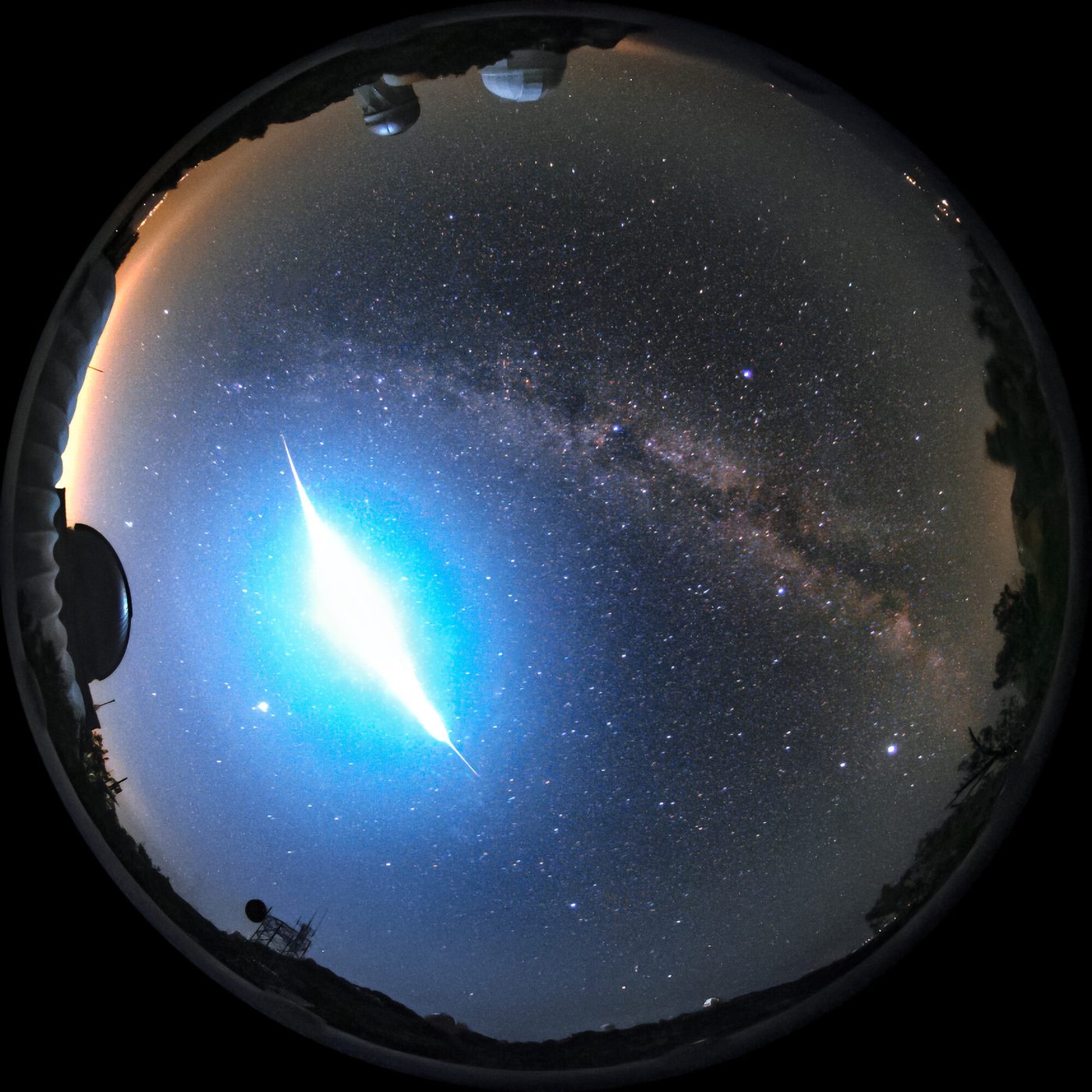
The 2 June 2016 Arizona Fireball: Not a Rocket, and the Stones to Prove It
At 3:56 a.m. on June 2, 2016, a fireball lit up the Southwest, and sonic booms were heard across the Phoenix area. More than 400 people reported it. It wasn't a launch or a re-entry. Radar tracked falling stones, and fifteen meteorites were recovered. They were named Dishchii'bikoh.
Sources Meteoritical Bulletin Database, “Dishchii'bikoh” (MB 106); NASA/JPL CNEOS Fireball Data API; American Meteor Society Event 1882-2016 (via Wayback Machine); Palotai et al., MNRAS (2019), arXiv:1801.05072; Jonathan McDowell, GCAT launch list
Before dawn on Thursday, June 2, 2016, a flash lit up the sky over Arizona and much of the Southwest. Across the Phoenix area, people woke to booms. It’s the kind of event that this desk’s readers sometimes ask about years later: was it a rocket? A re-entry?
It was a meteor. Unusually, pieces of it were picked up off the ground three weeks later.
What was seen
The Meteoritical Bulletin’s write-up puts the fireball at 3:56:34 a.m. MST (10:56:34 UTC), and says it “was widely observed throughout the southwestern US.” The American Meteor Society logged it as Event 1882-2016. By the archived count, the AMS had 424 reports from Arizona, California, Colorado, New Mexico, Nevada, Texas and Utah. 95 of those witnesses reported a delayed sound. A study in Monthly Notices of the Royal Astronomical Society by Csaba Palotai and colleagues says sonic booms “were heard across the greater Phoenix area.” It estimates the fireball’s peak brightness at about magnitude −20, far brighter than a full moon.
What the instruments recorded
Several independent instruments picked it up:
- US government sensors recorded its energy. The Meteoritical Bulletin gives a total radiated energy of 17.2 × 10¹⁰ joules, about 0.49 kilotons of TNT. NASA/JPL’s public fireball database, queried on 4 October 2026, lists 24.9 × 10¹⁰ J and 0.68 kt for the same event. The ledger shows both figures because they don’t match.
- Weather radar. The NOAA NEXRAD radar at Flagstaff picked up returns consistent with falling meteorites about 40 seconds after the fireball, and again a few minutes later.
- Seismic. The air-blast shockwave registered at the Payson-Strawberry seismic station.
- Cameras. Palotai’s team used three cameras in the SkySentinel fireball network, plus dash-cam footage. They worked out that the object entered at about 17.4 km/s, and that it was roughly 2 meters across and about 15 tonnes before it broke up.
Why it wasn’t a rocket
The ledger checked Jonathan McDowell’s public launch catalog for 1–2 June 2016. There was no orbital launch. The only entry was a NASA Black Brant IX sounding rocket from White Sands, about 16 hours before the fireball. A re-entering rocket stage or satellite leaves metal debris. This event left stones.
The meteorites
Doppler radar pointed searchers to the south-western corner of White Mountain Apache tribal lands. According to the Meteoritical Bulletin, the tribal chairman granted permission to enter the lands and search. A team from Arizona State University and three private meteorite hunters found 15 fusion-crusted stones, weighing 79.46 grams in total, on June 22 and 23. The meteorite was classified as an LL7 ordinary chondrite and approved in 2017 under the name Dishchii’bikoh. The Bulletin records it as “Apache for Cibecue star stone.”
The finds sit on tribal land that was searched only with permission. The ledger doesn’t publish find locations or pin the strewn field.
Ledger status
Cited (explained). It was a natural superbolide, recorded by eyewitnesses, government sensors, radar and a seismometer, with meteorites in hand. The rocket check comes up empty.
For the opposite answer, where the light in the sky really was a rocket, see SAOCOM 1A over Phoenix (2018) and Starlink 11-20 (2025).
Sources
- Meteoritical Bulletin Database, “Dishchii’bikoh” (MB 106, approved 29 May 2017), Meteoritical Society / Lunar and Planetary Institute — lpi.usra.edu
- NASA/JPL Center for Near Earth Object Studies, Fireball Data API, 2016-06-02 10:56:32 UTC, queried 4 Oct 2026 — cneos.jpl.nasa.gov/fireballs
- American Meteor Society, Event 1882-2016 — Wayback Machine copy
- C. Palotai, R. Sankar, D. L. Free, J. A. Howell, E. Botella & D. Batcheldor, “Analysis of June 2, 2016 bolide event,” Monthly Notices of the Royal Astronomical Society (2019), doi:10.1093/mnras/stz1424 — arXiv:1801.05072
- Jonathan McDowell, General Catalog of Artificial Space Objects (GCAT), launch list, 1–2 Jun 2016 (entry 2016-S36, Black Brant IX, White Sands, 1 Jun 19:00 UTC) — planet4589.org
Evidence ledger
Each claim in this file, the source it rests on, and how well it holds up: 4 corroborated · 1 debunked. What the labels mean.
| Claim | Source | Type · date | Status |
|---|---|---|---|
| A bright fireball was widely seen across the southwestern US at 3:56 a.m. MST on 2 Jun 2016. | Meteoritical Bulletin, “Dishchii'bikoh”; AMS Event 1882-2016 (424 reports from seven states) | primary record · 2016–2018 | corroborated |
| It was a rocket launch or a re-entry.No orbital launch on 1–2 Jun 2016. The only entry is a Black Brant IX sounding rocket from White Sands about 16 hours earlier. The recovered stones are natural chondrite, not hardware. | Ledger check of GCAT launch list | ledger analysis · 2026 | debunked |
| US government sensors measured its energy.The two published figures differ. Both are shown, with their dates. | Meteoritical Bulletin (DoD sensors: 17.2 × 10^10 J, 0.49 kt); CNEOS Fireball API, queried 4 Oct 2026 (24.9 × 10^10 J, 0.68 kt) | official · 2018; 2026 | corroborated |
| Meteorites from the fireball were recovered.15 fusion-crusted stones, 79.46 g total, found on 22–23 June 2016 with the White Mountain Apache Tribe's permission. Classified LL7 ordinary chondrite. | Meteoritical Bulletin, MB 106 | scholarly · 2018 | corroborated |
| The incoming body was about 2 m across and about 15 tonnes.14.8 ± 1.7 t; 2.03 ± 0.12 m; 17.4 km/s; peak magnitude about −20.4. | Palotai et al., MNRAS (2019) | scholarly · 2019 | corroborated |
Discussion
Discussions activating. Per-case threads will embed here once the Giscus GitHub App is installed on the public satellite repo.
Meanwhile, join the conversation on GitHub Discussions: https://github.com/dclewis21/anomaly-ledger-community/discussions
CoS / D.C.: see Community guidelines and
SETUP.mdin the site repo for the one-click Giscus install.