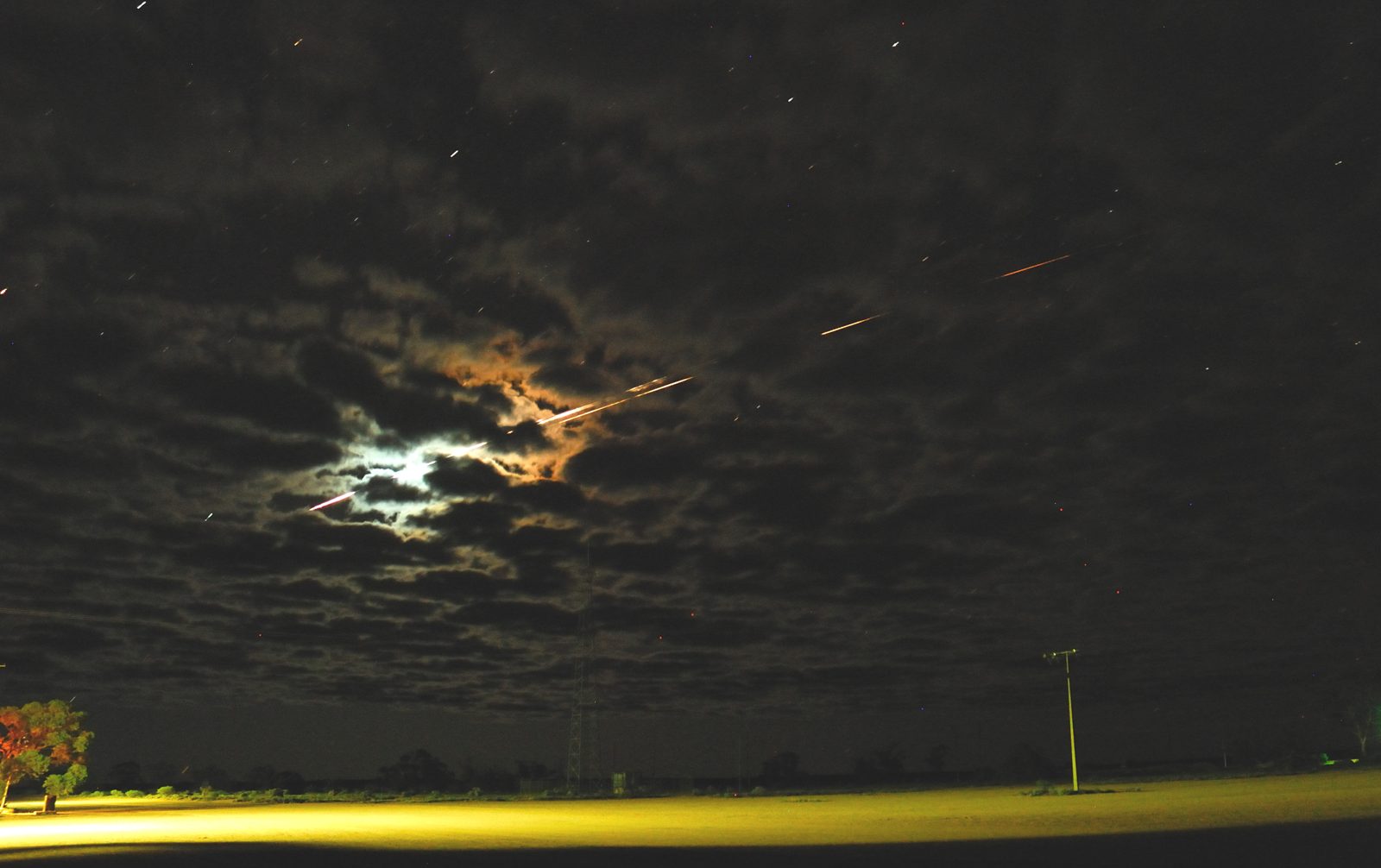
The Slow Fireball of December 22, 2015: A Russian Rocket Stage Comes Home Over Arizona
On the Tuesday before Christmas 2015, a bright, slow, fragmenting light crossed the evening sky from California to Arizona. It wasn't a meteor. It was the spent third stage of the Soyuz rocket that had launched a cargo ship to the space station the day before.
Sources Jonathan McDowell, GCAT satellite catalog, S41178 (2015-080B, Soyuz-2-1a Blok-I; decay 23 Dec 2015 02:08 UTC) and launch list 2015-080; American Meteor Society, Vincent Perlerin, “Space Junk Re-entry over California and Nevada,” 23 Dec 2015 (AMS Event #4087-2015; Wayback copy); Associated Press via CBC News, 23 Dec 2015 (U.S. Strategic Command identification)
At about 6:10 p.m. PST on Tuesday, December 22, 2015 (7:10 p.m. in Arizona), people from Northern California to Las Vegas to Kingman watched a bright light move slowly across the sky and break into pieces. Some filmed it. Many guessed it was a meteor. A few joked about Santa’s sleigh. Others wondered about a missile.
By the next morning, three independent sources agreed on the answer. The object had launched from Kazakhstan the day before.
Three kinds of evidence, one answer
- Witnesses, via the American Meteor Society. AMS received more than 55 reports of a bright object over California, Nevada and Arizona “around 18:10 PST.” Its write-up that week was blunt: “It wasn’t a fireball.” It was Russian space debris, “a SL-4 rocket body that reentered the atmosphere somewhere above Arizona.” AMS also published an approximate trajectory based on the reports (Event #4087-2015).
- The military, via AP. U.S. Strategic Command spokeswoman Julie Ziegenhorn told the Associated Press that the fireball was “an SL-4 rocket body booster from Russia that was launched Monday.” SL-4 is the U.S. designation for the Soyuz rocket family. Space-debris expert David Wright of the Union of Concerned Scientists told AP that it was “not something people need to worry about.”
- The public catalog. Jonathan McDowell’s GCAT pins it down. On Monday, December 21, 2015, at 08:44 UTC, a Soyuz-2-1a lifted off from Baikonur carrying Progress MS-01, a cargo ship bound for the International Space Station. The rocket’s third stage, the Blok-I (catalog piece 2015-080B), reached a low orbit with the spacecraft and was left behind when they separated at 08:53 UTC. GCAT gives its decay time as 02:08 UTC on December 23. That’s 7:08 p.m. MST on December 22, within two minutes of the AMS time. GCAT lists the approximate re-entry point as about 35°N, 111°W, which is northern Arizona.
Why debris doesn’t look like a meteor
A meteor hits the atmosphere at tens of kilometers per second and is usually gone in a second or two. A spent rocket stage falling out of a low orbit is moving at under 8 km/s, so it crosses the sky far more slowly and can stay visible for many seconds. Because it’s a large, hollow, multi-part object, it tends to break into a train of glowing fragments as it burns up. Witnesses often compare that to a line of burning planes, or a “fireball” that won’t end. A slow, fragmenting, long-lasting light is the classic sign of re-entry.
Ledger status
Cited (explained). Independent sources agree on the time, path and identification: AMS’s witness data, the U.S. military’s identification and the public orbital catalog.
This is the re-entry half of the Sky Desk’s “was it a rocket?” check. The other half is the launch plume. Exactly two years later, on 22 December 2017, the Iridium-4 launch lit up the same Southwest sky. For telling a re-entry from a meteor, see the October meteor guide.
No map pin, and no debris hunting. AMS says only that the stage re-entered “somewhere above Arizona.” Nothing in these sources says that any piece reached the ground.
Sources
- Jonathan McDowell, General Catalog of Artificial Space Objects (GCAT), satellite catalog entry S41178 (2015-080B, Soyuz-2-1a No. 026 Blok-I; separated 2015 Dec 21 0853 UTC; decayed 2015 Dec 23 0208 UTC). Launch list entry 2015-080 (Soyuz-2-1a, Progress MS-01, 2015 Dec 21 0844:39 UTC). planet4589.org
- Vincent Perlerin, “Space Junk Re-entry over California and Nevada,” American Meteor Society, 23 Dec 2015 (AMS Event #4087-2015). Wayback copy. The live AMS site was partly offline when the ledger checked (Oct 2026).
- The Associated Press, “Fireball over western U.S. identified as Russian rocket debris,” via CBC News, 23 Dec 2015. cbc.ca
Evidence ledger
Each claim in this file, the source it rests on, and how well it holds up: 3 corroborated · 1 debunked. What the labels mean.
| Claim | Source | Type · date | Status |
|---|---|---|---|
| More than 55 people reported a bright object over California, Nevada and Arizona around 6:10 p.m. PST (7:10 p.m. MST) on 22 Dec 2015. | American Meteor Society, Event #4087-2015 (Perlerin, 23 Dec 2015) | listing · 23 Dec 2015 | corroborated |
| U.S. Strategic Command identified the object as an SL-4 rocket body from Russia launched Monday.Official ID quoted second-hand; the USSTRATCOM release itself wasn't read. | AP via CBC News (spokeswoman Julie Ziegenhorn) | press · 23 Dec 2015 | corroborated |
| The object was the Soyuz-2-1a third stage (Blok-I, 2015-080B) from the Progress MS-01 launch, and it decayed at 02:08 UTC on 23 Dec, which is 7:08 p.m. MST on 22 Dec. | Jonathan McDowell, GCAT satcat S41178 | primary record · 2026 | corroborated |
| It was a meteor or fireball.AMS: “It wasn't a fireball.” | Witness posts collected by AMS and AP | social · 2015 | debunked |
Discussion
Discussions activating. Per-case threads will embed here once the Giscus GitHub App is installed on the public satellite repo.
Meanwhile, join the conversation on GitHub Discussions: https://github.com/dclewis21/anomaly-ledger-community/discussions
CoS / D.C.: see Community guidelines and
SETUP.mdin the site repo for the one-click Giscus install.