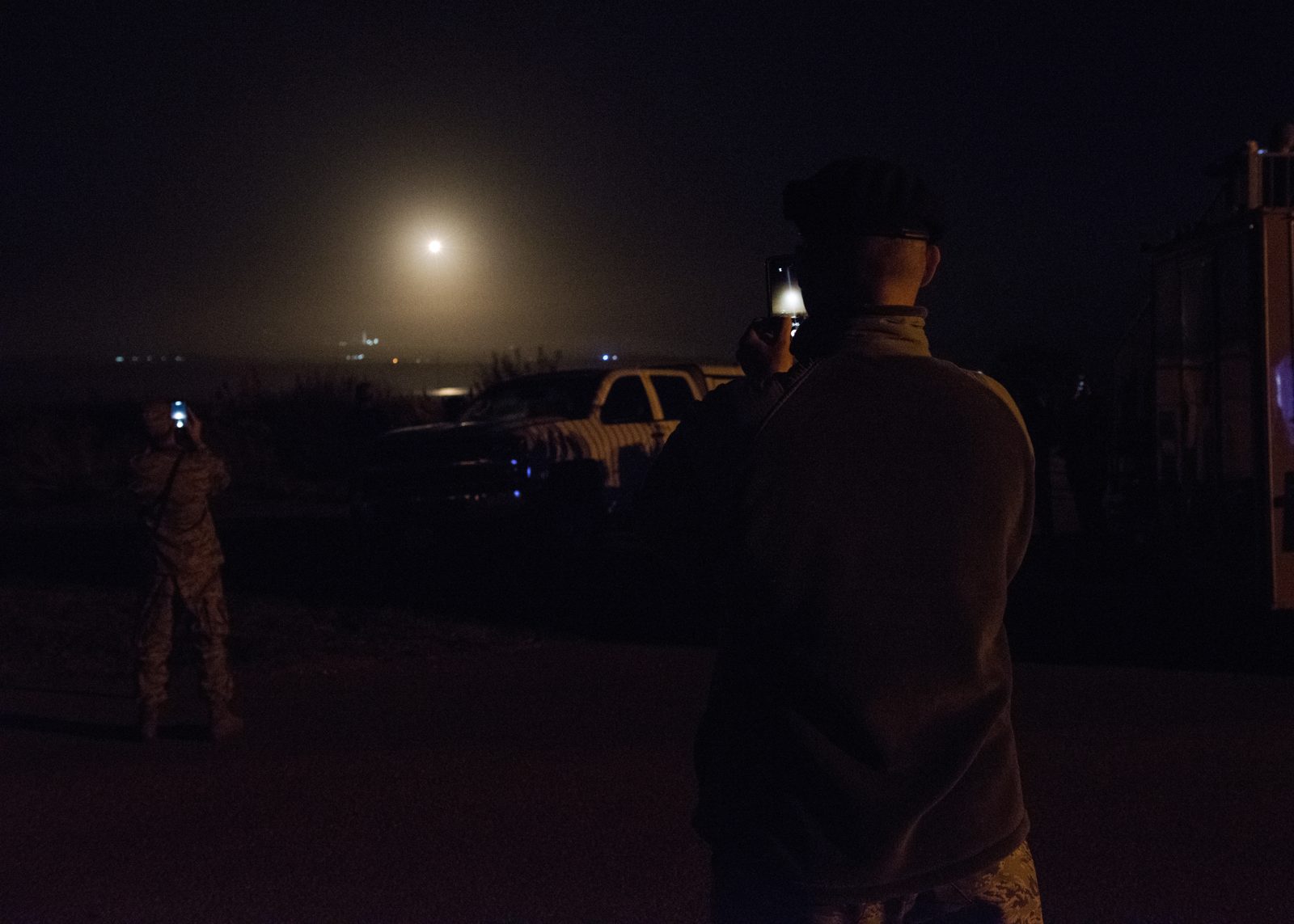
SAOCOM 1A: The 'Ghostlike' Streak Over Phoenix Was a Rocket (and Its Booster Coming Home)
At 7:21 p.m. on October 7, 2018, people across metro Phoenix photographed a strange glowing streak in the western sky. It was a Falcon 9 launched from Vandenberg in California, lit by a sun that had set over Arizona more than an hour earlier, and its first stage flew back to land at the base for the first time.
Sources Jonathan McDowell, GCAT launch list, entry 2018-076; U.S. Air Force, Vandenberg AFB photo caption, VIRIN 181007-F-XJ735-080 (7 Oct 2018, via Wayback Machine); KTAR News (8 Oct 2018)
On Sunday evening, October 7, 2018, people in the Phoenix area looked west and saw something they couldn’t place: a bright streak and a glowing, spreading cloud in a sky that had already gone dark. KTAR reported that witnesses across metro Phoenix “hit up social media with photos and videos of the peculiar streak of light and ghostlike images they saw.” One parent wrote that his son, watching from Surprise, was puzzled by the strange light until he was sent a link to the local news.
It was a rocket launched in California, and part of it was on its way back down.
The launch
A SpaceX Falcon 9 lifted off from Space Launch Complex 4 East at Vandenberg Air Force Base at 7:21 p.m. PDT on October 7, 2018. Arizona doesn’t observe daylight saving time, so that was also 7:21 p.m. in Phoenix. Jonathan McDowell’s public launch catalog logs it as 2018-076, at 02:21:28 UTC on October 8. The payload was SAOCOM 1A, an Argentine radar satellite, bound for a sun-synchronous orbit.
The flight had a second objective. The Air Force’s photo caption that night said the first stage landed at Landing Zone 4 at Vandenberg, the pad formerly called SLC-4W. It called this “SpaceX’s first land landing attempt” at the base. KTAR noted that the booster was back in less than ten minutes. So the sky that evening didn’t just have an ascending rocket in it. It also had a first stage turning around and firing its engines to fly home.
Why it glowed after dark
The ledger’s own calculation puts sunset in Phoenix at about 6:04 p.m. that day, with civil dusk ending around 6:29 p.m. At the launch site, sunset was about 6:37 p.m. PDT. The launch came roughly 44 minutes after sunset at Vandenberg and about 77 minutes after sunset in Phoenix. By then the ground in Arizona was dark. A rocket climbing high over the Pacific coast, though, was still in direct sunlight. Its exhaust spread out in the thin upper air and lit up as a pale, translucent cloud. This is the “twilight effect” behind most of the rocket sightings this desk gets from Arizona.
What the record shows
| Check | What the record shows |
|---|---|
| Time | Liftoff 7:21 p.m. in both California and Arizona. The KTAR posts are from that evening. |
| Direction | West, toward Vandenberg. |
| Appearance | A moving streak and a glowing, spreading plume, lasting minutes. That’s too slow and the wrong shape for a meteor. |
| Extra plumes | The returning first stage’s engine burns were also in the sky. Exactly what Phoenix saw of them, and when, isn’t documented, so the ledger doesn’t try to match individual photos to individual burns. |
Ledger status
Cited (explained). The launch catalog, the Air Force caption and the local press all point the same way. Local news identified the source of the light within hours.
It’s a companion to Iridium-4 over Los Angeles (2017) and Starlink 11-20 over Phoenix (2025). The pattern in all three is the same: a Vandenberg launch within about an hour and a half of sunset. For a pre-dawn flash that turned out not to be a rocket, see the 2 June 2016 Arizona fireball.
Sources
- Jonathan McDowell, General Catalog of Artificial Space Objects (GCAT), launch list, entry 2018-076 (Falcon 9 B1048.2, SAOCOM-1A, Vandenberg SLC-4E, 2018 Oct 8 02:21:28 UTC) — planet4589.org
- U.S. Air Force, “Vandenberg launches SpaceX Falcon 9,” photo caption, VIRIN 181007-F-XJ735-080, Vandenberg AFB, 7 Oct 2018 — Wayback Machine copy
- “SpaceX rocket brightens skies over Phoenix area, sparks curiosity, awe,” KTAR News, 8 Oct 2018 — ktar.com
- Sunset and twilight times: ledger computation with the open-source astral library (NOAA algorithm) for Phoenix and Vandenberg, 7 Oct 2018
Evidence ledger
Each claim in this file, the source it rests on, and how well it holds up: 4 corroborated · 1 debunked. What the labels mean.
| Claim | Source | Type · date | Status |
|---|---|---|---|
| A Falcon 9 carrying Argentina's SAOCOM 1A satellite launched from Vandenberg SLC-4E at 7:21 p.m. PDT (7:21 p.m. MST) on 7 Oct 2018. | GCAT entry 2018-076 (02:21:28 UTC, 8 Oct); USAF Vandenberg caption, VIRIN 181007-F-XJ735-080 | primary record · 2018 | corroborated |
| The first stage landed back at Vandenberg, at Landing Zone 4, the first land landing attempt there. | USAF Vandenberg caption; KTAR | official · 7–8 Oct 2018 | corroborated |
| People across metro Phoenix photographed a strange streak of light that evening. | KTAR News, 8 Oct 2018 (embedded posts from Surprise, Scottsdale and Phoenix) | press · 8 Oct 2018 | corroborated |
| Sun had set in Phoenix about 77 minutes before liftoff.Computed sunset 6:04 p.m. MST, civil dusk 6:29 p.m. At Vandenberg, sunset was about 6:37 p.m. PDT. These are the ledger's own figures, not an almanac's. | Ledger computation (NOAA solar algorithm via the astral library; Phoenix 33.45°N, 112.07°W) | ledger analysis · 2026 | corroborated |
| The light was a UFO.Time, direction and appearance match the launch exactly. | Social-media speculation that evening | social · 7 Oct 2018 | debunked |
Discussion
Discussions activating. Per-case threads will embed here once the Giscus GitHub App is installed on the public satellite repo.
Meanwhile, join the conversation on GitHub Discussions: https://github.com/dclewis21/anomaly-ledger-community/discussions
CoS / D.C.: see Community guidelines and
SETUP.mdin the site repo for the one-click Giscus install.