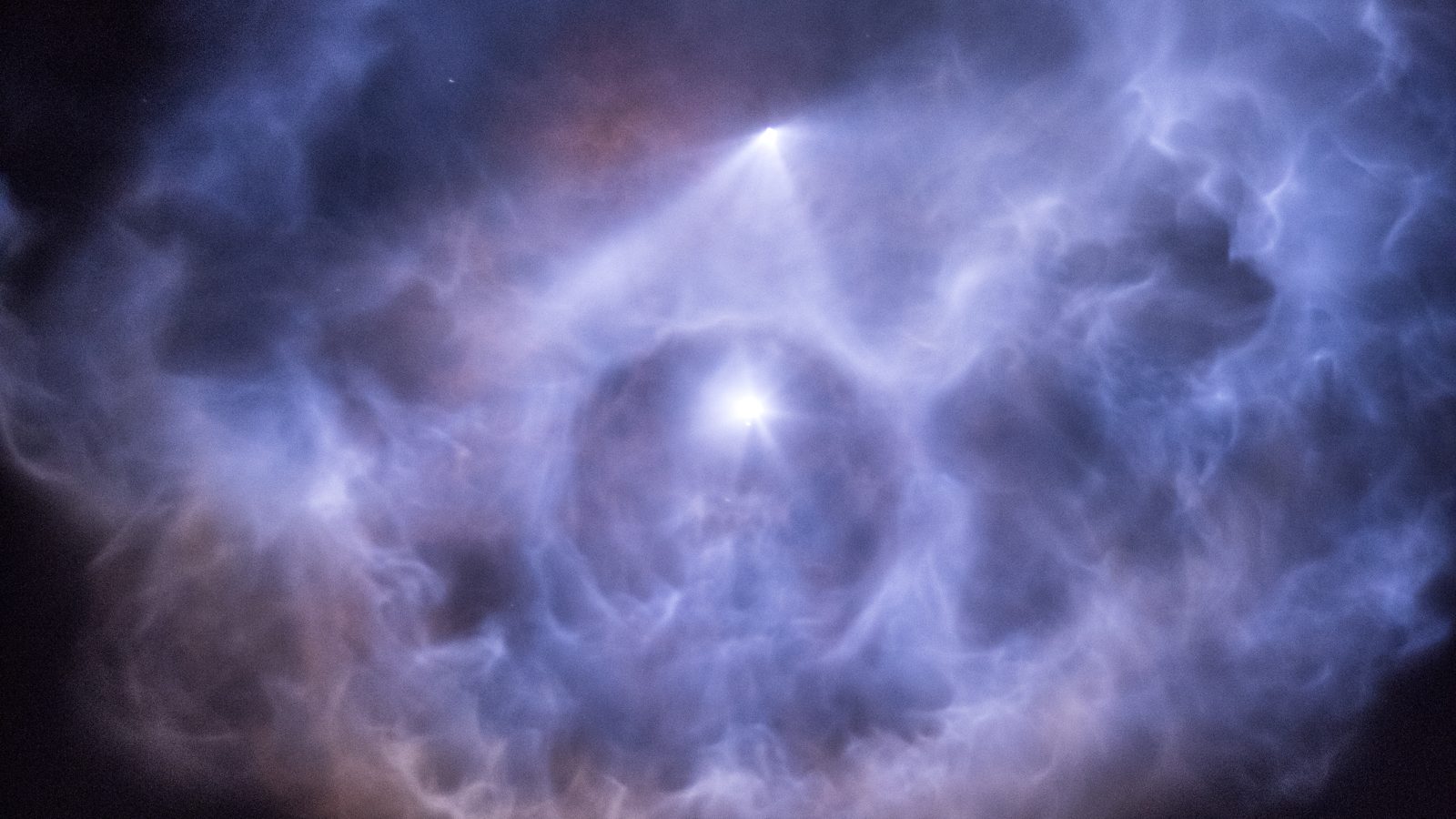
Starlink 11-20: The "Comet" Over Phoenix Was a Rocket
Just after 7 p.m. on September 28, 2025, a long, glowing streak drifted across Arizona from Flagstaff to Tucson, and some people asked if it was a comet. It was a Falcon 9 that had launched from Vandenberg a few minutes earlier, lit by a sun that had already set.
Sources Jonathan McDowell, GCAT launch list, entry 2025-221; Spaceflight Now (28 Sep 2025); Space.com (29 Sep 2025); KOLD/AZFamily (28 Sep 2025); Phoenix New Times (29 Sep 2025)
On Sunday evening, September 28, 2025, phones across Arizona were pointed west. A bright streak with a glowing, fanned-out tail moved slowly across the twilight sky, visible from Flagstaff down to Tucson. Phoenix New Times reported that pink, purple and white streaks hung in the sky for almost an hour. Some people who filmed it asked whether they were looking at a comet.
They were looking at a rocket launched in California a few minutes earlier.
The launch
A SpaceX Falcon 9 lifted off from Space Launch Complex 4 East at Vandenberg Space Force Base at 7:04 p.m. PDT on September 28, 2025. That’s also 7:04 p.m. in Arizona, which stays on MST (UTC−7) all year and matches Pacific Daylight Time in summer and early fall. McDowell’s public catalog logs the flight as 2025-221 at 02:04 UTC on September 29. It carried 28 Starlink satellites on the mission called Starlink 11-20.
Spaceflight Now reported that the rocket headed away from the pad on a south-easterly trajectory, which pointed it roughly toward Southern California and the desert Southwest. The first stage, on its 28th flight, landed on the droneship Of Course I Still Love You in the Pacific about eight and a half minutes after liftoff. The second stage carried on to orbit.
What people saw, and when
- KOLD/AZFamily (posted 7:37 p.m. MST that evening): “just after 7 p.m.,” people across the Southwest saw a comet-like trail. The station explained it as the “twilight effect,” where the sun has set for people on the ground but still lights the rocket’s exhaust as it climbs.
- Space.com: the launch put on a show “from Los Angeles to Phoenix,” and the clear skies at Vandenberg, which is often fogged in, helped. Space.com also mentioned a video from Phoenix asking whether the streak was a comet.
- Phoenix New Times: views from Tucson to Flagstaff, despite storms over the metro area that weekend. The paper’s story put liftoff “just after 8 p.m. Arizona time,” which is an hour off. McDowell’s launch log and Spaceflight Now give 7:04 p.m. PDT, which was 7:04 p.m. in Arizona.
Why it looks like a comet
A comet doesn’t visibly crawl across the sky over a few minutes. This did, because it was a rocket hundreds of miles away and far above the ground, still in sunlight while Phoenix was in dusk. The exhaust spreads into a wide, glowing cloud in the thin upper air. Seen side-on from Arizona, the bright engine and the cloud trailing behind it look a lot like a comet’s head and tail. Viewed more directly from underneath, as in the photo above from a different launch, it becomes the rounded “jellyfish.”
Ledger status
Cited (explained). The launch time, trajectory and twilight timing all match the reports, and news outlets identified it within the hour.
It joins Iridium-4 over Los Angeles (2017) as a reference case for the most common sky-light report this desk gets from Arizona: a launch from Vandenberg within about an hour of sunset.
Sources
- Jonathan McDowell, General Catalog of Artificial Space Objects (GCAT), launch list, entry 2025-221 (Falcon 9 B1063.28, Starlink Group 11-20, SLC-4E, 2025 Sep 29 02:04 UTC) — planet4589.org
- Will Robinson-Smith, “SpaceX launches 28 Starlink satellites on Falcon 9 rocket from Vandenberg SFB,” Spaceflight Now, 28 Sep 2025 — spaceflightnow.com
- Josh Dinner, “SpaceX Falcon 9 launch paints glowing ‘jellyfish’ across Western US skies,” Space.com, 29 Sep 2025 — space.com
- Lauren Kobley, “SpaceX rocket launch lights up Arizona sky,” KOLD/AZFamily, 28 Sep 2025 — kold.com
- Benjamin Leatherman, “Photos: SpaceX rocket launch over Phoenix amazes Valley,” Phoenix New Times, 29 Sep 2025 — phoenixnewtimes.com
Evidence ledger
Each claim in this file, the source it rests on, and how well it holds up: 3 corroborated · 2 debunked. What the labels mean.
| Claim | Source | Type · date | Status |
|---|---|---|---|
| A Falcon 9 carrying 28 Starlink satellites (Group 11-20) launched from Vandenberg SLC-4E at 7:04 p.m. PDT (7:04 p.m. MST) on 28 Sep 2025. | Jonathan McDowell, GCAT, entry 2025-221 (02:04 UTC 29 Sep); Space.com | primary record · 2025 | corroborated |
| The rocket flew a south-easterly trajectory and the booster landed on the droneship Of Course I Still Love You. | Spaceflight Now | press · 28 Sep 2025 | corroborated |
| The plume was seen across Arizona, from Tucson to Flagstaff, just after 7 p.m. | KOLD/AZFamily; Phoenix New Times; Space.com | press · 28–29 Sep 2025 | corroborated |
| Liftoff was “just after 8 p.m. Arizona time.”An hour off. GCAT and Space.com put it at 7:04 p.m. PDT, which is 7:04 p.m. in Arizona. | Phoenix New Times | press · 29 Sep 2025 | debunked |
| The streak over Phoenix was a comet.Comets don't move visibly over minutes; the launch timing matches. | Viewer video described by Space.com | social · 29 Sep 2025 | debunked |
Discussion
Discussions activating. Per-case threads will embed here once the Giscus GitHub App is installed on the public satellite repo.
Meanwhile, join the conversation on GitHub Discussions: https://github.com/dclewis21/anomaly-ledger-community/discussions
CoS / D.C.: see Community guidelines and
SETUP.mdin the site repo for the one-click Giscus install.