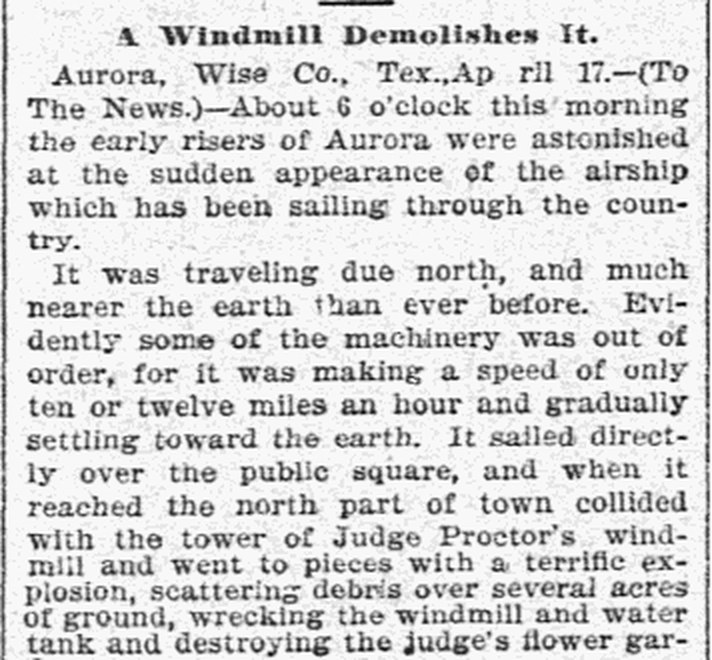
Aurora, Texas, 1897: The Martian Who Hit a Windmill
On April 19, 1897, The Dallas Morning News printed a dispatch saying an airship had crashed into a judge's windmill in Aurora, Wise County, killing a pilot 'not an inhabitant of this world.' The Texas State Historical Association calls it what it was: a fictional story written to put a dying town back on the map.
Sources S. E. Haydon, “A Windmill Demolishes It,” The Dallas Morning News, 19 Apr 1897, p.5 (clipping via Wikimedia Commons); Texas State Historical Association, Texas Day by Day, 19 Apr 1897; Mike Kingston, “When Airships Invaded Texas,” Texas Almanac 1990–1991
By the middle of April 1897, Texas newspapers had been printing airship sightings for days. The Texas Almanac counts 38 reported sightings in 23 counties between April 13 and 17, mostly in North Central Texas: cigar-shaped craft with propellers, wings and big lights, and crews who sometimes chatted with the locals. Then, on Monday, April 19, The Dallas Morning News ran a short item from a town called Aurora that went further than any of them.
What the dispatch said
The item, headed “A Windmill Demolishes It,” was datelined Aurora, Wise County, April 17, and signed S. E. Haydon. In the ledger’s summary of the clipping:
- At about 6 a.m. “the airship which has been sailing through the country” appeared over Aurora, flying north, low and slow, at only ten or twelve miles an hour, as if its machinery were failing.
- It passed over the public square and hit the tower of Judge Proctor’s windmill at the north end of town. It exploded, scattering wreckage over several acres and wrecking the windmill, the water tank and the judge’s flower garden.
- The pilot, apparently alone, was badly disfigured, but enough was found to show, the dispatch said, that he was “not an inhabitant of this world.” A T. J. Weems, described as the local Signal Service officer and an authority on astronomy, thought he came from Mars.
- Papers on the body were written in unknown hieroglyphics. The ship was made of an unknown metal like a mix of aluminum and silver, and weighed several tons.
- Townspeople were collecting pieces of the metal, and the pilot’s funeral was set for noon the next day.
It has every element a 20th-century UFO crash story would later have: a craft, a body, strange writing, strange metal, and an official to vouch for it. It appeared fifty years before Roswell.
Why Haydon wrote it
The Texas State Historical Association is direct about it: Haydon, a cotton buyer in Aurora, “released a fictional ‘news’ story.” It gives the background. Aurora had grown through the 1880s. Then an outbreak of spotted fever starting in 1888 drove people away, and when the railroad dropped plans to run through Aurora in the early 1890s, most of those left moved to Rhome, the new stop two miles southeast. TSHA says the story caused a sensation because airship tales were already circulating around Fort Worth, but it didn’t save the town. Aurora lost its post office in 1901.
The Texas Almanac notes that the Aurora story has been “labeled a hoax by 20th-century historians” and is still the best known of the Texas airship encounters. It also shows that Aurora was far from the only tall tale that week. Correspondents reported crews who said they came from the North Pole, a ship flown by a woman, a crew singing “Nearer My God to Thee” while handing out temperance tracts, and a doctor in Ennis who blamed the whole thing on “hypnotism and bad whiskey.” One theory the Almanac mentions is that railroad men planted sightings at stops along the lines.
Competing explanations
- A real crash and burial. This rests entirely on one signed dispatch. No independent account, wreckage or official record has been produced. Decades of searching by UFO researchers, described in the Texas Almanac, haven’t changed that.
- A booster’s joke. This is the best-supported reading. A local writer used a statewide craze to get a dying town’s name into the Dallas paper, in the same tongue-in-cheek style the Almanac finds in many 1897 dispatches.
A note on the cemetery
Aurora’s cemetery is a real burial ground with real graves, and it has become part of the legend as the supposed resting place of the “Martian.” This file gives no directions or map to it and doesn’t encourage visits. The story is a newspaper hoax, and the people buried there are someone’s family.
Ledger status
Hoax. The text of the original is plain fiction in news form, and the state’s historical association identifies it as a fictional story. It’s paired in the airship wave series with Sacramento, November 1896, where the papers took the sightings seriously.
Sources
Primary:
- S. E. Haydon, “A Windmill Demolishes It,” The Dallas Morning News, 19 Apr 1897, p.5 (dateline Aurora, 17 Apr). Read from the clipping on Wikimedia Commons.

Secondary:
- Texas State Historical Association, “Author attempts to jump-start town with fictional UFO story,” Texas Day by Day, 19 Apr 1897 — tshaonline.org
- Mike Kingston, “When Airships Invaded Texas,” Texas Almanac 1990–1991 — texasalmanac.com
Evidence ledger
Each claim in this file, the source it rests on, and how well it holds up: 3 corroborated · 2 debunked. What the labels mean.
| Claim | Source | Type · date | Status |
|---|---|---|---|
| An airship crashed into Judge Proctor's windmill at Aurora on 17 Apr 1897 and its pilot was buried there.One signed dispatch; no independent account, wreckage or record. TSHA calls it a fictional story. | S. E. Haydon, “A Windmill Demolishes It,” Dallas Morning News, p.5 | period press · 19 Apr 1897 | debunked |
| Haydon, a local cotton buyer, wrote the item as fiction to draw attention to the declining town. | Texas State Historical Association, Texas Day by Day | secondary · 19 Apr 1897 entry | corroborated |
| Texas papers carried 38 airship sightings in 23 counties between 13 and 17 Apr 1897. | Mike Kingston, “When Airships Invaded Texas,” Texas Almanac | secondary · 1990–1991 | corroborated |
| The pilot was “not an inhabitant of this world” and came from Mars, per T. J. Weems.Weems's opinion appears only inside the hoax text. | Haydon dispatch, Dallas Morning News | period press · 19 Apr 1897 | debunked |
| 20th-century historians label the Aurora story a hoax. | Texas Almanac (Kingston) | secondary · 1990–1991 | corroborated |
Discussion
Discussions activating. Per-case threads will embed here once the Giscus GitHub App is installed on the public satellite repo.
Meanwhile, join the conversation on GitHub Discussions: https://github.com/dclewis21/anomaly-ledger-community/discussions
CoS / D.C.: see Community guidelines and
SETUP.mdin the site repo for the one-click Giscus install.