Sacramento, November 1896: The Airship That Sang
On the evening of November 17, 1896, a bright light drifted southwest over Sacramento, and by the next day the city was full of people who said they'd heard voices, singing and orders shouted from it. The San Francisco Call ran it across its front page. This is where America's great airship wave starts.
Sources The San Francisco Call, 19 Nov 1896, p.1, “Strange Craft of the Sky” (Library of Congress, Chronicling America; text read from the LoC OCR), quoting the Sacramento Evening Bee
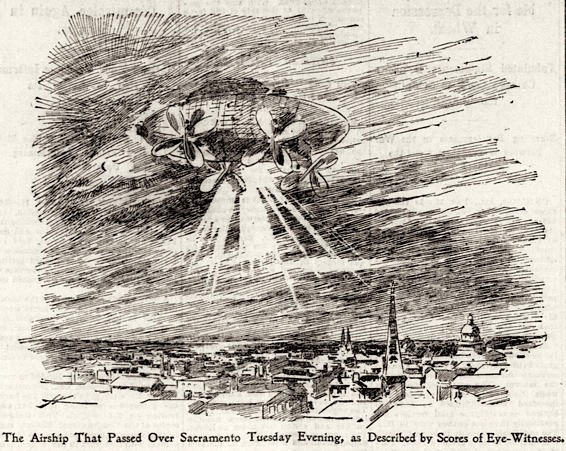
On the morning of Thursday, November 19, 1896, readers of The San Francisco Call opened their paper to a large drawing across the front page: an egg-shaped craft with fan-like wheels, beaming a searchlight down over the steeples and capitol dome of Sacramento. The headline read “STRANGE CRAFT OF THE SKY.” The subheads promised that Sacramento men had seen its occupants and heard them talking.
This is the first big story of the 1896–97 airship wave, and it already has everything the later ones would have: a light, a crowd, voices, a rumored inventor, and a newspaper that wanted very much to believe.
What the Call reported
The Call’s Sacramento correspondent, writing on the 18th, said the “one topic of conversation” in the capital was an airship seen over the east side of the city the night before, Tuesday, November 17. He described the town as split: hundreds who hadn’t seen it and were deeply skeptical, and hundreds more who swore they’d seen its searchlight and heard the people aboard.
He named his witnesses, which is what makes the page useful today:
- G. C. Snyder, foreman of the streetcar barn, put the time at about 6:30 p.m. The craft was too high for him to make out a shape, but he saw a searchlight that seemed to be heading into the wind and rolling like a ship in a heavy sea.
- Frank Ross, assistant superintendent of the electric streetcar system, said he hadn’t heard the voices himself but watched a brilliant light for about thirty minutes as it moved unevenly southwest, dipping and rising.
- R. L. Lowry gave the full description that the artist drew: an egg-shaped body with fan-like wheels on each side, a searchlight slung underneath, and four men working the wheels like bicyclists. He said a bystander had shouted up and been told the ship was bound for San Francisco by midnight. The Call admitted it couldn’t verify that, because nobody knew who the bystander was.
- David Carl, a horse trainer at Agricultural Park, said he heard a voice say the craft was too low and should go higher. He assumed at the time that it was a balloon.
- J. H. Vogel and E. Wenzel, a brewery worker, backed up the egg shape. Wenzel said the crew was singing.
- T. P. de Long saw only a light but said the singing sounded like a phonograph.
- A streetcar motorman, F. E. Briggs, stopped his crowded car so passengers could look. They heard singing but couldn’t make out the words.
- Mayor Hubbard didn’t see it, but told the paper his daughter had seen a bright white light moving slowly and unevenly from the east toward the southwest, and that she was sure it wasn’t a meteor.
The Call also reprinted part of the Sacramento Evening Bee’s story, which had voices calling down to “lift her up” before the craft hit a steeple, and laughter drifting over K Street.
The detail that matters most
Buried in the Bee excerpt is a line the Call passes over quickly. The previous day’s Bee had printed a telegram from New York saying an inventor had perfected an electric airship and would leave New York that Friday with a friend or two, reaching California in two days.
So on the evening of November 17, Sacramento had just been told to expect an airship. That doesn’t prove anyone made anything up. It does mean that when a light appeared in the sky, many people already had a story ready to explain it.
Rumors the paper itself didn’t believe
The same front page carried two more explanations going around town. One onlooker told the Call it was an invention Edison was rumored to have offered the government, now being tested by government engineers because relations with Spain were strained. The other was that a local inventor’s tethered trial had broken loose and landed in a field outside town. The Call noted that this second story was “not generally credited.”
The paper also ran a smaller item about an old hunter on Bolinas Ridge in Marin County who said he’d seen an airship in the fog weeks earlier. The Call pointed out that the “superior” type of mirage was common in those hills and could make a ship at sea appear to float in the sky.
The paper’s own conclusion didn’t hedge: it said there could be “no possible doubt” that an aerial vessel of some kind had passed over Sacramento.
Competing explanations
- A real, secret airship. Nothing on this page produces an inventor, a craft, a landing site or a crew, and the ledger hasn’t found any of those in the later coverage it has read.
- A light with a story attached. Many witnesses saw only a light. The shape, wheels and crew came mostly from one witness, Lowry, and were spread by the drawing. The New York telegram had primed the city to expect an airship.
- Pranksters with a lit balloon or kite. Possible, and it would explain a light that dipped and rose and “voices” nearby, but nothing on this page proves it.
- A newspaper story that fed itself. The Call ran “scores” of interviews, a large drawing and a firm conclusion. Airship reports went on to spread through California that winter and, by April 1897, across Texas and the Midwest.
Ledger status
Disputed. People in Sacramento clearly saw something: a light that moved slowly and erratically southwest for about half an hour. The airship, its crew and the overheard conversations rest on testimony that the paper collected under the headline it had already chosen, the day after a rival paper announced an airship was coming.
The airship wave series continues in Texas in April 1897, with the Aurora “Martian” hoax.
Sources
Primary:
- The San Francisco Call, 19 Nov 1896, p.1, “Strange Craft of the Sky: Sacramento Men Describe the Airship” (with the drawing “The Airship That Passed Over Sacramento Tuesday Evening,” the excerpt from the Sacramento Evening Bee, and the Bolinas Ridge item) — page at the Library of Congress, loc.gov. The ledger read the text from the LoC OCR (OCR page) through a public mirror while loc.gov wasn’t reachable; quotes were checked against that OCR.
Evidence ledger
Each claim in this file, the source it rests on, and how well it holds up: 2 corroborated · 2 disputed · 2 unverified. What the labels mean.
| Claim | Source | Type · date | Status |
|---|---|---|---|
| Many Sacramento residents saw a bright moving light over the east side of the city on the evening of 17 Nov 1896.Several named witnesses, including streetcar officials and the mayor's daughter, describe a light. | The San Francisco Call, “Strange Craft of the Sky,” p.1 | period press · 19 Nov 1896 | corroborated |
| The light was an egg-shaped airship with fan-like wheels and a four-man crew.Rests mainly on one witness, amplified by the paper's drawing. | R. L. Lowry, quoted in the Call | period press · 19 Nov 1896 | unverified |
| Voices and singing were heard from the craft.Heard by some; de Long likened it to a phonograph; no source identified. | Call witnesses (Carl, Wenzel, de Long, Briggs) and the Sacramento Evening Bee excerpt | period press · 19 Nov 1896 | disputed |
| A New York telegram printed the day before had told Sacramento to expect an inventor's electric airship. | Sacramento Evening Bee excerpt, reprinted in the Call | period press · 19 Nov 1896 | corroborated |
| An aerial vessel of some kind “beyond possible doubt” passed over Sacramento.The paper's own conclusion; no craft, inventor or landing site was ever produced in the coverage the ledger read. | The San Francisco Call (editorial conclusion) | period press · 19 Nov 1896 | disputed |
| The light was an illuminated balloon or a meteor rather than an airship.The local paper's skeptical suggestion; page image checked by the research desk. Added 3 Oct 2026. | Sacramento Record-Union, “What Was It?”, p.4 | period press · 18 Nov 1896 | unverified |
Updates
-
Local paper added. Sacramento's own morning paper, the Record-Union, covered the sighting on 18 Nov 1896 (p.4) under “WHAT WAS IT? An Apparition Wandering Through the Atmosphere.” Per the research desk's check of the page image, it describes a big ball of light seen between 6 and 7 p.m., moving slowly for more than half an hour, with some witnesses reporting singing voices. Unlike the Call, it leaned skeptical: it offered an illuminated balloon, and joked that perhaps a “stray meteor was hunting for the rest of the gang.” The light and its timing match the Call's witnesses. The airship does not appear in the Record-Union's account. Ledger status unchanged (disputed).
Sources Sacramento Record-Union, 18 Nov 1896, p.4, “What Was It?” (Library of Congress, Chronicling America; checked on the page image by the research desk): https://www.loc.gov/resource/sn82015104/1896-11-18/ed-1/?sp=4
Discussion
Discussions activating. Per-case threads will embed here once the Giscus GitHub App is installed on the public satellite repo.
Meanwhile, join the conversation on GitHub Discussions: https://github.com/dclewis21/anomaly-ledger-community/discussions
CoS / D.C.: see Community guidelines and
SETUP.mdin the site repo for the one-click Giscus install.