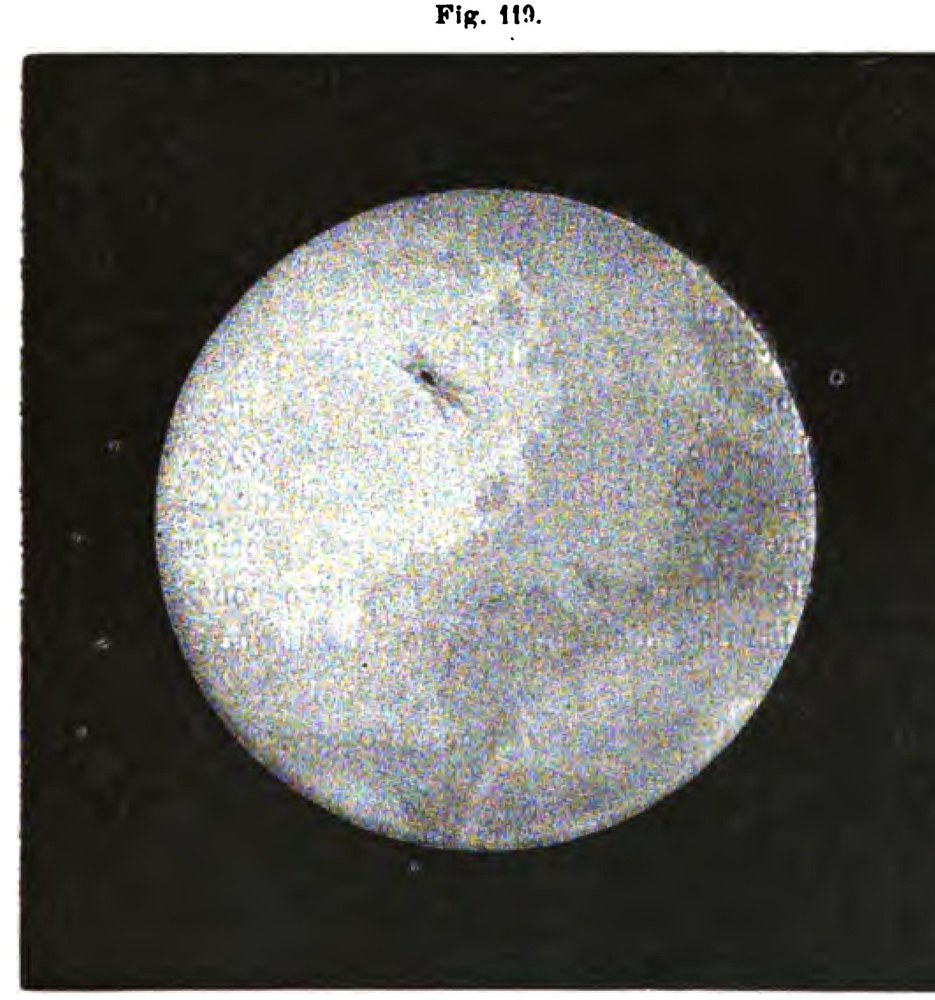
The evidence: Bonilla's photograph of the Sun and one of the bodies, 12 August 1883 (L'Astronomie Fig. 119)
Bonilla's Bodies Across the Sun, Zacatecas 1883: Hundreds of Dark Shapes and One Photograph
Last reviewed Next review
We review and update every article weekly. When the record changes, so does the article. How we review
In August 1883 the director of Mexico's Zacatecas observatory counted 447 dark bodies crossing the Sun and photographed one. We read his report and the replies.
Verdict: Bonilla really did count hundreds of dark bodies crossing the Sun and photographed one, but they were almost certainly close to his telescope, likely birds or insects; the 2011 idea of a comet that nearly hit Earth does not fit the record.
Original sources: Bonilla's report and the editors' note, L'Astronomie, September 1885, pp. 347-350 (Internet Archive) · Herschel and Bruguière letters on bodies crossing the Sun, L'Astronomie, 1886, pp. 70-71 (Internet Archive) · Durand Manterola, Ramos Lara and Cordero (UNAM), 'A fragmented Comet that nearly hits the Earth', arXiv:1110.2798 (2011)
Sources José A. y Bonilla, 'Passage sur le disque solaire d'un essaim de corpuscules, vu à l'Observatoire de Zacatecas (Mexique)', with the editors' note, L'Astronomie, 4th year, no. 9 (September 1885), pp. 347-350, Figs. 118-119; letters of J. Herschel and H. Bruguière with editorial comment, L'Astronomie, 5th year (1886), pp. 70-71; H. Corder, 'The August Meteors, 1883', The Observatory 6 (1883), p. 338; H. J. Durand Manterola, M. de la Paz Ramos Lara and G. Cordero, arXiv:1110.2798 (2011); Phil Plait, Bad Astronomy, 17 October 2011
On the morning of Sunday 12 August 1883, José A. y Bonilla sat down in the dome of the new observatory at Zacatecas, in the mountains of north-central Mexico, to draw sunspots, as he did every clear day. A few minutes later the Sun’s image on his drawing paper began to fill with small dark shapes crossing it one after another. By the next morning he and an assistant had counted 447 of them. He also made what is often called the first photograph of an unidentified flying object.
We read Bonilla’s own account in the French monthly L’Astronomie, in the Internet Archive scan of the 1885 volume, along with the editors’ reply printed under it and the letters it drew the following year. His report is in French, so the translations below are ours, with his original words quoted where it matters. We then read the 2011 paper by three researchers at Mexico’s national university, UNAM, that revived the case, and the astronomer Phil Plait’s answer to it.
What Bonilla reported
Bonilla explains first how he worked. The observatory stood about 2,500 meters above sea level. He fixed a projection screen to the 16-centimeter equatorial telescope, so that the Sun appeared as a disk 25 centimeters wide on a sheet of paper, and he kept the dome dark with heavy black curtains so that only the Sun’s image came through.
At 8 a.m. on 12 August, he wrote, he saw “un petit corps lumineux” (a small luminous body) enter the field of the telescope and cross the Sun’s disk “comme une ombre presque circulaire” (like an almost circular shadow). Before he had gotten over his surprise, it happened again and again, so often that in two hours “je pus compter jusqu’à 283 corps traversant le disque du Soleil” (I was able to count up to 283 bodies crossing the disk of the Sun). Clouds stopped him, but at midday he watched for another 40 minutes and 48 more were counted.
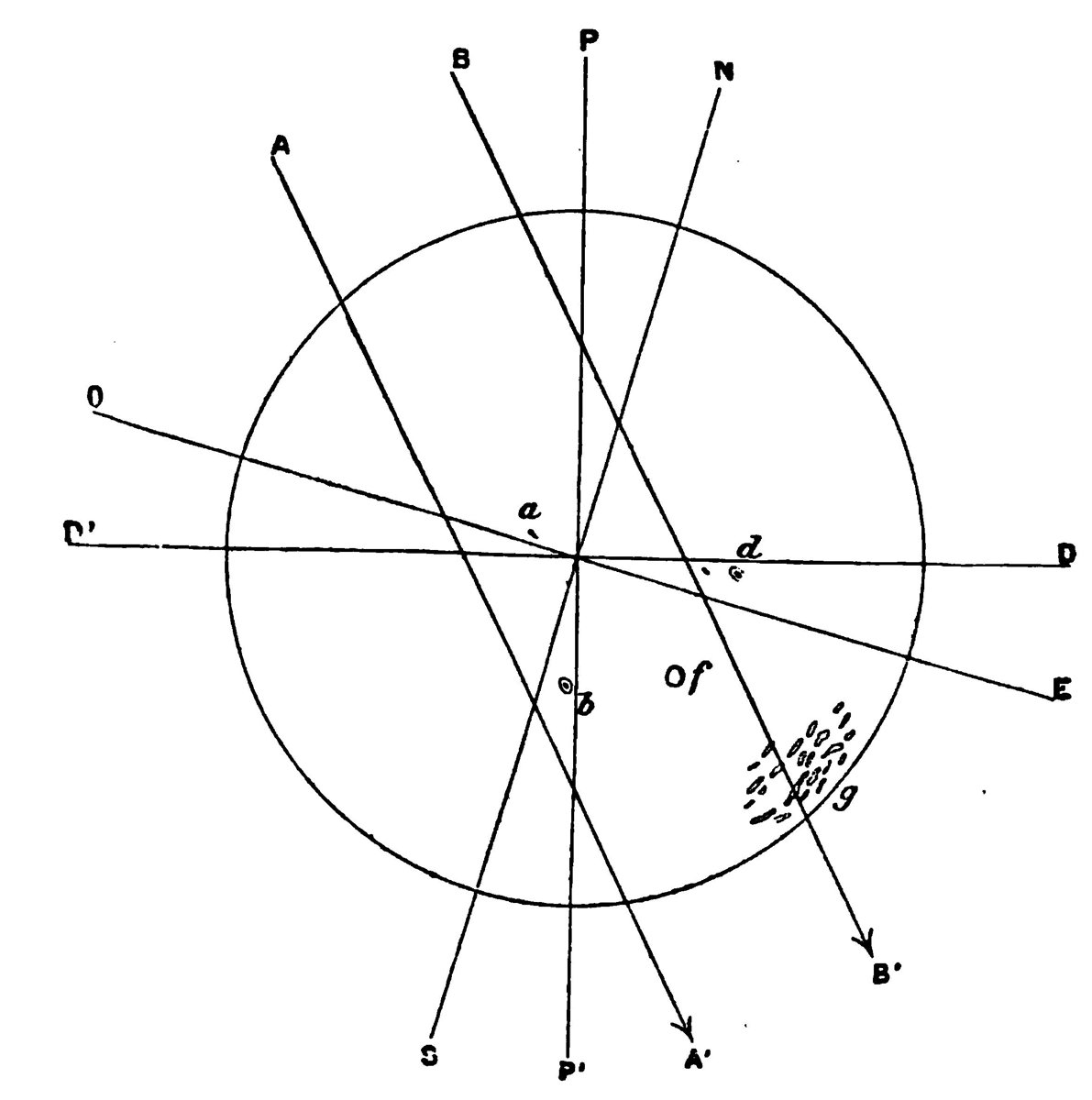
The bodies moved broadly from west to east. On the Sun they looked black, some perfectly round and some stretched, but at the edge of the field, off the disk, they looked bright and seemed to give off shining trails. Each took between a third of a second and a full second to cross. Sometimes one or two passed and then nothing came for a minute or two; at other times 15 or 20 went by almost together, difficult to count. He marked where several entered and left the disk, and the drawing under the photograph at the top of this page is the journal’s reduced copy of that sheet.
On 13 August the sky cleared a little after 8 a.m., and in 45 minutes of watching they counted 116 more.
The photograph
Bonilla switched to a photographic lens and, after several tries at focusing on the bodies, took a number of pictures. He sent the journal “la plus intéressante” (the most interesting one), the image at the top of this page. It was taken on wet collodion in a hundredth of a second, and he admitted the negative was slightly fogged because he had no time to prepare the chemicals properly. He also noted that “L’image du Soleil n’est pas au foyer, mais bien celle du corps” (the image of the Sun is not in focus, but that of the body is). In his photographs, he said, the bodies did not look round, as they had to the eye, but mostly irregular in shape.
How far away?
After the first day Bonilla telegraphed the observatories in Mexico City and Puebla and asked them to watch. Nothing was seen from either. He also tried a rough test of distance: he focused his instruments on the Sun and the bodies, and that night, without touching the focus, turned them on the planets and the Moon. Only the Moon looked nearly sharp. From both facts he concluded that the bodies were fairly close to the Earth, “à une moindre distance que la Lune” (at a smaller distance than the Moon), and that from Mexico City and Puebla they would have appeared off the Sun’s disk.
The editors’ reply
The journal printed a short note under the report. The observation was very interesting, the editors wrote, but not easy to explain. The date suggested the August meteors, but then it would be odd that nothing was seen from Mexico City or Puebla. “Seraient-ce des oiseaux?” (Could they be birds?) They measured the body on the photograph at 0.9 millimeters long and 0.6 to 0.7 wide, on a solar image 66 millimeters across, and concluded: “Nous serions portés à croire qu’il s’agit là d’oiseaux, d’insectes, ou de poussières supérieures, en tout cas de corpuscules appartenant à notre atmosphère” (We would be inclined to think these are birds, insects or high dust, in any case small bodies belonging to our atmosphere).
The report drew letters. In the journal’s 1886 volume, J. Herschel, writing from Kent, pointed to similar sightings described in the Monthly Notices of the Royal Astronomical Society in 1870, and H. Bruguière described watching more than 25 small, irregular bodies crossing the Sun from Marseille in April 1883 (the letter gives two different April dates), all moving west to east. The editors thought the two observations looked like the same kind of event, and wrote that it was not easy to guess the cause.
The 2011 comet idea
In October 2011 Héctor Javier Durand Manterola, María de la Paz Ramos Lara and Guadalupe Cordero of UNAM posted a preprint arguing that Bonilla had seen the pieces of a comet that had broken up just before passing very close to the Earth. They used the fact that Mexico City and Puebla saw nothing to set an upper limit of about 65,000 kilometers. Then, assuming the bodies moved at comet-like speeds of 15 to 75 kilometers per second and taking Bonilla’s crossing times at face value, they placed them between 538 and 8,062 kilometers away, each tens of meters to about a kilometer across. Scaling the 447 counted bodies up to a full day, they suggested a parent comet of up to several times the mass of Halley’s Comet, and wrote: “So if they had collided with Earth we would have had 3275 Tunguska events in two days, probably an extinction event.”
The authors were candid about their weakest point: “We don’t know how Bonilla estimated his times since he does not mention if he had access to a chronometer to measure the seconds and fractions of a second.” We found no journal version of the paper; it remains a preprint.
The objections
A few days later Phil Plait answered on his Bad Astronomy blog. A comet that breaks apart spreads out, he wrote, and squeezing its pieces into a strip only a few thousand kilometers wide, seen from a single observatory over two days, “strains credulity.” Such a comet should have been seen somewhere in the evening or morning sky, and its dust should have produced a meteor shower that would have been “practically biblical in size.” He added that he was not doubting Bonilla: “it’s perfectly reasonable to think he saw something,” and suggested flocks of birds or an odd atmospheric effect.
The meteor record that week backs him up. The observer H. Corder wrote to The Observatory that he had watched the Perseid shower on 9, 10 and 11 August 1883 and seen at most 43 meteors in an hour, “so that this year’s display cannot be reckoned a fine one by any means.” That was a weak year, not a storm.
Sources
- José A. y Bonilla, “Passage sur le disque solaire d’un essaim de corpuscules, vu à l’Observatoire de Zacatecas (Mexique)”, with the “Note de la Rédaction”, L’Astronomie, 4th year, no. 9 (September 1885), pp. 347-350, Figs. 118 and 119, Internet Archive scan (read 14 Nov 2026). Often cited as January 1886; the 1886 volume itself refers back to it as volume IV, no. 9, and Herschel’s letter calls it the September issue.
- J. Herschel and H. Bruguière, letters with editorial comment, “Passage de corpuscules devant le Soleil” and “Passage d’un essaim de corpuscules devant le Soleil”, L’Astronomie, 5th year (1886), pp. 70-71, Internet Archive scan (read 14 Nov 2026)
- H. Corder, “The August Meteors, 1883”, The Observatory 6 (1883), p. 338, scan via the NASA Astrophysics Data System (read 14 Nov 2026)
- Héctor Javier Durand Manterola, María de la Paz Ramos Lara and Guadalupe Cordero, “Interpretation of the observations made in 1883 in Zacatecas (Mexico): A fragmented Comet that nearly hits the Earth”, arXiv:1110.2798, preprint, 12 October 2011 (read 14 Nov 2026)
- Phil Plait, “Did a fragmenting comet nearly hit the Earth in 1883? Color me very skeptical”, Bad Astronomy, 17 October 2011, now hosted by Slate (read 14 Nov 2026)
Weighing it
We have no reason to doubt Bonilla. He was a working astronomer who described his equipment, his counts and his method plainly, published a photograph, and drew no wild conclusion of his own. The question is only how far away the bodies were, and on that point his own details lean one way. In our reading, the photograph is the strongest clue: a telescope focused for the Sun brings anything more than a few tens of kilometers away into focus at the same point, so a body hundreds of kilometers up would have been as soft as the Sun was. A sharp body against a blurred Sun suggests something much nearer, and the Bruguière sighting shows that small irregular shapes drifting across the Sun were not unique to Zacatecas. Birds or insects passing near the observatory, as the editors guessed in 1885, fit what he describes. A shattered comet passing a few thousand kilometers overhead does not fit the missing sightings or the quiet meteor nights, and it depends on crossing times nobody timed. We cannot name what crossed the Sun that morning, so we leave the case open, but we are confident it was close to the telescope, not close to disaster.
Verdict
Open Bonilla really did count hundreds of dark bodies crossing the Sun and photographed one, but they were almost certainly close to his telescope, likely birds or insects; the 2011 idea of a comet that nearly hit Earth does not fit the record.
Update log
-
We added this case file.
-
Added Bonilla's drawing (L'Astronomie Fig. 118) under the photograph at the top of the page, with its public-domain credit, and changed 'too many to count' to 'difficult to count' to match Bonilla's 'difficile de les compter.'
Sources https://archive.org/details/lastronomie03flamgoog/page/n393/mode/1up
-
Weekly re-check of sources; no newer change to the record. Next check November 23, 2026.
Discussion
Discuss this case on the on-site Community board — no GitHub account required. Prefer a private tip for the editorial team? Submit a Sighting.
House rules: Community guidelines.