The evidence: The Gangwon governor's dispatch of 1609 in the draft copy of the royal annals: both pages, read right to left
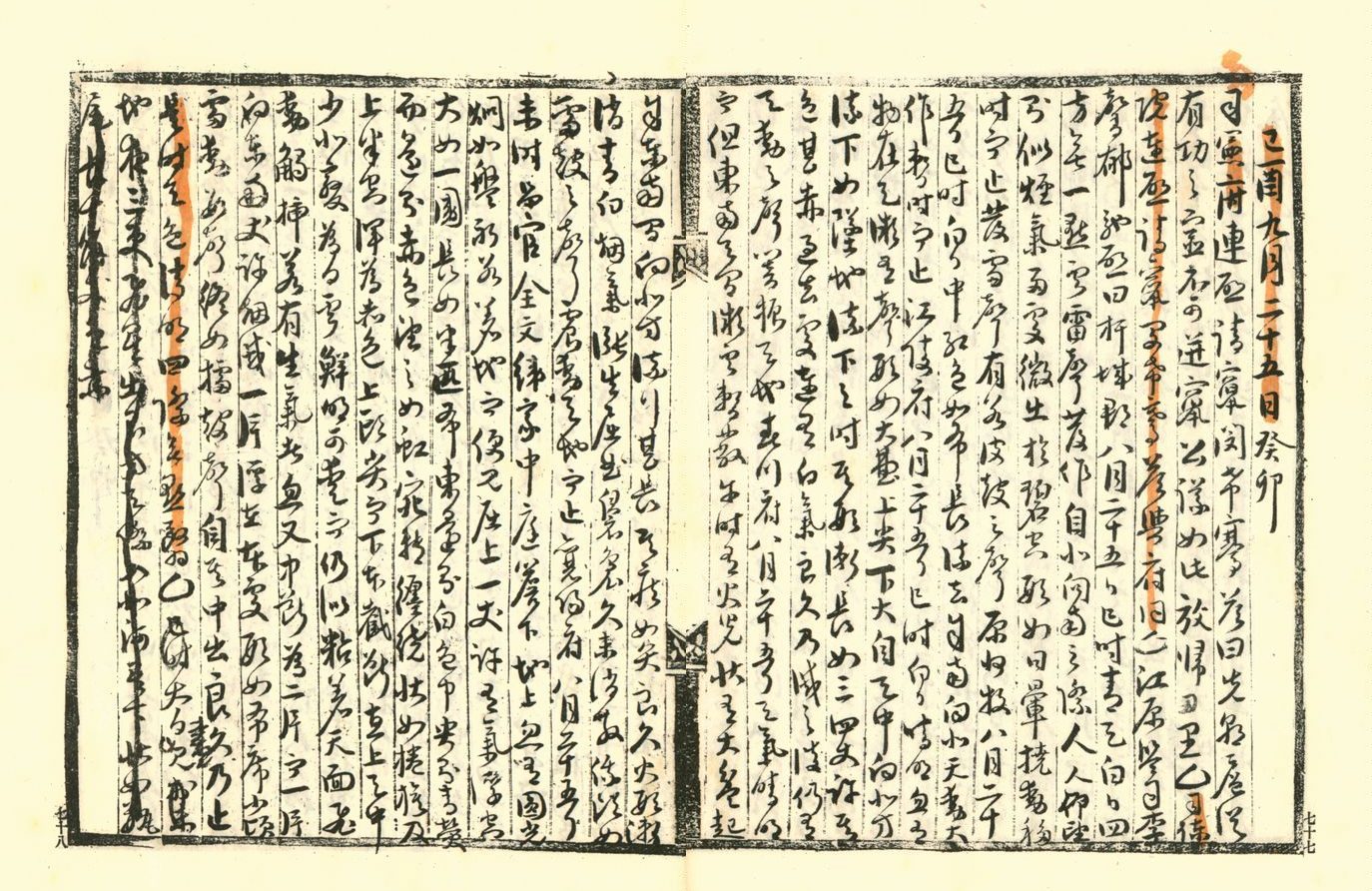
The Gangwon Sky Objects, Korea 1609: Fire in a Cloudless Sky, and a Light That Rose From a Courtyard
Last reviewed Next review
We review and update every article weekly. When the record changes, so does the article. How we review
On 22 September 1609 five towns in Korea's Gangwon province reported fire, smoke and thunder in a clear sky. We read the royal annals in Classical Chinese.
Verdict: Most of what Gangwon's officials reported on 22 September 1609 fits a daytime fireball, which the court logged the same day, but the Yangyang report of a light rising from a courtyard does not fit and remains unexplained.
Original sources: Gwanghaegun Ilgi, draft recension, 1609, 9th month, 25th day: the Gangwon governor's dispatch (Classical Chinese with modern Korean translation, National Institute of Korean History) · The same dispatch in the fair-copy recension (Jeongjoksan copy) · Gwanghaegun Ilgi, 1609, 8th month, 25th day: the daytime 'yeongduseong' seen by the court · Gwanghaegun Ilgi, 1609, 8th month, 25th day: the fireball at Seoncheon · Lee Seong-gyu, 'Science Talk: Joseon's UFO', Kukmin Ilbo, 18 January 2014 (Korean) · Kang Myeong-gwan, '1609, Gangwon Province, UFO', Hankyoreh, 2020 (Korean)
Sources Gwanghaegun Ilgi (Daily Records of Gwanghaegun), draft recension (Taebaeksan copy), vol. 20, 1st year of Gwanghaegun, 9th month, 25th day, entry 3: dispatch of the Gangwon governor Yi Hyeong-uk (sillok koa_10109025_003), and fair-copy recension (Jeongjoksan copy), entry kob_10109025_003; same annals, 8th month, 25th day, entries 2 and 3 (koa_10108025_002, koa_10108025_003), all via the National Institute of Korean History, sillok.history.go.kr, original text and modern Korean translation; 1931 Keijo Imperial University photographic facsimile of the draft, book 8, National Taiwan University Library copy on Wikimedia Commons; Lee Seong-gyu, 'Science Talk: Joseon's UFO', Kukmin Ilbo, 18 January 2014; Kang Myeong-gwan, '1609, Gangwon Province, UFO', Hankyoreh, 2020; Oh Seok-gi, 'UFOs in the Joseon era' parts 1 and 2, Kangwon Ilbo, 21 and 28 March 2023
On a cloudless autumn day in 1609, officials in five towns of Gangwon, the mountain province on Korea’s east coast, reported something in the sky. In Gangneung it looked like a big red flask falling toward the earth. In Chuncheon it was a fire as large as a basin, fast as an arrow, that left a curling trail of blue-white smoke. Almost everywhere there was thunder from a blue sky. And in Yangyang, in the afternoon, a round, glowing light is said to have come up out of the ground in an official’s courtyard, climbed into the sky and split in two.
The governor of Gangwon, Yi Hyeong-uk, gathered the five reports and sent them to the king, and the court wrote his dispatch into the annals of King Gwanghaegun, the Gwanghaegun Ilgi. Korean newspapers have told it as “the Joseon UFO”. Two Korean newspapers, the Kukmin Ilbo and the Kangwon Ilbo, say it was the inspiration for the 2013-14 television drama “My Love from the Star”, whose hero is an alien who came to Joseon about 400 years ago.
We read the entry in the Classical Chinese original and in the modern Korean translation published by the National Institute of Korean History, in both surviving versions of these annals, a working draft and a fair copy. We also read the two entries the court itself made on the day of the event, and three Korean newspaper pieces that take different views of it. The translations below are ours, made from the Classical Chinese with the help of the Korean translation.
When it happened
The governor’s dispatch is filed under the 25th day of the 9th lunar month, but every report in it is dated a month earlier, to the 25th day of the 8th month. We converted that date to the Western calendar: it falls on 22 September 1609, and the day’s place in the sixty-day cycle, gyeyu (癸酉), matches the heading of the annals’ entries for that day. The reports give times in the two-hour periods of the old Korean clock. As the Hankyoreh column glosses them, the sa hour is about 9 to 11 in the morning, the o hour 11 to 1, and the mi hour 1 to 3 in the afternoon.
What the five towns reported
Ganseong (today Ganseong-eup in Goseong county) reported that at the sa hour, under a clear blue sky with “not a single cloud on any side” (四方無一點雲), thunder broke out and moved from north to south. Everyone looked up and saw what seemed like smoke coming faintly out of the blue sky in two places. It was shaped like a halo around the sun, moved about for some time and then stopped, and the thunder sounded like a leather drum.
Wonju reported that at the sa hour, in broad daylight, something red like a length of cloth streamed from south to north, with a great roar in the sky that soon stopped.
Gangneung reported that at the sa hour, with the sun bright and clear, “忽有物在天, 微有聲” (suddenly there was a thing in the sky, making a faint sound). It was shaped like a large flask, pointed at the top and broad at the bottom, and came down from the middle of the sky toward the north as if it would fall to the ground. As it came down it grew longer, to about three or four jang, and it was deep red. Where it passed, a white vapor followed, and when that had faded at last there was a roar that “shook heaven and earth” (響振天地). A jang is about three meters, and the Kangwon Ilbo works the size out as 9 to 12 meters. In our reading that is the object’s apparent size in the sky as the witnesses judged it, not a measurement.
Chuncheon reported a clear day with only a small cloud for a moment in the southeast. At the o hour there was a fiery light, shaped like a large basin, that rose in the southeast and streamed a long way toward the north, “其疾如矢” (as fast as an arrow). After a while the fire faded and a blue-white smoke swelled out, “屈曲裊裊, 久未消散” (bending and curling, and not dispersing for a long time). Soon afterward came a sound like thunder and drums that shook heaven and earth.
Yangyang sent the strangest report. At the mi hour, in the courtyard of the local official Jeon Mun-wi, on the ground under the eaves, “忽有圓光炯如盤” (suddenly there was a round light, bright as a platter). At first it seemed to touch down, then it curved up about one jang, as if some vapor were floating in the air. It was about an armspan around and as long as half a bolt of cloth, white on the east side, glowing blue-green in the middle and red on the west. It looked like a rainbow, coiling round like a furled flag. Halfway up it turned all red, pointed at the top and cut off at the bottom, then rose to the middle of the sky a little to the north and turned into a white cloud, bright and lovely to see. It seemed to cling to the face of the sky, flying and darting “若有生氣者” (as if it were alive). Then it broke in the middle into two pieces. One went about a jang to the southeast and vanished like smoke; the other floated where it was, shaped like a cloth mat. After a little there were several claps of thunder, and at the end a sound like beating drums came from inside it before it finally stopped. The draft copy adds that the sky was clear at the time, with not a speck of cloud anywhere.
What the court saw the same day
The governor’s dispatch is not the only record. Under the day itself, 22 September, the annals note that Venus was visible in daylight at the sa hour, and that at the o hour a “yeongduseong” (營頭星) came out of the middle of the sky toward the northeast, “大如盆, 疾行如炬火, 砰隱有聲” (as big as a basin, moving fast like a torch, with a rumbling sound), yellow-white and three or four ja long. The Kukmin Ilbo column explains the term as a meteor that falls in the daytime.
A second entry for the same day comes from Seoncheon, in the far northwest of the peninsula, in what is now North Korea. At the o hour, in a sky with not a wisp of cloud, there was “倐若放砲之聲” (a sudden sound like a cannon firing) at the eastern edge of the sky. People looked up and saw a fire shaped like a bundle of fodder drop toward the horizon and vanish in an instant, and where it had passed the sky seemed to open “如瀑布之形” (in the shape of a waterfall).
The court historian who wrote the first entry read the daytime meteor as a warning to a bad king. He listed the king’s failings and wrote that “今又有營頭妖星白日飛行, 變之大者” (now again an ominous yeongduseong has flown in broad daylight, a great portent), and closed: “社稷殆哉” (the state is in danger).
Two versions, two names
The annals of Gwanghaegun survive in a draft and a fair copy, and the National Institute of Korean History publishes both. The Classical Chinese text of the dispatch is the same in each, apart from small variants, with one difference: the fair copy leaves out the closing line about the cloudless sky. In the 1931 photographic reprint of the draft, at the top of this page, that line has a red line drawn beside it.
The modern Korean translations differ on a name. The draft’s translation calls the Yangyang householder Jeon Mun-wi (전문위), as the Chinese characters 全文緯 read. The fair copy’s translation calls him Kim Mun-wi (김문위), even though its Chinese text also reads 全文緯. The Kukmin Ilbo and Kangwon Ilbo pieces use Kim; the Hankyoreh column uses the characters for Jeon. We follow the original text.
How Korean writers have read it
The science columnist Lee Seong-gyu, writing in the Kukmin Ilbo in 2014, explains that a very large, bright meteor leaves a bright trail and can set off a shock wave heard as thunder, and concludes: “강원도의 기이한 자연현상은 불덩어리 유성일 가능성이 높다” (the strange natural phenomenon in Gangwon is likely to have been a fireball meteor). The court’s yeongduseong, recorded where the kingdom’s sky watchers worked, makes that more likely, he writes. But he lists what bothers him: meteors were familiar to Joseon observers, so he sees no reason a governor would make such a fuss over one, and the Yangyang object went up from the ground instead of falling, split, and sent one piece off while the other hung in place. “이 같은 묘사는 현대인들의 UFO 목격담을 마치 베낀 것처럼 닮아 있다” (this description looks as if it had been copied from a modern UFO sighting).
Kang Myeong-gwan, a professor of Classical Chinese literature at Pusan National University, retold the dispatch in the Hankyoreh in 2020. After the first four towns he writes: “여기까지만 보면 운석이 추락하는 장면이라고도 우길 수도 있을 것이다. 하지만 양양부의 보고에 의하면 운석은 결코 아니다.” (Looking only this far, one could insist it was a meteorite falling. But going by Yangyang’s report, it was certainly not a meteorite.) He is not claiming a spacecraft, though: “여의도 광장에 유에프오가 착륙하기 전까지 나는 유에프오 따위는 믿지 않을 것이다” (until a UFO lands on Yeouido Plaza, I will not believe in such things as UFOs). He offers the story as a moment of idle daydreaming during the Covid-19 pandemic.
The Kangwon Ilbo’s Oh Seok-gi, in a two-part series in 2023, leans the other way. Because Joseon kept an astronomical office from the dynasty’s founding and observed the sky systematically, he writes, “실록에 남겨진 UFO의 흔적들을 단순히 기상현상을 착각하거나 오해한 것이라고 단정할 수는 없을 듯 하다” (it seems we cannot conclude that the traces of UFOs left in the annals are simply mistaken or misunderstood weather phenomena). He compares the Gangneung red glow and white vapor, and the Chuncheon fire that faded into swelling smoke, to a rocket burning fuel and dropping its boosters, and even to a SpaceX Falcon Heavy launch. He also points to the Seoncheon fireball, and notes that every report, in five places in Gangwon and one in the northwest, mentions a tremendous sound.
Sources
- Gwanghaegun Ilgi (Daily Records of Gwanghaegun), draft recension (中草本, Taebaeksan archive copy), vol. 20, 1st year of Gwanghaegun (1609), 9th month, 25th day (gyemyo), entry 3 of 4: “강원도에서 일어난 기이한 자연현상에 대해 강원 감사 이형욱이 치계하다” (the Gangwon governor Yi Hyeong-uk reports strange natural phenomena), Classical Chinese text and modern Korean translation, National Institute of Korean History (read 16 Nov 2026)
- The same dispatch in the fair-copy recension (正草本, Jeongjoksan archive copy), vol. 20, entry 3 of 3, sillok kob_10109025_003 (read 16 Nov 2026)
- Gwanghaegun Ilgi, draft recension, vol. 19, 1609, 8th month, 25th day (gyeyu), entry 2 of 3: “사시에 태백성이 나타나고 오시에 영두성이 나타나다” (Venus appears at the sa hour and a yeongduseong at the o hour), with the historian’s comment, and entry 3 of 3: “선천군에서 불덩어리가 떨어지다” (a fireball falls at Seoncheon) (read 16 Nov 2026)
- 光海君日記 (Gwanghaegun Ilgi), book 8, photographic facsimile published by the Faculty of Law and Literature, Keijo Imperial University, 1931, National Taiwan University Library copy, PDF on Wikimedia Commons, PDF pages 79-80, tagged PD-scan / PD-old (read 16 Nov 2026)
- Lee Seong-gyu (science columnist), “[사이언스 토크] 조선의 UFO” (Science Talk: Joseon’s UFO), Kukmin Ilbo, 18 January 2014 (read 16 Nov 2026)
- Kang Myeong-gwan (Pusan National University), “1609년, 강원도, UFO” (1609, Gangwon Province, UFO), column “Kang Myeong-gwan’s Gogeum Yusa”, Hankyoreh, 2020, page last modified 5 June 2020 (read 16 Nov 2026)
- Oh Seok-gi, “1609년 강원도 하늘에서는 ‘천둥소리’가 울렸다” (In 1609 ‘thunder’ rang out in the Gangwon sky), Kangwon Ilbo, 21 March 2023, and “호리병, 세숫대야 모양을 하고, 무지개 처럼 하늘에 떠 있어” (Shaped like a flask and a washbasin, floating in the sky like a rainbow), Kangwon Ilbo, 28 March 2023 (both read 16 Nov 2026)
Weighing it
We think the four mid-day reports and the court’s own entries describe something real and natural. A fire that streaks across a clear daytime sky, leaves a white or blue-white trail that hangs and twists for a long time, and is followed after a pause by booms like thunder, drums or cannon matches what the Kukmin Ilbo column describes for a fireball meteor: a bright trail left behind, and a shock wave heard as thunder. The court’s own record also files what was seen that day under a meteor term, yeongduseong, at the same o hour that Chuncheon and Seoncheon give. In our reading a single fireball high over the east of the peninsula could have been seen from Seoul, from Chuncheon and Gangneung, and low on the eastern horizon from Seoncheon. What does not line up neatly is the clock: Ganseong, Wonju and Gangneung put it in the sa hour, before the o hour of the court record, and the directions vary from town to town. Reports written up by local offices and sent on a month later could easily slip by one two-hour period, but the sources do not tell us that happened, so we cannot rule out more than one event that day. Yangyang is the real puzzle. A tricolored light that starts at the ground under the eaves of a named man’s house, climbs, turns to cloud, splits and hangs in the sky in the afternoon does not match a falling meteor, and nothing else in the record backs it up. It may be a garbled sighting of the same smoke trail, or something else entirely; the text alone cannot tell us. So we file the Gangwon objects as disputed: mostly a daylight fireball, with one courtyard light that no one has explained.
Verdict
Disputed Most of what Gangwon's officials reported on 22 September 1609 fits a daytime fireball, which the court logged the same day, but the Yangyang report of a light rising from a courtyard does not fit and remains unexplained.
Update log
-
We added this case file.
-
Weekly re-check of sources; no change to the record since filing. Next check November 23, 2026.
Discussion
Discuss this case on the on-site Community board — no GitHub account required. Prefer a private tip for the editorial team? Submit a Sighting.
House rules: Community guidelines.