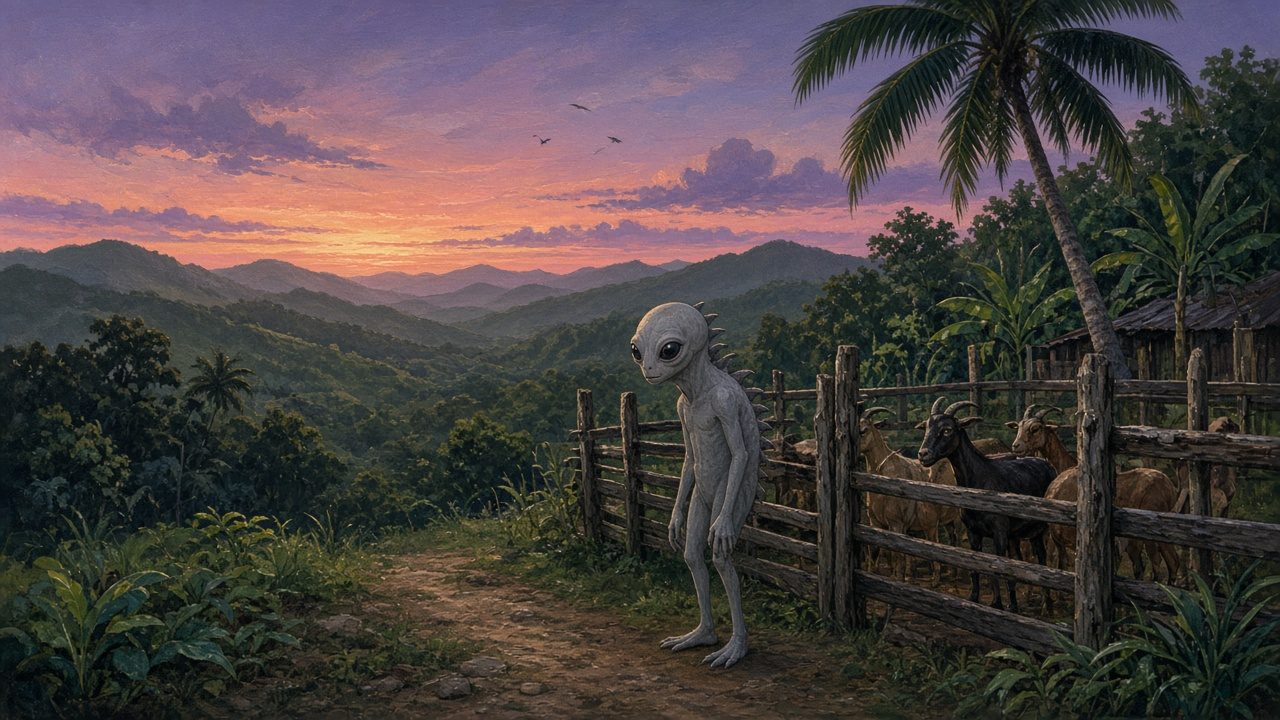




No original photo or video of this event is known.
The Chupacabra: Puerto Rico, 1995
Last reviewed Next review
We review and update every article weekly. When the record changes, so does the article. How we review
In 1995 Puerto Rican farmers found livestock dead with puncture wounds, and a witness described a spiny, big-eyed creature.
Verdict: The livestock deaths were real and fit ordinary predators; the monster was built by the media.
Sources Benjamin Radford, Tracking the Chupacabra (University of New Mexico Press, 2011); Wikipedia, 'Chupacabra'
In March 1995 farmers in central Puerto Rico began finding goats, sheep and chickens dead with small puncture wounds. By August, when a woman in Canóvanas described a two-legged creature with spines down its back and large dark eyes, the island’s comedian Silverio Pérez had given it a name: chupacabras, the goat-sucker.
A pan-American monster
The story spread through Spanish-language television and early internet forums to Mexico, Central and South America and the US Southwest. In the process the creature changed shape, from a spiny biped to a hairless, four-legged dog-like animal.
What investigation found
Benjamin Radford spent five years on the case. He found that the Canóvanas witness had watched the sci-fi film Species, whose alien closely matches her description. Radford also notes that very few of the “drained” animals were ever examined, so the claim of total blood loss was never verified. The hairless carcasses later sold as chupacabras turned out to be coyotes, dogs and foxes with severe mange.
Sources
- Benjamin Radford, Tracking the Chupacabra (University of New Mexico Press, 2011): unmpress.com
- Texas State University, news release on DNA testing of the Cuero ‘chupacabra’ (Nov 2007): web.archive.org
- Benjamin Radford, “Slaying the Vampire: Solving the Chupacabra Mystery,” Skeptical Inquirer 35.3 (May/June 2011), p. 45: skepticalinquirer.org (PDF)
- Wikipedia, “Chupacabra”: en.wikipedia.org
Weighing it
A real wave of livestock deaths, explained by ordinary predators; a monster built by media.
Verdict
Folklore The livestock deaths were real and fit ordinary predators; the monster was built by the media.
Evidence ledger
Each claim in this file, the source it rests on, and how well it holds up: 4 corroborated. What the labels mean.
| Claim | Source | Type · date | Status |
|---|---|---|---|
| Livestock deaths with puncture wounds were reported in Puerto Rico in 1995, attributed to a 'chupacabra'. | Radford (2011); Wikipedia | scholarly · 2011 | corroborated |
| The key 1995 eyewitness description from Canóvanas resembles the creature in the film Species (1995).The witness had seen the film. | Radford (2011) | scholarly · 2011 | corroborated |
| Very few 'drained' animals were ever examined, so the claimed blood loss was never verified by necropsy. | Radford, Skeptical Inquirer May/June 2011 | scholarly · 2011 | corroborated |
| Hairless 'chupacabras' found in Texas were canids, several with severe mange; DNA testing identified the 2007 Cuero animal as a coyote. | Texas State University (2007); Wikipedia | secondary | corroborated |
Update log
-
We added this case file.
-
Correction: we no longer say necropsies found ordinary bite marks and normal blood pooling. Radford's 2011 article says the reverse point: very few 'bloodless' animals were examined, so blood loss was never verified. We now cite Texas State University's 2007 DNA result (coyote) for the Texas carcasses.
Sources Radford, Skeptical Inquirer 35.3 (2011) p.45 · Texas State University news release (Nov 2007)
-
Weekly re-check of sources; no newer change to the record. Next check November 23, 2026.
Discussion
Discuss this case on the on-site Community board — no GitHub account required. Prefer a private tip for the editorial team? Submit a Sighting.
House rules: Community guidelines.