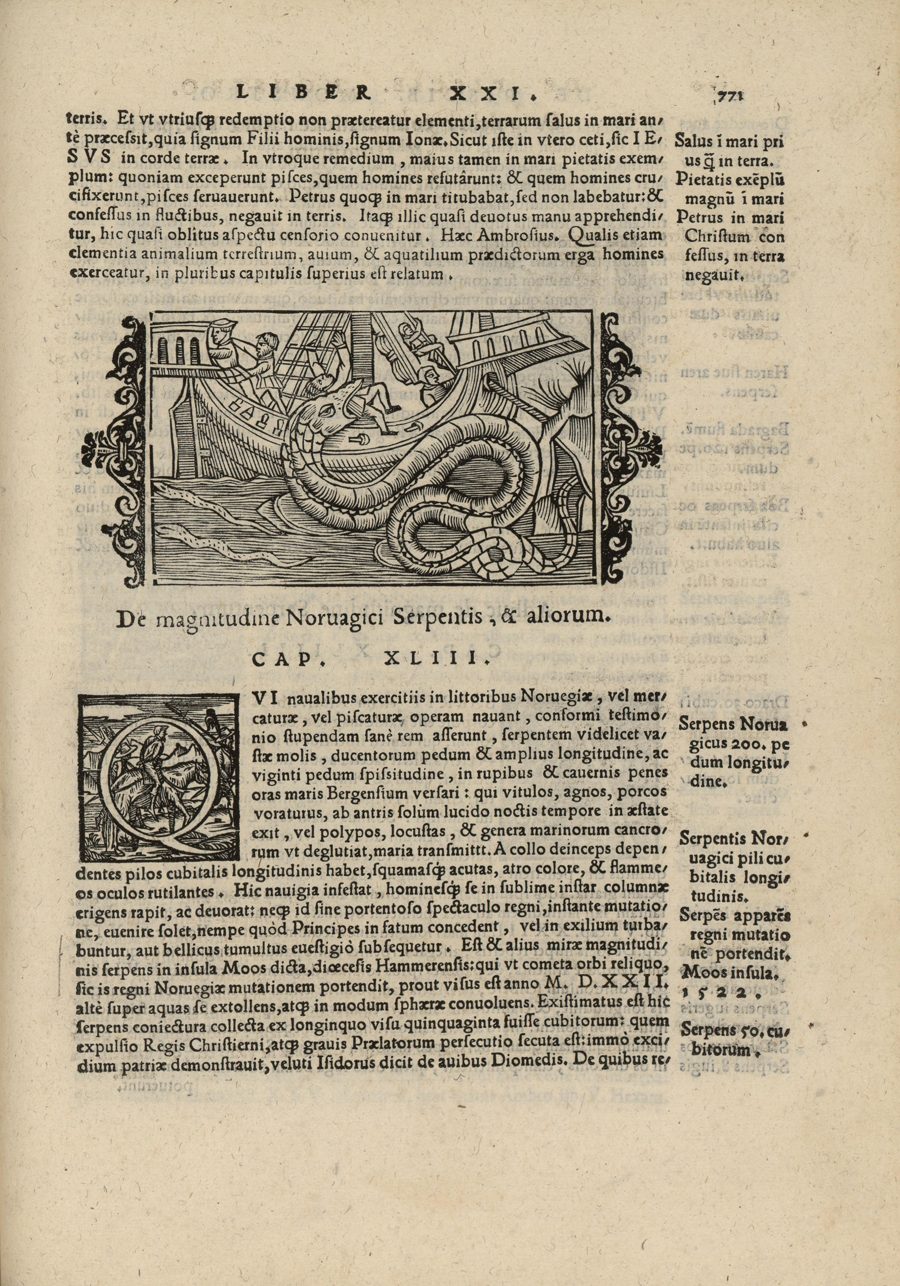
The evidence: Page 771 of Olaus Magnus's Historia de gentibus septentrionalibus (Rome, 1555): the woodcut of the serpent taking a man from a ship, and the opening of chapter 43, 'De magnitudine Noruagici Serpentis, & aliorum'
The Sea Serpent of Bergen, 1555: Olaus Magnus and the Great Worm of the Norwegian Coast
Last reviewed Next review
We review and update every article weekly. When the record changes, so does the article. How we review
In 1555 a Swedish archbishop wrote that sailors off Bergen agreed on a 200-foot serpent with a mane and flaming eyes. We read his Latin page and his map.
Verdict: Olaus Magnus faithfully passed on a story told on the Norwegian coast, but his 200-foot serpent that eats livestock and foretells the fall of kings is folklore, perhaps seeded by real long animals such as the oarfish.
Original sources: Olaus Magnus, Historia de gentibus septentrionalibus (Rome, 1555), book 21, chapter 43, p. 771, Project Runeberg facsimile and transcription · Olaus Magnus, Carta Marina (Venice, 1539), full map, Wikimedia Commons · A. C. Oudemans, The Great Sea-Serpent (Leiden and London, 1892), Internet Archive · Anne-Sofie Schjøtner Skaar, 'sjøorm', Store norske leksikon (Norwegian) · Leif Asbjørn Vøllestad, 'sildekonge' (oarfish), Store norske leksikon (Norwegian) · Elizabethanne Boran, 'The Sea Serpent of Norway', Edward Worth Library, Dublin · Grace Costantino, 'The Quest for the Sea Serpent: An Oarfish or Something More?', Biodiversity Heritage Library blog (2014)

Sources Olaus Magnus, Historia de gentibus septentrionalibus (Rome, 1555), book 21, chapter 43, p. 771; Olaus Magnus, Carta Marina (Venice, 1539); A. C. Oudemans, The Great Sea-Serpent (Leiden and London, 1892), pp. 104-109; Anne-Sofie Schjøtner Skaar, 'sjøorm', Store norske leksikon; Leif Asbjørn Vøllestad, 'sildekonge', Store norske leksikon; Elizabethanne Boran, 'The Sea Serpent of Norway', Edward Worth Library; Grace Costantino, 'The Quest for the Sea Serpent', Biodiversity Heritage Library blog (2014)
In 1555 a Swedish archbishop living in exile in Rome printed the most famous sea monster in European history. Olaus Magnus had lost his see at Uppsala to the Lutheran Reformation, and he spent his last years writing a huge book about the peoples, weather and wildlife of the North, the Historia de gentibus septentrionalibus. Book 21 is about the monsters of the northern seas. Chapter 43 opens with a serpent that, he said, lived in the cliffs near Bergen.
His picture of it is older than the book. Sixteen years earlier, in Venice, he had published the Carta Marina, a large wall map of Scandinavia crowded with ships, whales and beasts. Our header is a detail of that 1539 map: a red serpent wrapped around a ship, lifting a sailor off the deck. The evidence block is the 1555 page itself, with its woodcut of the same scene. We read the Latin on that page, then followed the story through a Dutch zoologist who believed in sea serpents, two Norwegian encyclopedia articles and two library write-ups.
What Olaus wrote
The chapter is headed “On the size of the Norwegian serpent, and of others.” Our own reading of the Latin goes like this. People who sail the coast of Norway to trade or to fish all tell the same astonishing thing, Olaus says: a serpent more than 200 feet long and 20 feet thick lives in the rocks and caves along the shore near Bergen. On clear summer nights it leaves its caves to eat calves, lambs and pigs, or goes out to sea after octopus, lobsters and crabs. It has hair a cubit long hanging from its neck, sharp black scales and flaming red eyes. It attacks ships, rears up out of the water like a column, snatches men and eats them.
Then comes the part Olaus seems to care about most. The serpent, he writes, does not show itself without a sign for the kingdom: princes will die or be driven into exile, or war will soon follow. He adds a second serpent “of wonderful size” at a place called Moos in the diocese of Hamar, which he says warns of change in Norway the way a comet warns the world. It was seen, he says, in 1522, raising itself high above the water and rolling itself up, and was judged from a distance to be about 50 cubits long. The banishment of King Christiern and a hard persecution of the bishops followed.
The Norwegian encyclopedia Store norske leksikon reads that second serpent as one living in the lake Mjøsa. It notes that the 1599 Norwegian writer Peder Claussøn Friis also placed a great serpent there.
The map and the woodcut
The Carta Marina puts its serpent at sea beside the island it labels Helgala, near a whirlpool marked “the horrible Charybdis” and up the coast toward Trondheim (the map’s Nidrosia), well north of Bergen. The number painted next to it reads 300 feet, not 200. The Dutch zoologist A. C. Oudemans noticed the same mismatch in 1892. He quoted the Swiss naturalist Conrad Gesner, who copied the map’s serpents in 1560 and wrote that the text says one or two hundred feet but the figure says three hundred.
The woodcut on the 1555 page shows a different moment: the serpent rising beside a ship moored at a rock, with a man in its jaws. Oudemans and the English writer Henry Lee read that picture in opposite ways. Lee thought the “body” was really the arm of a giant squid, with the line down its middle standing for suckers. Oudemans was sure the artist meant a big scaly snake.
Older and later reports
Olaus was not the first. Store norske leksikon cites a 1520 letter from Archbishop Erik Valkendorf to Pope Leo X, which says sea serpents show themselves in calm, fine weather, hunger to kill people and run from 30 to 150 ells long. After Olaus, the story passed into the natural histories of Gesner, Aldrovandi and Jonstonus, as the Edward Worth Library’s write-up traces. It was retold by Peder Claussøn Friis in 1599, by the poet Petter Dass in 1739 and by Erik Pontoppidan, bishop of Bergen, in his natural history of Norway in 1752-53. The encyclopedia notes that none of them doubted the serpent was real. The missionary Hans Egede even reported seeing one off Greenland in 1734.
What could lie behind it
Oudemans collected every sea-serpent report he could find, and he believed in the animal. Even so, he called the livestock-eating on summer nights a fable. He thought the man-snatching had been borrowed from stories about giant squid, and that the scales were invented, because close witnesses kept describing smooth skin. What he kept from Olaus was a large, dark, maned animal seen in calm summer weather.
The modern candidate most often named is the oarfish, called sildekonge, the “herring king,” in Norwegian. Store norske leksikon describes it as probably the longest bony fish alive, over 8 meters at most, silver with a long red dorsal fin and a crest of long rays behind the head. The species was first described in 1772 by the Norwegian naturalist Peter Ascanius from two fish found at Glesvær, a fishing village outside Bergen, which is where its scientific name Regalecus glesne comes from. The Biodiversity Heritage Library’s blog points to that crest as a match for the “mane” in Olaus and Pontoppidan. The encyclopedia is more careful: people speculate that the oarfish is behind some sea-serpent stories, it says, but that is far from clear.
We spotted one wobble in the translations. Some English versions give the scales as “dark brown.” The Latin on the 1555 page says atro colore, black.
Sources
- Olaus Magnus, Historia de gentibus septentrionalibus (Rome, 1555), book 21, chapter 43, p. 771: Project Runeberg facsimile and transcription (read 9 Nov 2026)
- Olaus Magnus, Carta Marina (Venice, 1539), James Ford Bell Library copy: Wikimedia Commons (read 9 Nov 2026)
- A. C. Oudemans, The Great Sea-Serpent (Leiden and London, 1892), pp. 104-109: Internet Archive (read 9 Nov 2026)
- Anne-Sofie Schjøtner Skaar, “sjøorm,” Store norske leksikon (Norwegian; read 9 Nov 2026)
- Leif Asbjørn Vøllestad, “sildekonge,” Store norske leksikon (Norwegian; read 9 Nov 2026)
- Elizabethanne Boran, “The Sea Serpent of Norway,” Edward Worth Library, Dublin (read 9 Nov 2026)
- Grace Costantino, “The Quest for the Sea Serpent: An Oarfish or Something More?,” Biodiversity Heritage Library blog (2014; read 9 Nov 2026)
Weighing it
Olaus did not claim to have seen the serpent. He reported what coastal people agreed on, and his own map and book cannot settle even its length or where it lived. The details that make it a monster, the raids on livestock, the men plucked from decks and the warnings of dead princes, are exactly the parts Oudemans, its most committed believer, threw out. What remains is a long, dark, maned shape seen in calm weather off the Norwegian coast, and a real fish of that kind was later named from specimens caught near Bergen. That is a plausible seed, not a proof. We file the Bergen serpent as folklore.
Verdict
Folklore Olaus Magnus faithfully passed on a story told on the Norwegian coast, but his 200-foot serpent that eats livestock and foretells the fall of kings is folklore, perhaps seeded by real long animals such as the oarfish.
Update log
-
We added this case file.
-
Weekly re-check of sources; no change to the record since filing. Next check November 23, 2026.
Discussion
Discuss this case on the on-site Community board — no GitHub account required. Prefer a private tip for the editorial team? Submit a Sighting.
House rules: Community guidelines.