The Bunyip Skull: Sydney, 1847, and the Freak Foal That Fooled a Colony
A skull found on the Lower Murrumbidgee in 1846 was hailed in the Sydney Morning Herald as proof of an unknown animal. Five months later, in the same paper, a naturalist identified it from its milk teeth as a malformed foal. Then the skull disappeared.
Sources W. H. Hovell, letter to the Sydney Morning Herald, 9 Feb 1847, p.3 (Trove, nla.news-article12897214; archived copy); W. S. Macleay, “On the Skull now exhibited at the Colonial Museum of Sydney, as that of the ‘Bunyip’,” letter to the Sydney Morning Herald dated 5 Jul 1847, reprinted in the Tasmanian Journal of Natural Science vol. 3, Art. XXI, pp. 275–278 (Internet Archive); National Library of Australia, Bunyips exhibition, “Were skulls physical proof that bunyips existed?” (archived 2006)
In 1847 the Australian colonies had a monster with a body part attached. For about five months a broken skull from the Murrumbidgee River was the best physical evidence anyone had offered for the bunyip. The same newspaper that made the case for it also printed the identification that ended it.
The finder and the advocate
On 9 February 1847 the Sydney Morning Herald printed a long letter from the explorer W. H. Hovell under the heading “The Apocryphal Animal of the Interior of New South Wales.” Hovell had just come back from a trip along the Lachlan, Murrumbidgee and Murray. He said rumors there of a large water animal had “begun to assume a more certain form.”
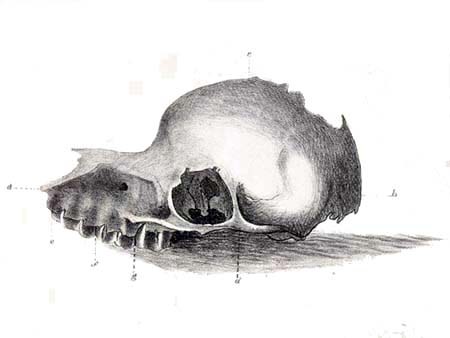
His evidence was a skull. A Mr. Fletcher on the Lower Murrumbidgee had found the upper part of an animal’s skull at a lake near the river. Hovell said it was not long dead, with “traces of blood” still visible when he saw it. Hovell had four woodcut views made from it “under my own direction” at a station on the Edward River. He described three strong grinders on each side “resembling those of the ox,” and admitted that the measurements had been taken on slips of paper that he’d since lost. He concluded:
“…some large animal, with which we are yet unacquainted, really exists in the districts I have named.”
He hoped any further remains would be put “in the possession of witnesses regularly trained in anatomical knowledge.” Within five months, that’s exactly what happened.
The naturalist
In July 1847 the skull reached Sydney. It had been sent from Port Phillip by Edward Curr to the Speaker of the Legislative Council, who handed it to William Sharp Macleay, the colony’s leading naturalist. Macleay’s reply, a letter to the Herald dated Elizabeth Bay, 5 July 1847 and reprinted in full in the Tasmanian Journal of Natural Science, takes it apart carefully:
- It wasn’t old. An inscription on the skull said it was found in 1846 on the Lower Murrumbidgee by Atholl T. Fletcher. Membranes and ligaments were still attached, so it was “far from being fossil,” and in fact “quite fresh.” He also noted marks of gnawing teeth.
- It was young. The skull was thin and light, and the sharp-crowned molars were milk teeth. They were “exactly those of a young foal,” with the extra small crown that sets the horse family apart from cud-chewing animals. The upper jaw bones were “exactly those of a horse.”
- It was deformed. At first glance it looked like no known mammal, even bird-like, because the eye sockets sat abnormally low and wide and the back of the skull was swollen. Macleay had in his own collection the skull of a mare’s foetus found floating in the Hawkesbury River in 1841, deformed the other way, with the eyes merged into a single socket, a “true Cyclops.”
His conclusion was “the skull of a mis-shapen foal or foetus of a mare,” a lusus naturae, or freak of nature. He added that even if it were somehow a new species, it would be a grass-eating, horse-like animal, nothing like the solitary water creature described in “so many unintelligible accounts” in the Sydney papers.
What happened next
The National Library of Australia’s Bunyips exhibition says the skull was put on show at the Australian Museum, then housed at the Supreme Court House in Sydney, for two days in July 1847. Crowds came, and the Herald reported a rush of people suddenly remembering “strange sounds” from lagoons at night. The library quotes the Australian Medical Journal warning that “bunyip skull” claims were an “ostentatious display of our ignorance and credulity.” The debate died down, and the skull disappeared. Nobody knows where it is.
A note on what this file doesn’t cover
The bunyip is a figure from Aboriginal cultures of south-eastern Australia and is still a living cultural figure. This case is about one skull and the colonial press, not about Aboriginal tradition. The 1847 letters relay settlers’ second-hand versions of what Aboriginal people told them, in the colonists’ language. Those aren’t authoritative accounts of anyone’s culture, and the ledger doesn’t paraphrase or quote them. No map pin is given. The find spot is described only as “a lake near the Murrumbidgee.”
Ledger status
Cited (explained). The specimen was identified in print by a qualified naturalist within five months, with reasons a reader can check. It belongs on the ledger’s Antipodes desk next to other cases where a crowd saw an object before the experts did, like the Cardiff Giant.
Sources
- W. H. Hovell, “The Apocryphal Animal of the Interior of New South Wales,” letter to the editors, Sydney Morning Herald, 9 Feb 1847, p.3 (dated Sydney, 6 Feb). Trove, nla.news-article12897214. The ledger read an archived copy.
- W. S. Macleay, “On the Skull now exhibited at the Colonial Museum of Sydney, as that of the ‘Bunyip’,” letter to the Sydney Morning Herald dated 5 Jul 1847, reprinted in The Tasmanian Journal of Natural Science vol. 3, Art. XXI, pp. 275–278. Internet Archive.
- National Library of Australia, Bunyips exhibition, “Were skulls physical proof that bunyips existed?” (archived 28 Feb 2006).
Evidence ledger
Each claim in this file, the source it rests on, and how well it holds up: 3 corroborated · 1 debunked. What the labels mean.
| Claim | Source | Type · date | Status |
|---|---|---|---|
| A partial skull was found on the Lower Murrumbidgee in 1846 by Atholl T. Fletcher. | Macleay, letter dated 5 Jul 1847 (Tas. J. Nat. Sci. v.3), quoting the skull's inscription; Hovell, SMH 9 Feb 1847 | primary record · 1847 | corroborated |
| The skull proved that “some large animal, with which we are yet unacquainted, really exists.”Hovell drew his conclusion from sketches and second-hand accounts; he wasn't an anatomist. | W. H. Hovell, Sydney Morning Herald, 9 Feb 1847 | period press · 1847 | debunked |
| The skull was fresh, not fossil, and its milk molars were exactly those of a young foal. Macleay called it a malformed foal or mare's foetus. | W. S. Macleay, letter dated 5 Jul 1847, Tas. J. Nat. Sci. v.3, Art. XXI | scholarly · 1847 | corroborated |
| The skull was exhibited at the Australian Museum for two days in July 1847, and later disappeared.The ledger hasn't checked the exhibition dates against 1847 primaries. | National Library of Australia, Bunyips exhibition (archived 2006) | museum / archive · 2006 | corroborated |
Discussion
Discussions activating. Per-case threads will embed here once the Giscus GitHub App is installed on the public satellite repo.
Meanwhile, join the conversation on GitHub Discussions: https://github.com/dclewis21/anomaly-ledger-community/discussions
CoS / D.C.: see Community guidelines and
SETUP.mdin the site repo for the one-click Giscus install.