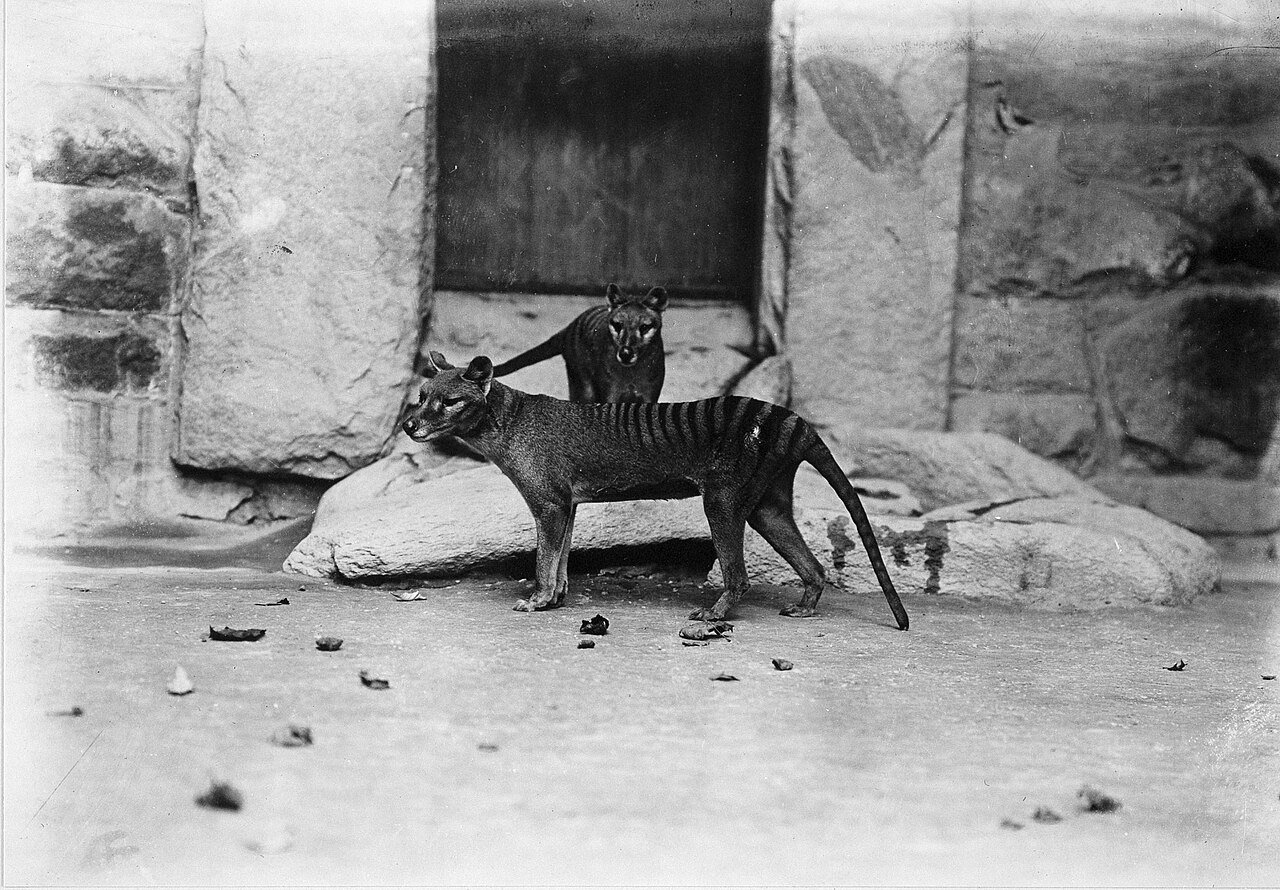
After 1936: The Thylacine's Paper Trail
The last known thylacine died in a Hobart zoo on 7 September 1936. Two years later an official party was searching western Tasmania for survivors, and eighty years after that the state government was still logging reports of striped animals crossing roads at dusk. This case follows the records, not the animal.
Sources National Museum of Australia, “Extinction of thylacine”; Evening Post (Wellington), 14 Nov 1938 and 11 Jan 1939 (Papers Past); Tasmanian Department of Primary Industries, Parks, Water and Environment, RTI release 025 2019-20, “Thylacine Sighting Reports - 1 September 2016 to 19 September 2019”
The last known thylacine
On 7 September 1936 the last known thylacine, or Tasmanian tiger, died at Beaumaris Zoo in Hobart. According to the National Museum of Australia, the species had been given protected status “just 59 days” earlier, and the animal may have died of exposure and neglect. (The popular story that it was a male called Benjamin is, the museum notes, a myth that researchers disproved in 2022.) The thylacine has been officially extinct since 1986.
But a species doesn’t leave a death certificate. What it leaves is a paper trail: searches, rumours and reports. This file follows that trail through two sets of records, eighty years apart.
1938–39: the official search
In November 1938 the Wellington Evening Post carried a Sydney report headed “TASMANIAN TIGER: Its Last Stand.” An expedition “will leave Hobart shortly” to find “the few remaining haunts of this animal and take a census of the number still alive,” with the aim of saving it from extinction. The Royal Zoological Society of New South Wales had chosen a Sydney journalist-naturalist, M. R. Sharland, to represent it. The report added that zoos had been unable to get a specimen for years.
By January 1939 the same paper reported that a party “appointed by the Tasmanian Fauna Board” had been searching rough country in western Tasmania for traces of the animal, and that the government might consider protecting the area. Its last line is the earliest piece of post-1936 testimony in this file: “Bushmen in southern Tasmania say they have seen spoor of the animal in recent years.”
That’s hearsay, relayed through a newspaper. But it shows that, within three years of the zoo death, officials were treating survival as a real possibility worth searching for.
2016–19: the government’s log
In 2019 the Tasmanian Department of Primary Industries, Parks, Water and Environment (now NRE Tasmania) released, under the state’s Right to Information Act, a five-page table of thylacine reports it had received between 1 September 2016 and 19 September 2019. There are eight. Names and contact details are redacted. The department lists each report by the date it was made, a general location, time, duration and the details as given. The dates below are report dates; some sightings happened earlier.
- Union Bridge Road, reported September 2016. A pre-dawn winter sighting of a cat-sized animal in the road, with dark bands across its back, seen for four or five seconds in the headlights. The witness’s summary: “It was not a dog or cat or fox.”
- Murchison Highway, January 2017. At about 7 pm, an animal ran across the road about 150 metres ahead. The report notes it looked sandy, with no stripes.
- April 2017. A night sighting from a car on a highway towards Launceston.
- King William Saddle, Lyell Highway, February 2018. A motorcyclist describes a “large cat like creature” with black stripes on the back of the body that “didn’t really make sense” as a cat or a fox.
- Near Corinna, reported February 2018. Two visitors from Western Australia describe an animal “the size of a large Kelpie” with “a stiff and firm tail” and “stripes down it’s back,” in clear view for 12 to 15 seconds.
- Hartz Mountains, November 2018. A woman reports what she believes was a thylacine and two cubs.
- Sleeping Beauty mountain, July 2019. A footprint, which the walker identified by searching online when he got home.
- The Midlands, August 2019. A landowner “thinks he saw a Tassie Tiger on his land 7 years ago.”
The ledger deliberately leaves out the exact locations in the released document, and asks readers not to go looking. Many of these places are remote roads or private land. The department’s request is simply that sightings be reported to it.
What the records show, and don’t
The two sets of records are independent: one is 1930s press reporting of an official search, the other a 21st-century government log. Together they show that people have kept reporting thylacines for as long as the species has been officially gone. They don’t show that the animal survives. Not one of the eight logged reports includes a photograph, a body or a DNA sample, and the National Museum of Australia’s summary still stands: many reported sightings, but “no conclusive evidence.”
| Explanation | For | Against |
|---|---|---|
| A surviving population | Repeat reports from remote north and west Tasmania; some witnesses describe stripes and a stiff tail in detail | No body, confirmed photo or DNA in 90 years |
| Misidentified dogs, foxes, quolls or mangy animals | Most reports are brief, at dusk or night, from a moving vehicle; witnesses compare the animal to a Kelpie or a Labrador | Doesn’t easily explain the most detailed descriptions |
| Expectation and an iconic image | One report recalls a sighting seven years earlier; another identifies a footprint by searching online | Doesn’t explain every report |
| A late survival that has since died out | The 1938–39 search heard of tracks “in recent years” | Hearsay only |
Ledger status
Unresolved (presumed extinct). The death in 1936, the 1938–39 search and the 2016–19 log are all documented. Survival is not. The ledger will add new official records if they’re released.
Visiting
No map pin. The ledger doesn’t point readers to sighting locations. To learn more, the Tasmanian Museum and Art Gallery in Hobart and the National Museum of Australia have thylacine material.
Sources
- National Museum of Australia, “Extinction of thylacine” (accessed 4 Oct 2026) — nma.gov.au
- Evening Post (Wellington), 14 Nov 1938, “Tasmanian Tiger: Its Last Stand” — Papers Past
- Evening Post (Wellington), 11 Jan 1939, “Tasmanian Tigers” — Papers Past
- Department of Primary Industries, Parks, Water and Environment (Tasmania), RTI release 025 2019-20, “Thylacine Sighting Reports - 1 September 2016 to 19 September 2019” (PDF, 5 pp.) — nre.tas.gov.au
Evidence ledger
Each claim in this file, the source it rests on, and how well it holds up: 3 corroborated · 2 unverified. What the labels mean.
| Claim | Source | Type · date | Status |
|---|---|---|---|
| The last known thylacine died at Beaumaris Zoo, Hobart, on 7 September 1936.The species had been protected for just 59 days. The NMA notes that the popular name “Benjamin” for the last animal is a myth. | National Museum of Australia, “Extinction of thylacine” | museum / archive · accessed 4 Oct 2026 | corroborated |
| An official search for survivors was organised in 1938–39.A party appointed by the Tasmanian Fauna Board, with a NSW Royal Zoological Society nominee, searched western Tasmania. | Evening Post (Wellington), 14 Nov 1938 and 11 Jan 1939 | period press · 1938–39 | corroborated |
| Bushmen had seen thylacine tracks in the years before 1939.Second-hand: “Bushmen in southern Tasmania say they have seen spoor of the animal in recent years.” | Evening Post, 11 Jan 1939 | period press · 11 Jan 1939 | unverified |
| The Tasmanian government received eight thylacine reports between September 2016 and September 2019.This confirms that the reports were made and logged. It doesn't confirm any sighting. | DPIPWE (now NRE Tasmania) RTI release 025 2019-20 | official · 2019 | corroborated |
| Thylacines survive in Tasmania today.No body, confirmed photo or DNA. The NMA: “no conclusive evidence”; officially extinct since 1986. | RTI 025 2019-20; National Museum of Australia | ledger analysis · 2026 | unverified |
Discussion
Discussions activating. Per-case threads will embed here once the Giscus GitHub App is installed on the public satellite repo.
Meanwhile, join the conversation on GitHub Discussions: https://github.com/dclewis21/anomaly-ledger-community/discussions
CoS / D.C.: see Community guidelines and
SETUP.mdin the site repo for the one-click Giscus install.