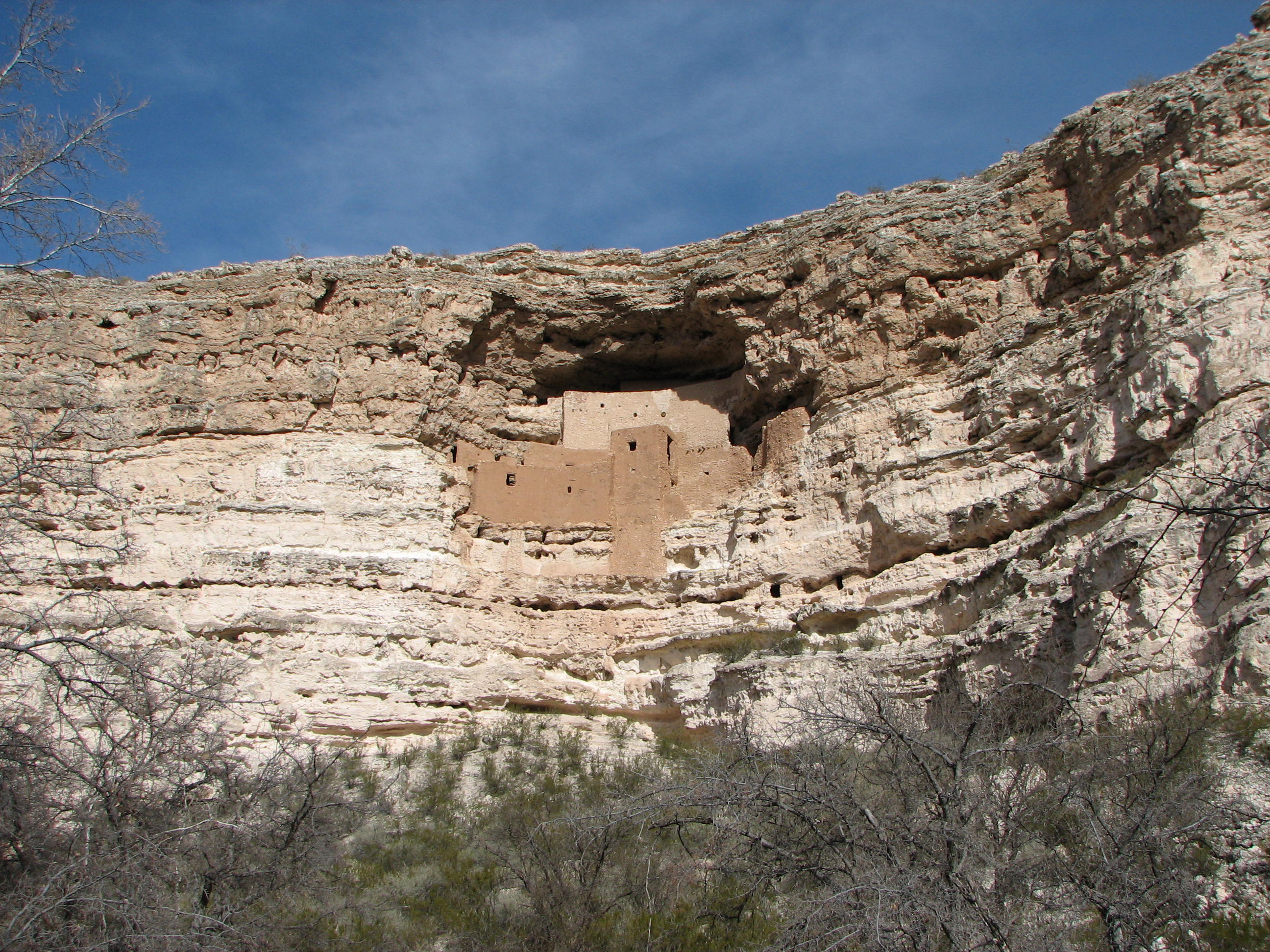
Verde Valley history day
Three public stops across the valley: the Sinagua cliff dwelling at Montezuma Castle National Monument, the 1870s army post at Fort Verde State Historic Park, and the Douglas Mansion museum high above the copper town of Jerome. Agency-sourced notes, with the Yavapai-Apache Nation’s own history linked rather than retold.
The day in one paragraph
The first two stops are in and around the Town of Camp Verde, off I-17. Start at Montezuma Castle for the short trail below the cliff dwelling, then go to Fort Verde for the 1870s–80s army post and its house museums. Then head west across the valley and up SR 89A to Jerome, the old copper town, for the Douglas Mansion museum. All three close in the late afternoon (Jerome State Historic Park at 4:30 p.m.), so if the day feels tight, drop one stop rather than rushing. We don't publish drive times or stop-to-stop mileage; check the agency pages and a current map instead.
-
Montezuma Castle National Monument
NPS Sinagua cliff dwelling near Camp Verde — short legal trail view from below; interior climbing not allowed.
Getting there
- Take I-17 to exit 289. Drive east through two traffic circles for about 0.5 miles to the blinking red light, then turn left onto Montezuma Castle Road. The parking lot and visitor center are 0.8 miles from the entrance gate. The address is 2800 Montezuma Castle Rd., Camp Verde, AZ 86322. (NPS: Montezuma Castle directions)
On site
- Entrance is $10 per adult aged 16 and over, and children 15 and under are free. The pass covers Montezuma Castle and Tuzigoot National Monuments for 7 days. America the Beautiful passes are accepted. (NPS: Fees & passes)
- NPS lists 27 October (Theodore Roosevelt’s birthday) and 11 November (Veterans Day) among its remaining 2026 fee-free days. (NPS: Fees & passes)
- A self-guided, paved loop trail of about a third of a mile passes the five-story cliff dwelling, a sycamore grove and spring-fed Beaver Creek. Pets on leashes no longer than 6 feet are allowed on the trails. (NPS: Plan your visit)
- Visitors have not been allowed into the dwelling since 1951 because of damage to the structure. You view it from the trail. (NPS: History & culture)
- Hours are posted on the NPS operating-hours page, which loads them live. Check it the day you go. (NPS: Operating hours)
The “Montezuma” name is a settler-era mistake; NPS interpretation centers the Sinagua people who built here. This is an ancestral place, so it gets no pin from us: use the NPS directions above.
-
Fort Verde State Historic Park
Arizona's best-preserved Indian Wars–era army post, with three house museums furnished in the 1880s style. It's also the place to start understanding the Verde Valley's harder history: the 1875 forced removal of the Yavapai and Dilzhę́'é Apache people from the Rio Verde Reserve.
Approx. 34.5644, -111.8525 (public reference — verify on official maps before travel) Getting there
- The park is at 125 E. Hollamon St., Camp Verde, AZ 86322. Arizona State Parks publishes park-entrance GPS of 34.564358, −111.852493 (WGS84). (Arizona State Parks: Fort Verde maps)
On site
- The park, visitor center and store are open 9 a.m.–4:30 p.m. daily. On Thanksgiving and Christmas Eve hours are 9 a.m.–2 p.m., and the park is closed on Christmas. (Arizona State Parks: Fort Verde)
- Entrance is $10 for adults (14+), $5 for youth (7–13), and free for children 0–6. (Arizona State Parks: Fort Verde)
- There are three historic house museums furnished in the 1880s style. The former Administration building is the visitor center, with exhibits on military life, the Indian Scouts and the Indian Wars era. There are also picnic tables, restrooms, and RV and tour-bus parking. (Arizona State Parks: Fort Verde)
- Autumn 2026 events: Fort Verde Days (10–11 Oct, 10 a.m.–4 p.m.); the park’s lantern-lit ghost-story walk, A Haunting at the Fort (31 Oct, 6–8 p.m.); and a Living History Day (14 Nov, 10 a.m.–3 p.m.). (Arizona State Parks: Fort Verde)
The park’s ghost walk is about the fort’s own soldiers and residents. We keep it that way, and we don’t turn Yavapai or Apache history into “spooky” material.
-
Jerome State Historic Park (Douglas Mansion)
James S. Douglas's 1916 mansion above his Little Daisy Mine, now a state museum overlooking the copper town that boomed to nearly 15,000 people and then, its historical society says, became 'virtually a ghost town.'
Approx. 34.7540, -112.1112 (public reference — verify on official maps before travel) Getting there
- The park is at 100 Douglas Road, Jerome, AZ 86331, on the hillside above town off SR 89A. Arizona State Parks publishes park-entrance GPS of 34.753972, −112.111176 (WGS84). (Arizona State Parks: Jerome maps)
- SR 89A climbs to Jerome on steep, narrow switchbacks. We don’t report road conditions: check AZ511 or call 511 (not while driving) on the day. (AZ511 (ADOT traveler information))
On site
- The park and museum/park store are open 9 a.m.–4:30 p.m. daily. On Thanksgiving and Christmas Eve hours are 10 a.m.–2 p.m., and the park is closed on Christmas. (Arizona State Parks: Jerome)
- Entrance is $10 for adults (14+), $5 for youth (7–13), and free for children 0–6. (Arizona State Parks: Jerome)
- James S. Douglas built the mansion in 1916 on the hill above his Little Daisy Mine. It’s now a museum of Jerome-area and Douglas family history, with photographs, artifacts, minerals, a video and a 3-D model of the town and its underground mines. Outside there are more displays and a picnic area looking over the Verde Valley. (Arizona State Parks: Jerome)
- Regular programs as listed by the park: historical walking tours (Saturdays 10 and 11 a.m.), a geology tour and presentation (Sundays 10:15, 11:15 and 12:15), and “The Inside History of Jerome” (Tuesdays and Fridays, 11 a.m.). October 2026 also has a Bat Walk (17 Oct, registration required) and Flashfright Tours of the mansion after dark (24 Oct, 6:30–8:30 p.m.). (Arizona State Parks: Jerome events)
The Jerome Historical Society calls the town a former “Ghost City” and “virtually a ghost town” after the mines closed, and the park runs its own after-dark tour. That’s the ghost story we point you to. There’s no after-hours wandering anywhere else, and none in the mine country around town.
Food and camping (as of Oct 2026)
- The Haunted Hamburger, 410 Clark Street, Jerome: open 11 a.m.–9 p.m. daily. (business site)
- The Clinkscale, 309 Main Street, Jerome: a restaurant in a restored 1899 building, open daily 8:30 a.m.–8:30 p.m. Dinner reservations are recommended. Its FAQ says The Haunted Group restored and reopened the building in 2020. (business site)
- Dead Horse Ranch State Park, Cottonwood: open year-round, with gates closing at dark. Fall and winter day-use hours are 7 a.m.–6 p.m. It has campsites and cabins. Rates and booking are on Arizona State Parks' reservation system. (Arizona State Parks)
- Clear Creek Campground, Coconino National Forest, off SR 260 east of Camp Verde (Forest Road 626): listed as open year-round. A single site is $27 a night, plus $10 per extra vehicle. There are 13 reservable sites on Recreation.gov and 5 first-come sites. Call the fire-restrictions hotline (928-226-4607) or ask the host before lighting a fire. (USFS)
We don't suggest roadside camping. Before you plan anything outside a developed campground, check the alerts and closure orders for the national forest you'll be in.
If you have time: Montezuma Well, with care
Montezuma Well is a separate unit of the same national monument, about 11 miles from the Castle. There's no entrance fee, and it has its own short loop trail. NPS directions are I-17 north to exit 293, then follow the signs through McGuireville and Rimrock to the entrance. NPS asks drivers in low-clearance vehicles, RVs and buses to stay on paved roads, because GPS may route you onto rough backcountry roads (NPS directions).
NPS describes the Well as the ancestral home of, and a place of great power for, the Native peoples whose ancestors lived there. It also notes that many local tribes still consider it sacred (NPS: Exploring Montezuma Well). We give no pin for it and no story beyond that. Go quietly, stay on the trail, and treat it as someone else's sacred place, because it is.
Whose valley this is
The Verde Valley is the homeland of the Yavapai (Yavapé) and Dilzhę́'é (Apache) peoples, who today form the Yavapai-Apache Nation. The Nation's own history tells of the 1871 Camp Verde Indian Reservation, known as the Rio Verde Reserve. It also records that troops from Fort Verde hunted its people during the war years. Beginning in February 1875, the people were forcibly removed to the San Carlos Apache Reservation, about 180 miles to the southeast. Each year the Nation holds Exodus Day to remember its ancestors' journey back home to Camp Verde.
We link to the Nation's account instead of retelling it: Brief History of the Yavapai-Apache Nation (PDF) and Exodus Day. When you visit the fort, you're visiting a site of that history too.
Sources
- NPS: Montezuma Castle NM, directions
- NPS: Montezuma Castle NM, fees & passes
- NPS: Montezuma Castle NM, operating hours
- NPS: Montezuma Castle NM, plan your visit
- NPS: Montezuma Castle NM, history & culture
- NPS: Exploring Montezuma Well
- Arizona State Parks: Fort Verde State Historic Park
- Arizona State Parks: Fort Verde maps & GPS
- Yavapai-Apache Nation: Brief History of the Yavapai-Apache Nation (PDF, Jan 2024)
- Yavapai-Apache Nation: Exodus Day
- Arizona State Parks: Jerome State Historic Park
- Arizona State Parks: Jerome programs & events
- Arizona State Parks: Jerome maps & GPS
- Town of Jerome: Jerome Then and Now
- Jerome Historical Society: About Us
- AZ511: ADOT traveler information
- The Haunted Hamburger (business site): hours and address
- The Clinkscale (business site): FAQ, restaurant hours
- Arizona State Parks: Dead Horse Ranch State Park
- USFS Coconino NF: Clear Creek Campground