Iridium-4: The Night Los Angeles Pulled Over to Watch a Rocket
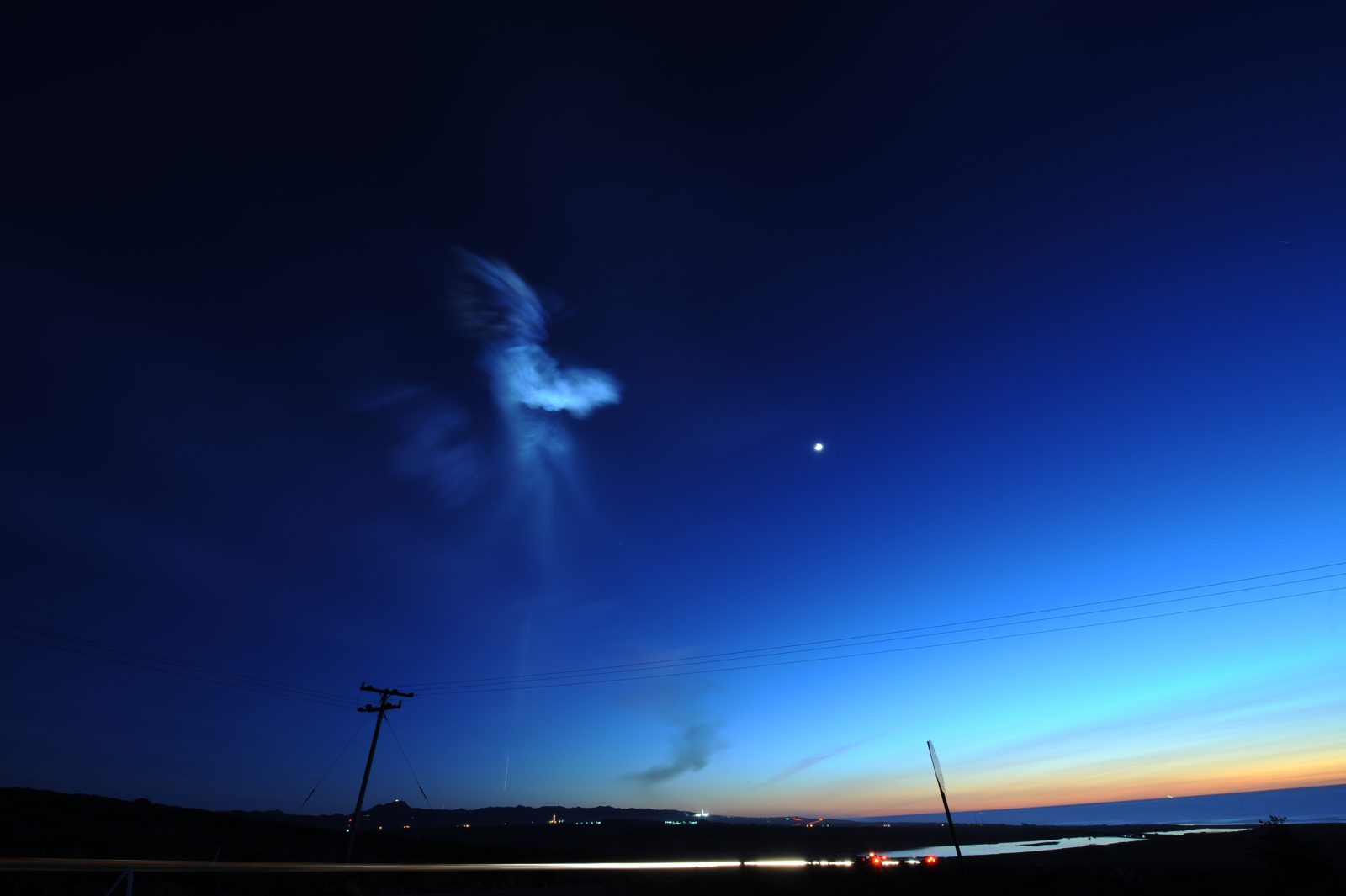
At dusk on December 22, 2017, a glowing, branching cloud crossed the Southern California sky and stopped traffic on the freeways. The Los Angeles Fire Department had to explain it: a Falcon 9 launch from Vandenberg. AP reported it was seen as far away as Phoenix.
Sources Jonathan McDowell, General Catalog of Artificial Space Objects (GCAT), launch 2017-083; Vandenberg AFB / 30th Space Wing release (22 Dec 2017); NPR, The Two-Way (23 Dec 2017); Associated Press via NBC News (22–23 Dec 2017); KPCC/LAist (22 Dec 2017)
Late on the Friday afternoon before Christmas 2017, people across Southern California looked west and saw something they couldn’t place. It was a bright point trailing a luminous cloud that spread into a fan, then a spiral, then something like a jellyfish, glowing blue and white against a sky that was already going dark. Drivers stopped on Los Angeles freeways to take pictures. TV stations took calls from as far south as San Diego.
It was a rocket, and for once that was established within the hour.
What launched
A SpaceX Falcon 9 lifted off from Space Launch Complex 4 East at Vandenberg Air Force Base on the Santa Barbara County coast at 5:27 p.m. PST on December 22, 2017 (6:27 p.m. in Arizona). It carried ten Iridium NEXT communications satellites, the fourth batch of a planned 75, on a mission called Iridium-4. Jonathan McDowell’s public launch catalog logs it as 2017-083 at 01:27 UTC on December 23. The base’s own release gives the same 5:27 p.m. time. The first stage had flown before, on the Iridium-2 mission, and SpaceX didn’t try to recover it this time. AP noted that it was SpaceX’s eighteenth and final launch of 2017.
How it was reported
- Los Angeles Fire Department. The department put out an advisory saying the “mysterious light in the sky” was a rocket launched from Vandenberg to put a satellite into orbit, as reported by NPR and AP.
- Vandenberg. KPCC reported that the base confirmed the glowing cloud was the SpaceX launch.
- Reach. AP said the glowing trail was seen as far away as Phoenix (that rests on the wire report alone; the ledger hasn’t yet read an Arizona outlet’s account), and stations in San Diego, more than 200 miles south of the launch site, got calls about it.
- Reactions. NPR collected social-media posts asking whether it was a UFO or even a missile attack. One AP staffer touring a Burbank studio lot told the wire service that people wondered whether it was something to do with movies, TV or a UFO.
Why a launch looks like that
The timing did most of the work. AP pointed out that the rocket went up around sunset. On the ground in Los Angeles it was getting dark, but a rocket climbing into the upper atmosphere is high enough to still be in sunlight. Up there the air is so thin that the exhaust doesn’t stay in a narrow contrail. It balloons outward, and the sun, already below the horizon for people on the ground, lights that expanding cloud against a dark sky. Space.com and Arizona outlets describe the same “twilight effect” for later Vandenberg launches (see Starlink 11-20 over Phoenix). Stage separation and later engine burns can add extra layers and branches to the cloud.
Because the plume is so high, people hundreds of miles away can see it, and from that far off it looks slow and silent and much closer than it is. Those are three things people often say about UFOs.
Ledger status
Cited (explained). An agency identified the launch the same evening, the launch time is on public record, and what witnesses described matches a dusk launch from Vandenberg. Nobody who reported it was being foolish. A launch seen in twilight is one of the strangest-looking things in the sky, and it’s the first thing this desk checks when a glowing spiral is reported over California or Arizona.
Two years earlier to the day, the Southwest saw the opposite kind of rocket light: a Russian Soyuz stage re-entering over Arizona on 22 December 2015.
Check first next time: if a slow, glowing, expanding cloud appears in the western sky within about an hour after sunset or before sunrise, look up whether Vandenberg had a launch at that time.
Sources
- Jonathan McDowell, General Catalog of Artificial Space Objects (GCAT), launch list, entry 2017-083 (Falcon 9, Iridium-4, SLC-4E, 2017 Dec 23 01:27 UTC) — planet4589.org
- Vandenberg Air Force Base, “Falcon 9 Iridium-4 Successfully Launched,” photo release, 22 Dec 2017 (launch at 5:27 p.m. PST from SLC-4) — vandenberg.spaceforce.mil
- Amy Held, “SpaceX Rocket Launch Lights Up The California Sky, Freaks Out Some Residents,” NPR, 23 Dec 2017 — npr.org
- Associated Press, “SpaceX rocket lights sky as it carries satellites from California,” via NBC News, 22–23 Dec 2017 — nbcnews.com
- Mike Roe and Jacob Margolis, “What’s that flying over Los Angeles? A SpaceX rocket,” KPCC (LAist archive), 22 Dec 2017 — laist.com
Evidence ledger
Each claim in this file, the source it rests on, and how well it holds up: 3 corroborated · 1 unverified · 1 debunked. What the labels mean.
| Claim | Source | Type · date | Status |
|---|---|---|---|
| A Falcon 9 carrying ten Iridium NEXT satellites launched from Vandenberg SLC-4E at 5:27 p.m. PST on 22 Dec 2017. | Jonathan McDowell, GCAT launch list, entry 2017-083 (01:27 UTC 23 Dec) | primary record · 2017 | corroborated |
| Vandenberg confirmed the glowing cloud was the SpaceX launch. | Vandenberg AFB release; KPCC/LAist | official · 22 Dec 2017 | corroborated |
| The Los Angeles Fire Department said the “mysterious light in the sky” was a Vandenberg rocket launch. | NPR (Amy Held); AP via NBC News | press · 22–23 Dec 2017 | corroborated |
| The plume was visible as far away as Phoenix.Single wire-service source; the ledger hasn't read an Arizona outlet's report. | AP via NBC News; NPR citing AP | press · 22–23 Dec 2017 | unverified |
| The light was a UFO or a missile attack.Launch time, place and twilight geometry match. | Social-media posts quoted by NPR | social · 23 Dec 2017 | debunked |
Discussion
Discussions activating. Per-case threads will embed here once the Giscus GitHub App is installed on the public satellite repo.
Meanwhile, join the conversation on GitHub Discussions: https://github.com/dclewis21/anomaly-ledger-community/discussions
CoS / D.C.: see Community guidelines and
SETUP.mdin the site repo for the one-click Giscus install.